How to Create a Loyalty Programme in 7 Steps
Step-by-step guide to creating a loyalty programme for your small business. Choose a reward structure, pick a platform, and launch in one afternoon.
Key Takeaway: You don't need special software skills or a big budget to create a loyalty programme. Choose a stamp card (simplest for small businesses), set 6–10 stamps with a free-item reward, pick a digital platform, and launch in one afternoon. FaveCard lets you do all of this for $0.
FaveCard Team
Published April 18, 2026 · Updated April 18, 2026

Last updated: April 2026
A loyalty programme is a system that rewards customers for repeat visits, typically with stamps, points, or tiered perks. For small businesses like cafes, salons, and restaurants, it’s one of the simplest ways to turn one-time visitors into regulars who come back week after week.
Key Takeaway: You don’t need special software skills or a big budget to create a loyalty programme. Choose a stamp card (simplest for small businesses), set 6–10 stamps with a free-item reward, pick a digital platform, and launch in one afternoon. FaveCard lets you do all of this for $0.
If you’ve been thinking about starting a loyalty programme but haven’t because it seems complicated or expensive, this guide is for you.
No jargon. No enterprise software. Just seven clear steps to go from “I should probably do something about customer retention” to “my first customer just earned their reward.”
Step 1: Choose Your Reward Structure
There are four common reward structures. Each works differently depending on your business type.
Stamp cards (recommended for most small businesses)
How it works: the customer gets a stamp for every visit or purchase. After a set number of stamps, they earn a reward.
Best for: Cafes, coffee shops, barbershops, bakeries, nail salons, food trucks, or any business with regular, similar-value visits.
Why stamps work: They’re simple. Customers understand them instantly. No maths, no tiers, no confusion. A stamp card is the digital version of what most people already know from paper punch cards.
If you’re unsure which structure to pick, start here. You can always change later.
Points systems
How it works: customers earn points based on how much they spend (e.g. 1 point per £1). Points add up to rewards at different thresholds.
Best for: Businesses with a wide price range: restaurants, retail shops, spas with different service tiers.
Downside: Points can confuse customers. “How many points do I have? What can I get?” If your average ticket is consistent (like a £3.50 coffee), points add unnecessary complexity. Stick with stamps.
Tiered programmes
How it works: customers unlock different reward levels (Silver, Gold, Platinum) based on lifetime spending or visits.
Best for: Premium services with high lifetime value: high-end salons, wellness studios, boutique fitness.
Downside: Tiers require ongoing management and enough customers at each level to justify the effort. Most small businesses don’t need this.
Cashback or credit
How it works: customers earn a percentage back on purchases (e.g. 5% cashback) that accumulates as store credit.
Best for: Retail shops with variable pricing.
Downside: Requires tracking spend amounts for every transaction. Harder to manage without POS integration.
Quick comparison
| Structure | Simplicity | Best for | Setup time |
|---|---|---|---|
| Stamp card | Very simple | Cafes, salons, barbershops | Minutes |
| Points | Moderate | Restaurants, retail | Hours |
| Tiered | Complex | Premium services | Days |
| Cashback | Moderate | Retail | Hours |
Bottom line: If you’re a small local business, start with a stamp card. It takes minutes to set up, customers get it immediately, and you can always add complexity later if you need it.
For more ideas on stamp card designs and reward themes, see our punch card ideas guide.
Step 2: Set Your Reward Thresholds
Two decisions here: how many stamps before a reward, and what the reward should be.
How many stamps?
The sweet spot is 6 to 10 stamps for most businesses:
- 6–8 stamps: good for frequent visits (coffee shops, lunch spots). Customers can realistically earn a reward in 2–3 weeks.
- 8–10 stamps: good for businesses with weekly visits (barbershops, nail salons). Customers earn a reward in 2–3 months.
- More than 10: risky. Customers lose motivation when the finish line feels too far away.
A good rule: the reward should come within a timeframe that feels achievable. If your average customer visits once a week, 8 stamps means about two months to a reward. That works. Twenty stamps at the same frequency means five months, and most people will forget.
What should the reward be?
Free items outperform percentage discounts. A free coffee feels like a gift. 10% off feels like maths.
Good rewards by business type:
| Business | Stamps | Good reward | Why it works |
|---|---|---|---|
| Coffee shop | 8 | Free coffee | Customers already buy it, feels like a treat |
| Barbershop | 6 | Free hot towel shave | Encourages trying a premium service |
| Nail salon | 8 | Free nail art add-on | Low cost to you, high perceived value |
| Restaurant | 10 | Free starter or dessert | Brings them back without giving away a full meal |
| Bakery | 6 | Free pastry | Quick reward cycle keeps them engaged |
The cost check
Your reward should cost you roughly 10–15% of the total spend across all the stamps leading up to it. Example: if a coffee is £3.50 and the customer buys 8 coffees (£28 total), a free coffee worth £3.50 costs you about 12.5%. That’s healthy.
If the reward costs you more than 15%, either increase the number of stamps or choose a lower-cost reward.
Step 3: Choose Digital Over Paper
Paper stamp cards have been around for decades. They work, barely.
The problems:
- Customers lose them (or leave them in the wrong jacket)
- You get zero data about who’s actually loyal
- Printing costs add up over time
- Fraud is easy: anyone with a hole punch can fake stamps
Digital loyalty cards solve all of this. The card lives on the customer’s phone, it can’t be lost, and you get real analytics on visits, rewards, and who’s coming back.
For a full breakdown of the trade-offs, read our paper vs digital loyalty cards comparison.
If you’re still using paper cards, switching to digital is probably the single highest-impact thing you can do for customer retention this year.
Step 4: Pick Your Platform
Once you’ve decided on a digital stamp card, you need a platform to run it. Here’s what to look for:
Must-haves for small businesses
- No app download for customers: if customers need to install an app, most won’t bother. The best platforms use Apple Wallet and Google Wallet, which are already on every phone.
- Free or low-cost: you shouldn’t need to spend $49/month to give loyal customers a free coffee.
- Works with any POS: avoid platforms that lock you into a specific payment system.
- Quick setup: if it takes more than an afternoon, it’s too complicated.
Platform comparison
| Platform | Free plan? | Customer app needed? | Price |
|---|---|---|---|
| FaveCard | Yes ($0 forever) | No | Free / paid plans (see pricing) |
| Stamp Me | No (trial only) | Yes | $49/month |
| Loopy Loyalty | No (trial only) | No | $25/month |
| Square Loyalty | No | No (but needs Square POS) | $45/month per location |
| CandyBar | No (trial only) | No | $45/month |
FaveCard is the only platform on this list with a permanent free plan: $0, no time limit, unlimited customers. Every new account also starts with premium tools until the first 30 customers are on the card (Apple and Google Wallet passes, custom branding, customer messages) so you can try everything before deciding.
For a deeper comparison with honest pricing, see our guide to free digital loyalty card apps.
Step 5: Design Your Card
This is the fun part. A well-designed card looks professional and makes customers want to collect stamps.
Colours
Pick colours that match your brand. If your cafe has green walls and a wooden interior, don’t make your card neon pink. Consistency builds recognition.
Most platforms let you set a primary colour and a background colour. Match these to your logo or shop signage.
Stamp icons
Choose an icon that relates to your business:
- Coffee cup for cafes
- Scissors for barbershops and salons
- Paw print for pet groomers
- Utensils for restaurants
Some platforms (including FaveCard on a paid plan) let you upload your own custom stamp icon: your logo, a custom illustration, whatever fits your brand.
Card details
- Business name: keep it short and recognisable
- Reward description: be specific. “Free coffee” beats “Reward”
- Number of stamps: already decided in Step 2
- Logo: upload your logo if the platform supports it (on FaveCard, custom logos are a paid feature)
Don’t overthink this step. A clean card with your brand colours and a clear reward description is better than a complicated design that took three weeks. You can always update it later.
Step 6: Launch and Promote
Your card exists. Now customers need to find it.
At your counter (most important)
Print a QR code and place it where customers can see it: at the till, on the counter, or next to the card reader. When someone pays, say: “We’ve got a loyalty card. Scan the QR code and your next coffee starts earning toward a free one.”
This works better than any social media post. Most loyalty programme sign-ups happen in person, at the moment of purchase.
On social media
Post about it on Instagram and Facebook. Keep it simple:
“We just launched our loyalty card! Collect 8 stamps, get a free coffee. Tap the link in our bio to add it to your phone, takes 5 seconds.”
If your platform gives you a shareable link or a business page (FaveCard includes a link-in-bio business page on every account), add it to your Instagram bio. That way customers can find your card anytime, not just when you post about it.
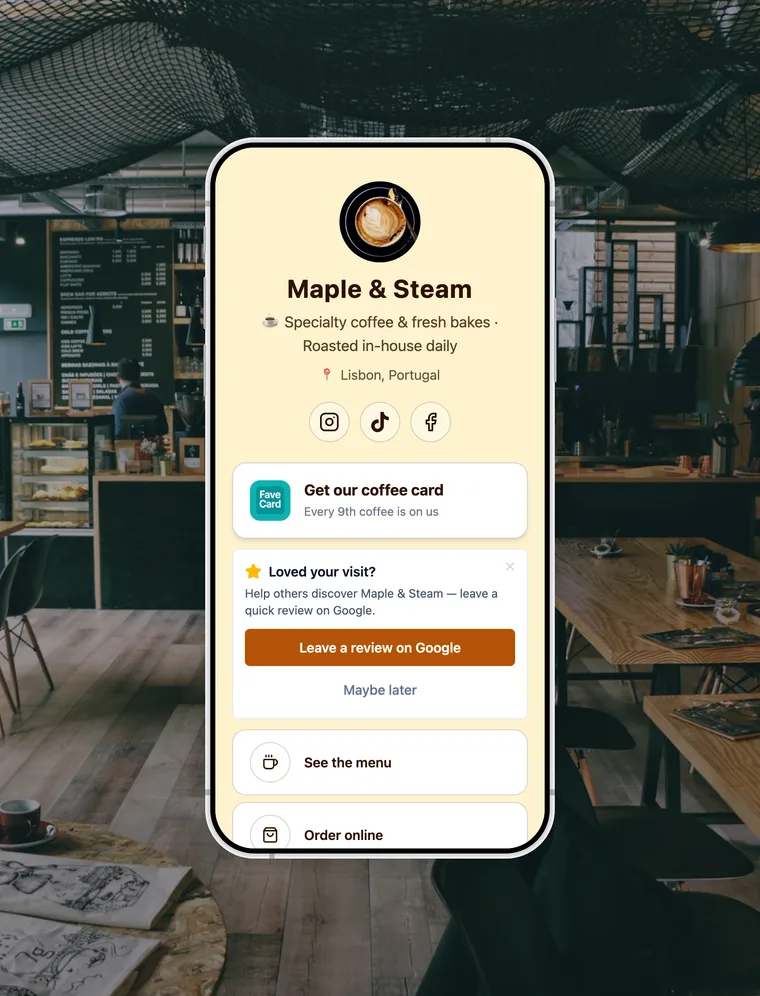
A FaveCard business page is ready to share the moment you create it: drop it in your Instagram bio or print a QR code for the counter. The Google review card shown is a paid-plan feature.
On Google
Add your loyalty card link to your Google Business Profile. Go to your profile, click “Edit,” and add it under the website or menu section. Customers searching for your business on Google Maps will see it.
On receipts and packaging
If you print receipts, add a line: “Loyalty card: [your link].” If you use takeaway bags or packaging, a small sticker with the QR code works well.
Staff training
Tell your team about the loyalty programme. The single most effective promotion channel is a staff member saying, “Have you got our loyalty card?” at checkout. If your team doesn’t mention it, customers won’t know it exists.
Step 7: Track and Adjust
Launching your programme is step one. Keeping it effective is ongoing.
What to watch
- Enrolment rate: how many customers are signing up? If hardly anyone joins in the first two weeks, your promotion isn’t working (go back to Step 6).
- Completion rate: how many customers actually earn a reward? If most people get 2–3 stamps and stop, your threshold might be too high (go back to Step 2).
- Repeat visits: are loyalty members coming back more often than non-members? This is the number that matters most.
When to adjust
- Too few sign-ups? Make the QR code more visible. Ask staff to mention it at every checkout.
- Low completion rate? Lower the number of stamps. 10 might need to become 7.
- Customers forget about it? With a FaveCard paid plan, you can send a message to inactive customers: a reminder that pops up on their phone, no app or phone numbers needed.
- Reward feels stale? Change it seasonally. A free iced drink in summer, a free hot chocolate in winter.
Don’t set it and forget it. Check your analytics once a month, see what’s working, and make small adjustments.
For more strategies on bringing back lapsed customers, read our guide on how to get repeat customers.
Common Mistakes to Avoid
Making the reward too hard to reach
If customers need 15 stamps at a weekly visit frequency, that’s nearly four months of waiting. Most will lose interest after six weeks. Keep it achievable: 6 to 10 stamps for most businesses.
Overcomplicating the structure
Points, tiers, multipliers, bonus days: these confuse customers. A small business doesn’t need the complexity of a Starbucks programme. A simple stamp card with a clear reward is more effective than a complex system nobody understands.
Not telling customers about it
The most common reason loyalty programmes fail isn’t the reward or the platform. It’s that customers don’t know it exists. Promote it in person, at every single checkout.
Sticking with paper cards
Paper gets lost. You get no data. You can’t send reminders. Switching to digital costs nothing (FaveCard’s Free plan is $0) and solves every one of these problems. Read our paper vs digital comparison if you’re on the fence.
Choosing a platform that’s too expensive
You don’t need to spend $49/month to reward loyal customers. Start free, see if it works for your business, and upgrade only when you need premium features. If you’re wondering whether the investment makes sense, see is a loyalty programme worth it?
How Much Does a Loyalty Programme Cost?
Here’s a realistic breakdown:
| Approach | Setup cost | Monthly cost | What you get |
|---|---|---|---|
| Paper cards | £30–£60 per print run | £10–£20 (reprints) | Basic stamps, no data |
| FaveCard Free | $0 | $0 | Digital stamp card, QR scanning, unlimited customers, analytics |
| FaveCard paid plans | $0 | See pricing | Everything free + Apple & Google Wallet passes, custom branding, customer messages, visit reminders |
| Stamp Me | $0 (trial) | $49/month | Digital stamps, requires customer app download |
| Square Loyalty | $0 | $45/month per location | Points-based, requires Square POS |
For most small businesses, the free tier of a digital platform is more than enough to start. You can always upgrade to a paid plan when you want Apple and Google Wallet passes, your own branding on every card, or the ability to send messages to customers between visits.
Want to understand the full value equation? Read our guide on loyalty programmes for small business.
Create Your Loyalty Card
You’ve read the steps. Now pick one afternoon this week and do it:
- Choose a stamp card (2 minutes)
- Set 8 stamps and a free-item reward (1 minute)
- Create your loyalty card for free (5 minutes)
- Print a QR code for your counter (2 minutes)
- Tell your first customer (10 seconds)
That’s it. No contracts, no credit card, no app your customers need to download. Every new account starts with premium tools until the first 30 customers are on the card, so you can try Apple and Google Wallet passes, custom branding, and customer messages before deciding if you need them.
Your regulars are already coming back. Now give them a reason to come back even more.
Frequently Asked Questions
How much does it cost to create a loyalty programme?
You can start for $0. FaveCard offers a permanent free plan with unlimited customers, a digital stamp card, and QR scanning. Paid plans add Apple and Google Wallet passes, custom branding, and customer messages (see pricing for current rates). Enterprise platforms like Square Loyalty start at $45 per month per location.
How many stamps should a loyalty card have?
Between 6 and 10 stamps works best for most small businesses. Fewer than 6 and customers don’t feel they’ve earned the reward. More than 10 and most people give up before finishing. Coffee shops and quick-service businesses usually do well with 8 stamps. Salons and higher-value services often work better with 5 or 6.
What rewards work best for a small business loyalty programme?
Free items outperform percentage discounts. A free coffee after 8 visits feels more tangible than 10% off. The reward should cost you roughly 10–15% of the total spend across those visits. The best rewards are things customers already buy: they feel like a gift, not a discount.
Should I use a paper or digital loyalty card?
Digital. Paper cards get lost, damaged, or left at home, and you get zero data about who your loyal customers are. Digital loyalty cards live on the customer’s phone, can’t be lost, and give you real analytics on visits and rewards. See our full comparison of paper vs digital loyalty cards.
How do I promote my loyalty programme to customers?
Start with three things: a QR code at your counter, a post on Instagram or Facebook linking to your business page, and a verbal mention at checkout. Most customers will join when asked in person. After that, add the link to your Google Business Profile, email signature, and receipts.
Frequently Asked Questions
How much does it cost to create a loyalty programme?
You can start a loyalty programme for $0. FaveCard offers a permanent free plan with unlimited customers, a digital stamp card, and QR scanning. Paid plans add Apple and Google Wallet passes, custom branding, and customer messages (see favecard.co/en/pricing for current rates). Enterprise platforms like Square Loyalty start at $45 per month per location.
How many stamps should a loyalty card have?
Between 6 and 10 stamps works best for most small businesses. Fewer than 6 and customers don't feel they've earned the reward. More than 10 and most people give up before finishing. Coffee shops and quick-service businesses usually do well with 8 stamps. Salons and higher-value services often work better with 5 or 6.
What rewards work best for a small business loyalty programme?
Free items outperform percentage discounts. A free coffee after 8 visits feels more tangible than 10% off. The reward should cost you roughly 10–15% of the total spend across those visits. The best rewards are things customers already buy: they feel like a gift, not a discount.
Should I use a paper or digital loyalty card?
Digital. Paper cards get lost, damaged, or left at home, and you get zero data about who your loyal customers are. Digital loyalty cards live on the customer's phone, can't be lost, and give you real analytics on visits and rewards. See our full comparison of paper vs digital loyalty cards.
How do I promote my loyalty programme to customers?
Start with three things: a QR code at your counter, a post on Instagram or Facebook linking to your business page, and a verbal mention at checkout. Most customers will join when asked in person. After that, add the link to your Google Business Profile, email signature, and receipts.