



Punch Card Ideas for Business: 9 Cards Customers Finish
Nine punch card ideas, each with the stamp count, the first reward and the exact card wording, for cafés, bakeries, barbers, salons, gyms and more.
Key Takeaway:
Build a punch card around how often your regulars come back. Use 8 stamps if they come a few times a week, 6 if weekly, 5 every two to three weeks and 4 if monthly. Put a small free item about a third of the way in, such as a size upgrade on stamp 3 of 8 or a beard trim on stamp 2 of 4, and the main reward on the last stamp. In our study of 1,013 small businesses, cards that paid out within 2–4 weeks had an 11.4% completion rate; cards that took 8–16 weeks, 4.0%.
Last updated: September 2026
A good punch card gives a regular something small and free within the first few visits, and the main reward within about 8 weeks. Pick the number of stamps from how often customers come back: 8 if they come a few times a week, 6 if weekly, 5 every two to three weeks, 4 if once a month. Put a cheap free extra about a third of the way in (a size upgrade, a cookie, a beard trim) and the main reward on the last stamp.
Below are nine cards built that way, one per type of business, with the exact line each card shows and the reasoning behind the numbers. The card images are real FaveCard loyalty cards, set up the way an owner would set them up in the card editor.
| Business and how often regulars come | What the card says | Weeks to first / main reward |
|---|---|---|
| Coffee shop, every 2–3 days | ”Free size upgrade at 3, free coffee at 8” | 1 / 2–3½ |
| Bakery, once a week | ”Free cookie at 2 visits, free loaf at 6” | 2 / 6 |
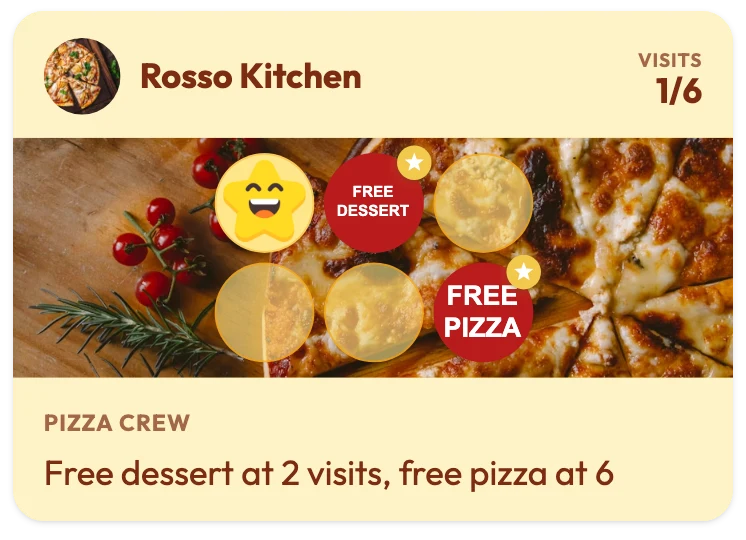
| Restaurant, every 7–10 days | ”Free dessert at 2 visits, free pizza at 6” | 2–3 / 6–9 |
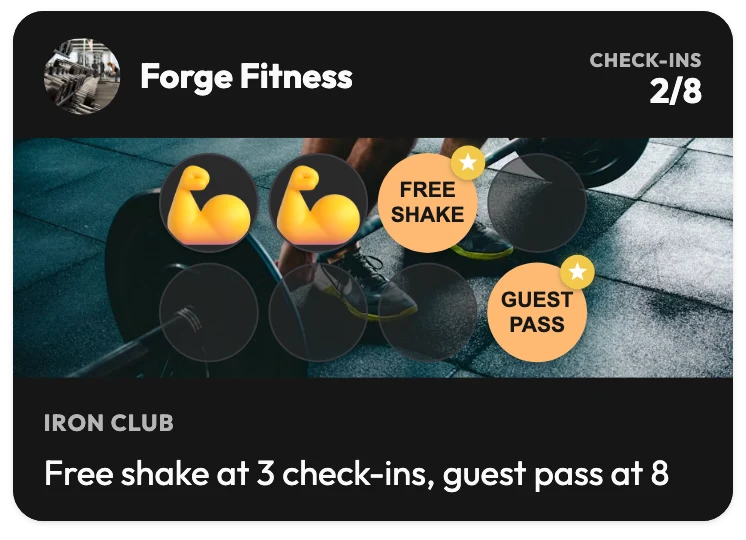
| Gym or fitness studio, 2–3 times a week | ”Free shake at 3 check-ins, guest pass at 8” | 1 / 2–3½ |
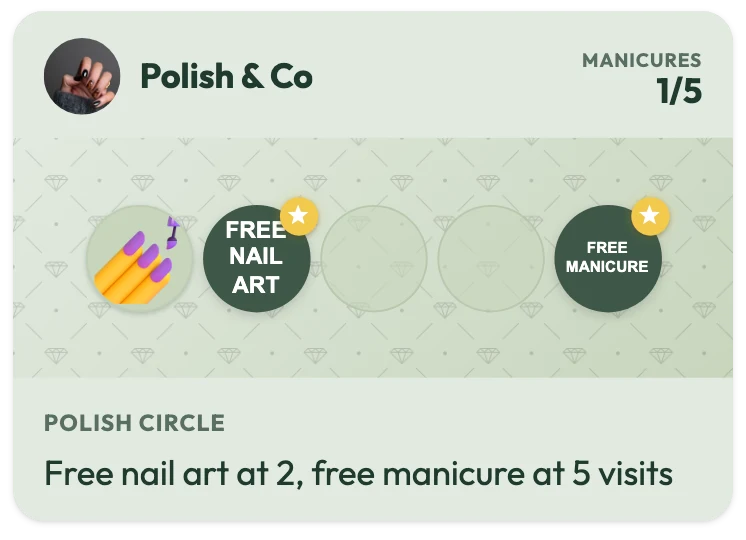
| Nail studio, every 2–3 weeks | ”Free nail art at 2, free manicure at 5 visits” | 4–6 / 10–15 |
| Car wash, every 2–3 weeks | ”Free tire shine at 2, free wash at 5” | 4–6 / 10–15 |
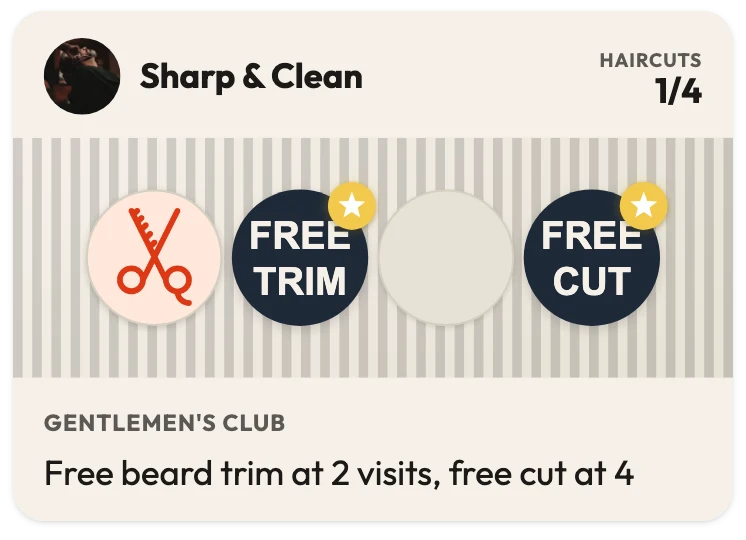
| Barbershop, every 3–5 weeks | ”Free beard trim at 2 visits, free cut at 4” | 6–10 / 12–20 |
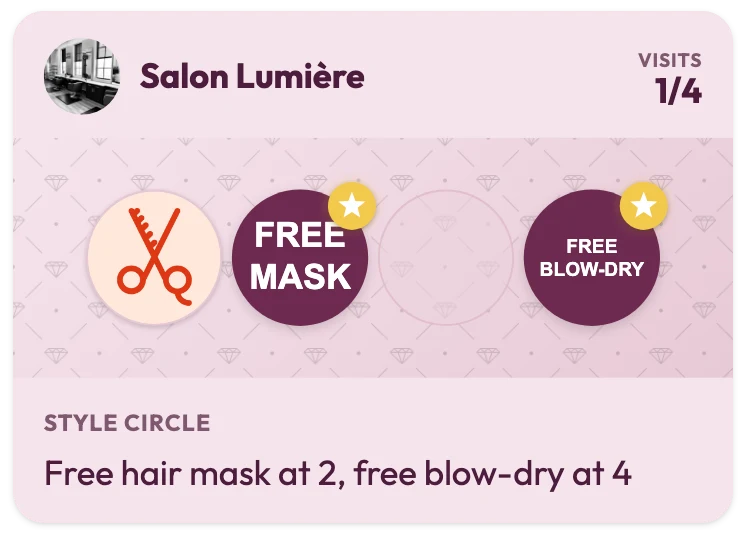
| Hair salon, every 6–8 weeks (start everyone on 1 stamp) | “Free hair mask at 2, free blow-dry at 4” | 6–8 / 18–24 |
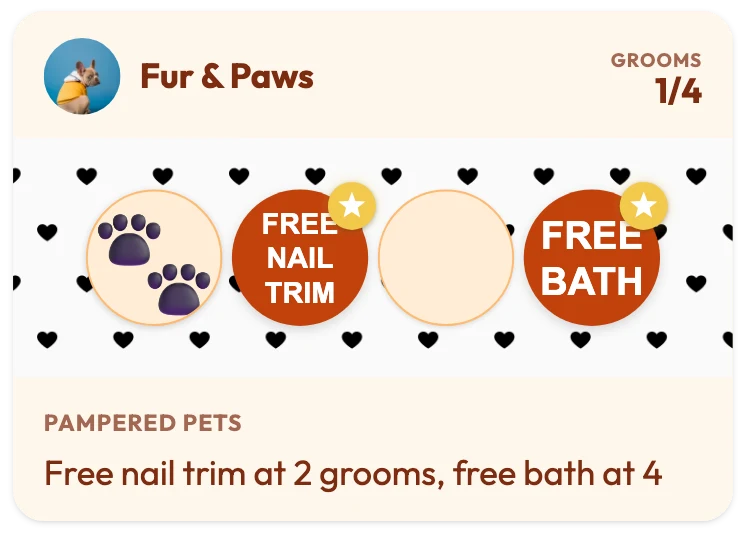
| Pet groomer, every 4–6 weeks (start everyone on 1 stamp) | “Free nail trim at 2 grooms, free bath at 4” | 4–6 / 12–18 |
The last number in each line is also the number of stamps on the card. The weeks use the same yardstick as FaveCard’s card editor and our completion study: days between visits × stamps to collect ÷ 7, with a starter stamp counted as already collected.
What makes a punch card idea work?
A punch card works best when the first reward arrives while coming back is still a fresh habit. The reward matters, but in our data the wait made the bigger difference.
We looked at 23,296 stamps from 1,013 small businesses running their cards on FaveCard between January and May 2026. When a card was set up to pay out within 2 to 4 weeks, 11.4% of customer cycles ended with a full card. At 8 to 16 weeks, 4.0%. Past 32 weeks, 0.8%. More than half of the cards (56% of those with a known visit rhythm) were set up to take longer than 8 weeks. The method and the caveats are in the completion rate study.
Every card on this page follows the rule FaveCard’s card editor applies when you create a card:
- Stamps come from the visit rhythm: 8, 6, 5 or 4, as in the first paragraph. The full reasoning is in how many stamps a loyalty card should have.
- A small extra goes about a third of the way in. The editor suggests the first extra reward at 30% of the card, which lands on stamp 2 of a 4-, 5- or 6-stamp card and on stamp 3 of an 8-stamp card.
- The main reward sits on the last stamp.
When a card has fewer than two rewards, the editor also shows a tip about what kind of reward to pick: “‘Free’ rewards work better than discounts.” A free cookie is easier to picture than 10% off, and you know exactly what it costs you.
Coffee shop punch card: free upgrade at 3, free coffee at 8
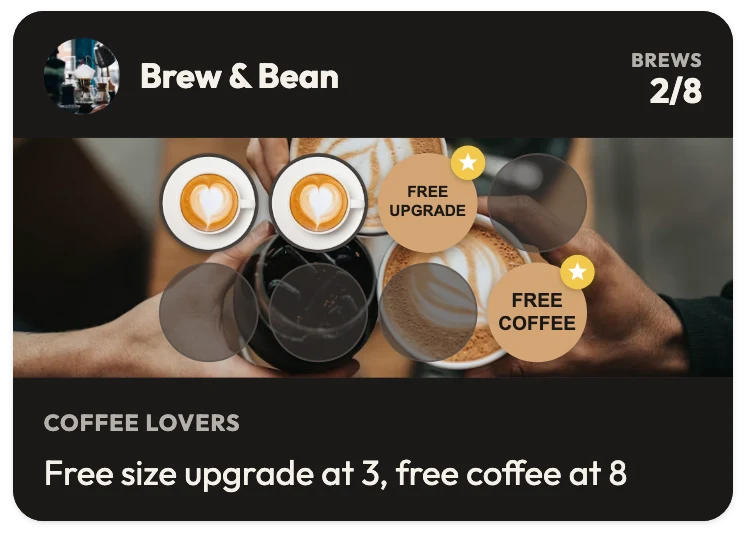
Give coffee regulars 8 stamps, a free size upgrade on the 3rd and a free coffee on the 8th. Someone who stops in every two or three days gets the upgrade in about a week and the coffee in two to three and a half weeks, inside the 2–4 week band where our study saw 11.4% completion.
The upgrade costs you a splash more milk and coffee, and it lands in the customer’s first week with the card. If most of your regulars come in every single day, you can stretch the card to 10 stamps and still pay out inside three weeks. Keep the upgrade on stamp 3 either way. The coffee shop loyalty program guide covers the rest of the program.
Bakery punch card: free cookie at 2, free loaf at 6
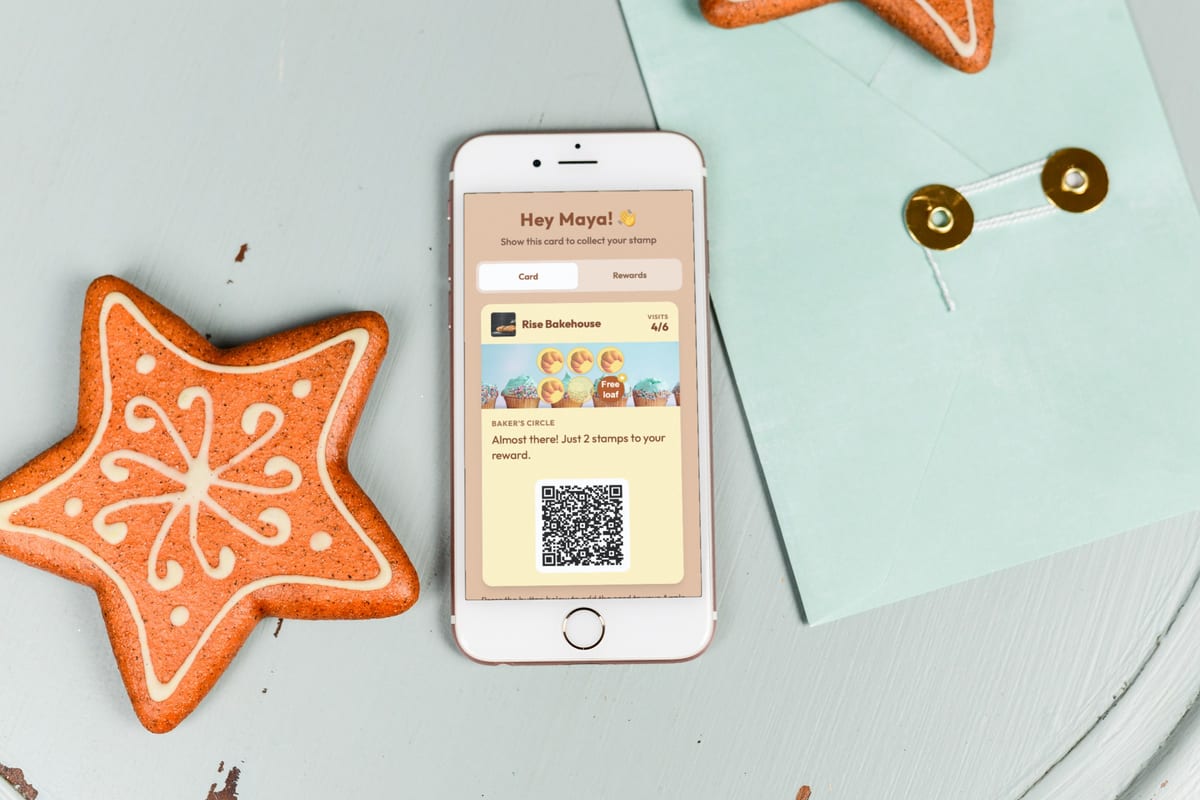
Bread customers come less often than coffee drinkers, so the card gets shorter. If your regulars buy bread once a week, use 6 stamps: a free cookie on the 2nd visit and a free loaf on the 6th. Two weeks to the cookie, six to the loaf. An 8-stamp card would take the same customer 8 weeks, right where completion starts to drop.
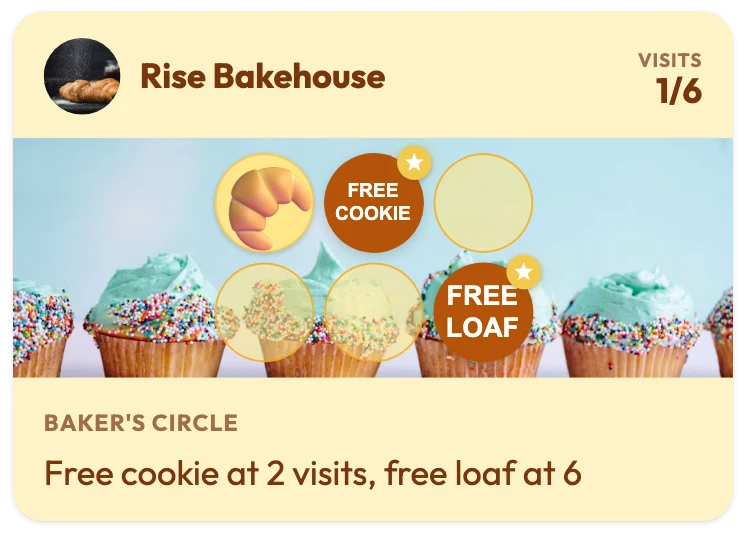
The phone at the top of this page shows this card four visits in, cookie already eaten, with the reminder FaveCard puts on a card two stamps before a reward. If yours is the coffee-and-croissant kind of bakery, with people in three times a week, use the café card instead.
Restaurant punch card: free dessert at 2, free main at 6
Six stamps, a free dessert on the 2nd visit and a free main dish (or pizza) on the 6th suit a restaurant whose regulars come back every week or so. At a visit every 7–10 days, dessert arrives in 2–3 weeks and the main in 6–9.
Desserts have a low food cost and often get shared, which is an easy way to introduce the rest of the table to the card. Be exact about the main reward. “Free pizza” is clear; “free meal” makes people ask whose.
Owners do shorten long cards once they see them stall. On Square’s community forum, a taco restaurant owner described his program as “spend $100 and get a free taco.” Later in the thread: “Now I have taken the lead from El Pollo Loco and it’s simply ‘Spend $50 and get $5 off.’” More setup advice is in the restaurant loyalty program guide.
Gym punch card: free shake at 3, guest pass at 8
A guest pass costs you almost nothing and brings a new person through the door, which makes it the best final reward on this page. Members who train two or three times a week fill a card fast, so a gym can use the full 8 check-ins, with a free protein shake at the 3rd. That’s about a week to the shake and under four weeks to the pass. If most members come once a week, use 6 check-ins and move the shake to the 2nd.
Worried about people checking in twice to speed things up? If members stamp themselves on FaveCard’s iPad kiosk (Business plan), it waits 15 minutes between stamps on the same card and allows two self-service stamps per customer per day by default (you can set anywhere from 1 to 5).
Nail studio punch card: free nail art at 2, free manicure at 5
A nail tech on SalonGeek planned her card as “25% off 5th and the 10th free.” At a three-week rhythm, that 10th visit is 30 weeks away, and even the first reward is 15 weeks out.
For clients who come back every 2–3 weeks, use 5 stamps: free nail art at the 2nd appointment and a free manicure at the 5th. The art arrives in 4–6 weeks, the manicure in 10–15. Two accent nails take a few minutes, and clients tend to show them off. More for nail techs in the nail salon loyalty program guide.
Car wash punch card: free tire shine at 2, free wash at 5
Drivers who return every 2–3 weeks need a 5-stamp card: a free tire shine on the 2nd wash (4–6 weeks in) and a free wash on the 5th (10–15 weeks). Pick a first reward your crew can add in under a minute without holding up the line. If you also sell monthly wash plans, aim the card at drive-up customers who aren’t on one.
Barbershop punch card: free beard trim at 2, free cut at 4
Use 4 stamps: a free beard trim at the 2nd cut and a free cut at the 4th. Clients who come every 3–5 weeks get the trim in 6–10 weeks and the cut in 12–20.
Four is the fewest stamps the card editor ever suggests, and for a barber even four makes a long card. The trim is what keeps it going, because it comes early enough for the habit to stick. A classic “10th cut free” card at the same rhythm takes 30 to 50 weeks. In our study, businesses whose customers visit about once a month saw 1.1% of cycles completed. Rebooking and reminders are covered in the barbershop loyalty program guide.
Hair salon punch card: free hair mask at 2, free blow-dry at 4
Clients who come every six to eight weeks break every stamp formula: even a 4-stamp card takes half a year. So the salon card leans on a starter stamp. Use 4 stamps with 1 starter stamp, a free hair mask on stamp 2 and a free blow-dry on stamp 4. The mask comes at the client’s very next appointment, 6–8 weeks later. The blow-dry comes on the third return visit, 18–24 weeks in.
Treat the blow-dry as a thank-you for your most loyal clients. The mask on the first return visit is what keeps the card alive. The hair salon loyalty program guide goes deeper on salon rewards.
Pet groomer punch card: free nail trim at 2, free bath at 4
Same idea as the salon, with shorter gaps. A dog that comes in every 4–6 weeks starts with 1 stamp, gets a free nail trim at its next groom and a free bath on its third groom after signing up, 12–18 weeks in. A nail trim is a quick, visible perk, and a bath is a smaller job than a full groom, so the final reward stays affordable.
What are some creative punch card reward ideas?
The best early rewards are free, small and tied to what you already sell: an upgrade, an add-on, a taste of something new. Save the full product or service for the last stamp. The card editor’s own hint puts it the same way: a “small reward (free add-on, upgrade, or sample)” early on, and a “main reward (free service or product)” at the end.
| Business | Cheap first rewards | Main rewards |
|---|---|---|
| Coffee shop | Size upgrade, extra shot, flavor syrup, a cookie | Any drink |
| Bakery | Cookie, a bread roll, a taste of a new bake | Loaf, pastry |
| Restaurant | Dessert, a side, a soft drink | Main dish, pizza |
| Gym or studio | Protein shake, smoothie | Guest pass, a free class |
| Nail studio | Nail art on two nails, a hand massage | Manicure |
| Car wash | Tire shine, air freshener, interior vacuum | Full wash |
| Barbershop | Beard trim, hot towel finish | Haircut |
| Hair salon | Hair mask, fringe trim | Blow-dry |
| Pet groomer | Nail trim, teeth brushing, a bandana | Bath |
| Retail shop | Gift wrapping, a sample | A small product from a set range |
A few twists work in almost any business:
- Make the new thing on your menu the first reward. Regulars try it without a separate promotion.
- Make the final reward something to share. A guest pass, a second drink or a dessert for two brings someone new through the door.
- Change what the card says as it fills up. On a FaveCard card you can write a different message for any stamp, so stamp 1 can say “Welcome! Your cookie is one visit away.”
For incentives beyond the card itself, like birthdays and VIP thank-yous, see customer incentive ideas.
What should a punch card say?
Put the reward and the stamp it’s on in one line, like “Free cookie at 2 visits, free loaf at 6.” If a customer can’t repeat the offer back to you, it’s too complicated.
On a FaveCard card, that line is the card message, up to 50 characters. The reward names on the stamps can be up to 50 characters too, but short ones (“FREE COOKIE”) fit the stamp circle best. A header label of up to 30 characters, such as BAKER’S CIRCLE, gives the card a name. You don’t have to write the reminders: two stamps before each reward the card switches to “Almost there! Just 2 stamps to your reward.” by itself.
For the sign at the counter, FaveCard’s print editor suggests headlines for 76 types of business. Some of them, word for word:
| Business | Suggested headline |
|---|---|
| Coffee shop | ”Make yourself a regular.” · “Good coffee. A little more rewarding.” |
| Bakery | ”Fresh from our oven. A card to keep.” |
| Restaurant | ”Good food. Great reasons to return.” |
| Barbershop | ”Fresh cut. Your card is ready.” · “Every cut, one card.” |
| Hair salon | ”From one appointment to the next.” |
| Nail studio | ”Fresh nails. Your card on your phone.” |
| Gym | ”Ready for your next session?” |
| Car wash | ”A clean car. A card to keep.” |
| Pet groomer | ”Freshly groomed. A card for next time.” |
| Retail shop | ”Shopping local? Your card is ready.” · “A little more rewarding to shop local.” |
Some trades also get a second line that fits how the visit works: “Scan the code while you wait for the chair.” for barbers, “Show your card when you drop off your pet.” for groomers, “Show your card before your wash.” for car washes.
Want to see a design before you print? The free loyalty card templates have 16 designs you can fill in and download, and the loyalty card design guide covers colors, logos and layout.
Should a punch card start with a free stamp?
Yes, on the long cards: the 4- and 5-stamp ones. A card that already has a stamp on it feels started, not empty. Marketing researchers Joseph Nunes and Xavier Drèze called this the endowed progress effect in a 2006 paper: “By converting a task requiring eight steps into a task requiring 10 steps but with two steps already complete, the task is reframed as one that has been undertaken and incomplete rather than not yet begun.”
FaveCard lets you give 0, 1 or 2 starter stamps, which the customer gets “immediately after downloading the card.” They count toward the total, so a 4-stamp card with 1 starter stamp takes 3 visits. A café card that pays out in three weeks doesn’t need one.
What should you leave off a punch card?
Too many stamps for how often people come. Ten stamps at a salon where clients come every six weeks means more than a year of carrying a card around. The card editor flags this with a warning that ends “Most customers give up after 4 months.”
Discounts that need a bigger spend. “20% off your next order over $50” only pays out if the customer spends more than usual. A free item doesn’t ask for anything.
A reward you can’t afford to give often. If a card pays out in under a week, the editor shows a note: “Make sure the reward cost is OK to give that often!” A free drink every five days adds up.
Rewards where the rules are strict. FaveCard’s print editor writes no stamp or reward wording at all for bars, breweries, wine shops, clinics, pharmacies, vets, tanning salons and childcare, and it adds a legal-age line for businesses that sell alcohol. If you run one of those, check your local rules before rewarding the core product or service.
How do you make a punch card for your business?
- Count the days that usually pass between a regular’s visits. A rough number is enough.
- Pick the stamps: 8 for every 1–4 days, 6 for 5–10 days, 5 for 11–21 days, 4 for anything longer.
- Place the rewards: a small free one about a third of the way in, the main one on the last stamp.
- Write the offer in one line and put it on the card and on the counter sign.
- Print it or make it digital.
For paper, start from our stamp card templates. A paper card can still end up lost in a coat pocket; the trade-offs are in paper vs digital loyalty cards.
For a digital card, FaveCard does steps 2 and 3 with you. Tell it how often your customers visit when you sign up, and the card editor marks the recommended number of stamps and shows where an early reward would go and how many weeks each one takes. Customers open the card from a QR code, with no app to install. Several rewards on one card and starter stamps are on every plan, including Free; Apple Wallet and Google Wallet passes and your own logo come with a paid plan. See pricing for what each plan includes.
The completion figures come from FaveCard platform data (20 January to 18 May 2026) and describe cards on FaveCard, not the whole industry. Method and caveats are in the full study.
Frequently Asked Questions
What are good punch card ideas for a small business?
Match the card to how often regulars come back, and give them something small and free early on. A coffee shop can use 8 stamps with a free size upgrade at stamp 3 and a free coffee at 8. A bakery with weekly bread customers can use 6 stamps: a free cookie at 2 and a free loaf at 6. A barbershop can use 4 stamps: a free beard trim at 2 and a free cut at 4.
What are some creative incentive ideas for punch cards?
The best ones are early, small wins rather than one big prize at the end. Put a free extra partway through the card: a size upgrade, a cookie, nail art on two nails, a beard trim or a tire shine. For gyms, a guest pass makes a good final reward because it costs nothing and brings in someone new. A starter stamp on day one makes a long card feel already begun.
How many punches should a punch card have?
As many as a regular can collect in about 8 weeks. That means 8 punches if customers come a few times a week, 6 if they come weekly, 5 if they come every two to three weeks and 4 if they come once a month. This is the rule FaveCard's card editor uses to suggest a stamp count.
Can you give me an example of a punch card?
A bakery card: 6 stamps, with the line "Free cookie at 2 visits, free loaf at 6." A customer who buys bread once a week gets the cookie after two weeks and the loaf after six. A barbershop card: 4 stamps, "Free beard trim at 2 visits, free cut at 4."
Should a punch card reward be a discount or a free item?
A free item, in most cases. It is easy to picture, and you know exactly what it costs you. FaveCard's card editor gives owners the same advice when they add rewards: 'Free' rewards work better than discounts.
How do I make a punch card for my business?
Work out how many days usually pass between a regular's visits. Pick the stamp count from that (8, 6, 5 or 4), put a small free reward about a third of the way in and the main reward on the last stamp, and write the offer in one line. Then print it from a template or set it up as a digital card that customers keep on their phone.