




Do Loyalty Programs Work? Data From 1,013 Small Businesses
Are loyalty programs worth it for a small shop? We tracked 23,296 stamps at 1,013 businesses: when they work, when they fail, and what a reward costs.
Key Takeaway: Loyalty programs work for small businesses when customers can reach the reward within about 8 weeks. In FaveCard's study of 23,296 stamps at 1,013 small businesses, 11.4% of started cards were finished when the reward took 2-4 weeks, against 0.8% when it took 32+ weeks. The reward is cheaper than it looks: in a worked example, a free $4.50 coffee costs about $1.35 to make, and the card breaks even at 0.43 to 1.4 extra visits per finished card.
FaveCard Team
Published February 13, 2026 · Updated October 6, 2026
Last updated: September 2026
Yes, loyalty programs work for small businesses, as long as customers can reach the reward within about 8 weeks. We tracked 23,296 stamps at 1,013 small businesses: 11.4% of started cards were finished when the reward took 2-4 weeks, and 0.8% when it took more than 32 weeks. The reward is also cheaper than most owners think: on a 10-stamp coffee card, the break-even is less than two extra visits per finished card.
This page covers when loyalty programs work and when they don’t, what a reward costs in cash, and how long to wait before judging one. The numbers come from our own loyalty card completion study and from outside research we checked at the source. Where a number is an example rather than data, we say so.
Do loyalty programs work for small businesses?
They do when the card fits how often your customers visit. The biggest factor in whether a card gets finished is how long the customer has to wait for the reward. The stamp count on its own, the type of reward and the industry all matter less.
Across 1,013 small businesses on FaveCard between January and May 2026:
| How the card was set up | Cards finished |
|---|---|
| Reward reachable in 2-4 weeks | 11.4% |
| Reward reachable in 8-16 weeks | 4.0% |
| Reward 32+ weeks away | 0.8% |
| Daily-visit businesses (coffee shops) | 10.2% |
| Monthly-visit businesses (salons) | 1.1% |
Source: FaveCard Loyalty Card Completion Rate Benchmark, 23,296 stamps from 10,690 customers. “Finished” means the customer reached the reward stamp in that cycle.
Outside data points the same way. In a joint Toast and Resy report covered by CX Dive in June 2026, restaurants that got a guest to sign up for a loyalty program shifted “that customer’s return rate from a baseline 7% to nearly 30%.”
So the program itself isn’t the question. The conditions are. A loyalty program that works at a coffee shop can fail at a salon down the street for purely arithmetic reasons.
When do loyalty programs work?
A loyalty program pays off when customers already come back often and the first reward is weeks away, not months. It helps if the reward is something they buy anyway.
Frequency is where the money is. The same Toast report found that guests who visited a restaurant multiple times “accounted for just 7% of the total guest base but drove up to 50% of total order volume” (Toast point-of-sale data, Q1 2026). A stamp card doesn’t create those regulars out of nothing. It gives the people who are halfway there a reason to pick you over the place next door, and to come in on the day they’d otherwise skip.
Small gains add up. Frederick Reichheld of Bain & Company found that increasing customer retention rates by 5% increases profits by 25% to 95% (Harvard Business Review, 2014). That research covers companies in general, not cafés. The logic still holds at a small scale: a regular who comes in one more time a month costs you nothing to acquire.
Where this works well: coffee shops, bakeries, smoothie and boba bars, lunch spots, car washes, gyms with drop-in classes. Anything people buy weekly or more.
When don’t loyalty programs work?
Most often they fail because the card asks for more visits than customers make in a couple of months. An app download or a reward nobody wants sinks many of the others.
The card is too long. This is the most common failure in our data, and it’s self-inflicted. 56% of the loyalty cards in our study were set up so a typical customer needs more than 8 weeks to reach the reward. One in eight needs more than 8 months. A salon with monthly clients and an 8-stamp card is asking for 34 weeks of loyalty before the first thank-you. Monthly-visit businesses finished 1.1% of cards. Their customers weren’t less loyal. They forgot the card existed.
Customers don’t want another app. In a 201-comment r/restaurantowners thread titled “Why do some people just not care about loyalty programs”, owners kept coming back to download fatigue (“Having another app… is not easy”) and customers not knowing what’s in it for them. Several said cards in Apple Wallet or Google Wallet got better uptake than apps.
Points aren’t what people value most. In Toast’s survey of 1,500 consumers, staff remembering a name or a usual order was the No. 1 thing that made diners feel valued, “selected by about half of respondents.” Points-based rewards came “a distant second, selected only by 22% of respondents.” A stamp card supports a good welcome. It doesn’t replace one.
Everyone around you runs the same scheme. The best-known skeptical study, by Dowling and Uncles in MIT Sloan Management Review (1997), opens: “Given the popularity of loyalty programs, they are surprisingly ineffective.” The authors argue that “most schemes do not fundamentally alter market structure.” They studied big brands in crowded consumer markets, where every competitor offers the same points. An independent shop with a short, simple card is in a different spot. Their warning still applies: a program nobody notices is just a discount.
“Doesn’t it just reward people who’d come anyway?” Partly, yes. Barbers ask exactly this about “10th cut free.” Your most frequent regulars will finish the card whatever you do. What matters is whether the card brings enough occasional customers back one extra time to cover those rewards. The next section shows how few extra visits that takes.
What does a loyalty reward really cost?
Usually far less than the menu price. A free coffee costs you the beans, the milk and the cup. Here’s a worked example. These are example assumptions, not data. Swap in your own numbers.
| Line | Example café |
|---|---|
| Price of a coffee | $4.50 |
| Cost to make it (assumed ~30%) | $1.35 |
| Gross profit per coffee | $3.15 |
| Card | 10 stamps, then a free coffee |
| What a customer paid to finish the card | 10 × $4.50 = $45 |
| Reward at menu price | $4.50, “10% off” |
| Reward at cost | $1.35, or 3.0% of the $45 |
That 3% assumes every customer who starts a card finishes it. Most don’t, and an unfinished card never costs you a reward. Across our whole study, 23,296 stamps produced 1,099 finished cards: roughly one reward for every 21 stamps. At that rate, the example coffee would cost about 6 cents per stamped visit, or 1.4% of the sales that earned stamps. That’s an average across all kinds of businesses, though. A busy café will land above it, because daily visitors finish more cards. Plan on the 3% ceiling and treat anything lower as a bonus.
Now compare that with what an extra visit earns. The reward costs $1.35. One extra visit earns $3.15 in gross profit. The card pays for its rewards if each customer who finishes it comes back 0.43 extra times. Put another way: one extra visit from every two or three customers who finish a card.
There’s a catch. If the free coffee goes to a regular on a visit they’d have made anyway, you lose the sale too, so that reward really costs you the full $4.50. Even then, the card breaks even at $4.50 ÷ $3.15 = about 1.4 extra visits per finished card, out of the 10 or more visits it took to finish. That’s the honest range: 0.43 extra visits at best, 1.4 at worst.
Two more lines, if they apply to you:
- Software fees. A $45-a-month tool needs about 15 extra coffees a month at $3.15 each just to cover the fee. FaveCard’s Free plan has no monthly fee; paid plans are on the pricing page.
- Services. For a salon or barber, a free cut costs the stylist’s hour, which is real money when the chair could be booked. So if you want to reward regulars without giving away too much margin, give a smaller reward sooner: a free blow-dry or a treatment add-on at the 4th visit, not a free cut at the 10th. The hair salon and barbershop guides cover setups for each.
Our ROI calculator turns your order value and daily customers into a monthly estimate. It assumes the program lifts your repeat rate by 25%. The break-even line above tells you how much lift you actually need, which is usually far less.
What completion (redemption) rate should you expect?
For a well-designed stamp card, expect 4-8% of started cards to reach the reward. Above 8% is good. Under 2% means your card asks customers to wait too long.
Owners ask for this number on forums and rarely get one. A Toast Loyalty user on r/restaurantowners asked “what is the redemption rate?” and nobody posted a figure. Ours, from the completion rate benchmark:
- 11.4% for cards that take 2-4 weeks
- 9.3% for 4-8 weeks
- 4.0% for 8-16 weeks
- under 2% beyond 16 weeks
We measure completion: the customer reached the reward stamp. We don’t measure whether they came back to claim it. The rates also come from the busier cards on the platform, so the all-card average is likely a little lower.
A low completion rate isn’t a failure in itself. Customers who stop short still paid for every visit that earned a stamp, and they never cost you a reward. The number to watch is whether card holders come back more often than everyone else.
How long until a loyalty program shows results?
Give it about two full card cycles, so that customers who visit a little less often than your regulars get a chance to finish too. For a café card that takes 3 weeks, that’s 6-8 weeks. Work out your own wait:
The wait formula: days between a typical customer’s visits × stamps needed ÷ 7 = weeks to the reward.
- Coffee shop, a visit every 2 days, 10 stamps: 2 × 10 ÷ 7 = about 3 weeks
- Restaurant, a visit every 14 days, 8 stamps: 14 × 8 ÷ 7 = 16 weeks
- Hair salon, a visit every 30 days, 8 stamps: 30 × 8 ÷ 7 = 34 weeks
In the first weeks, watch sign-ups and second stamps. If people join but almost nobody gets a second stamp, the problem is the offer or the card, not time. Your first finished cards should appear around the expected wait. If your number is over 8 weeks, waiting longer won’t help. Shorten the card or add an earlier reward.
What makes customers actually finish a loyalty card?
Mostly a short wait. An early first reward and a small head start help too. The chart shows how steeply completion falls as the wait grows.
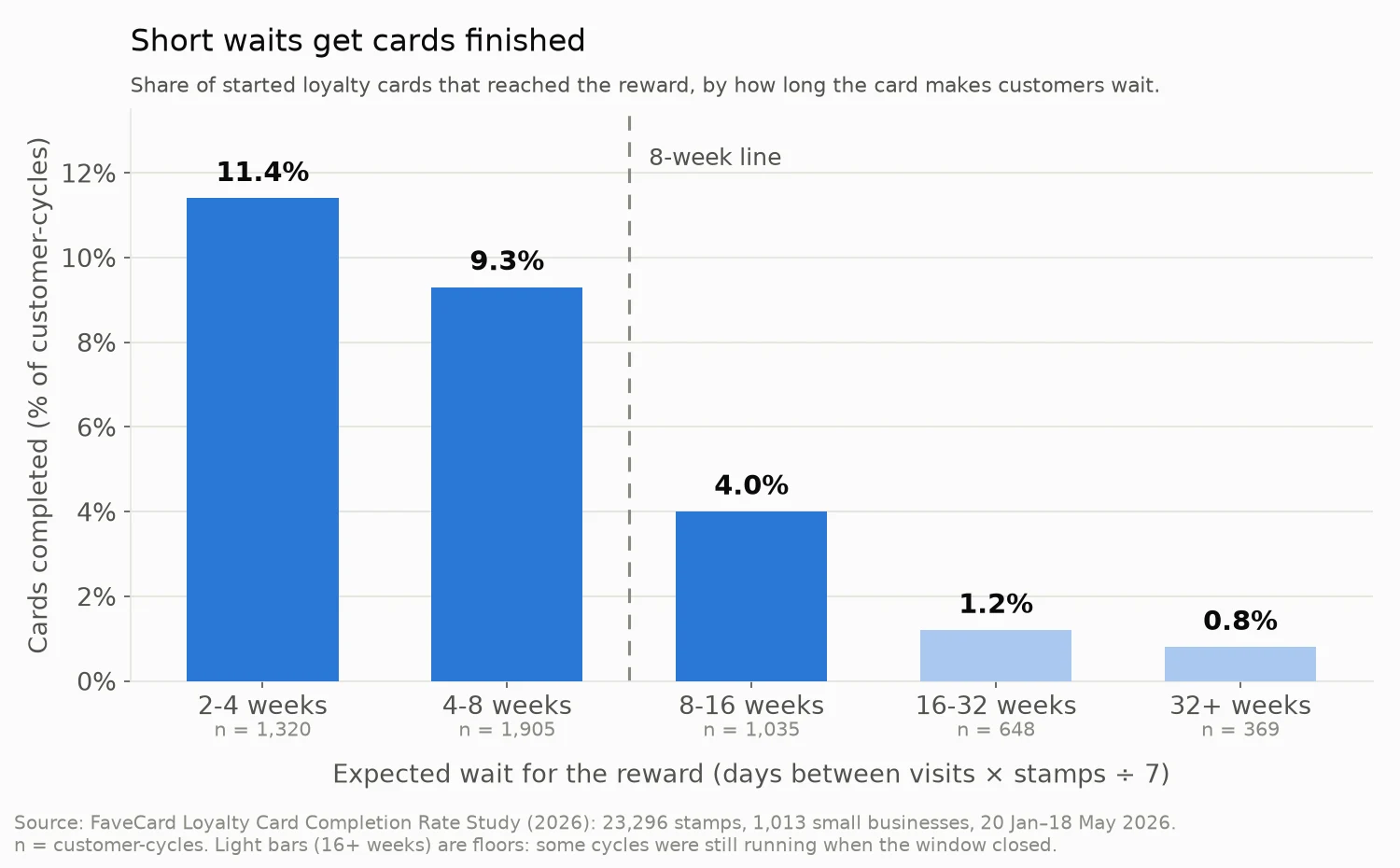
Keep the wait under 8 weeks. Every doubling of the wait roughly halved completion in our data. The drop is sharpest at the 8-week line: 9.3% just under it, 4.0% just over.
Use fewer stamps. 27.9% of started 5-stamp cards were finished, against 5.6% of 10-stamp cards. The 5-stamp figure comes from only 8 card designs, so read it as a direction, not a precise number.
Put a reward in the middle. If your card has to be long, split the reward. Two rewards turn one long wait into two short ones.
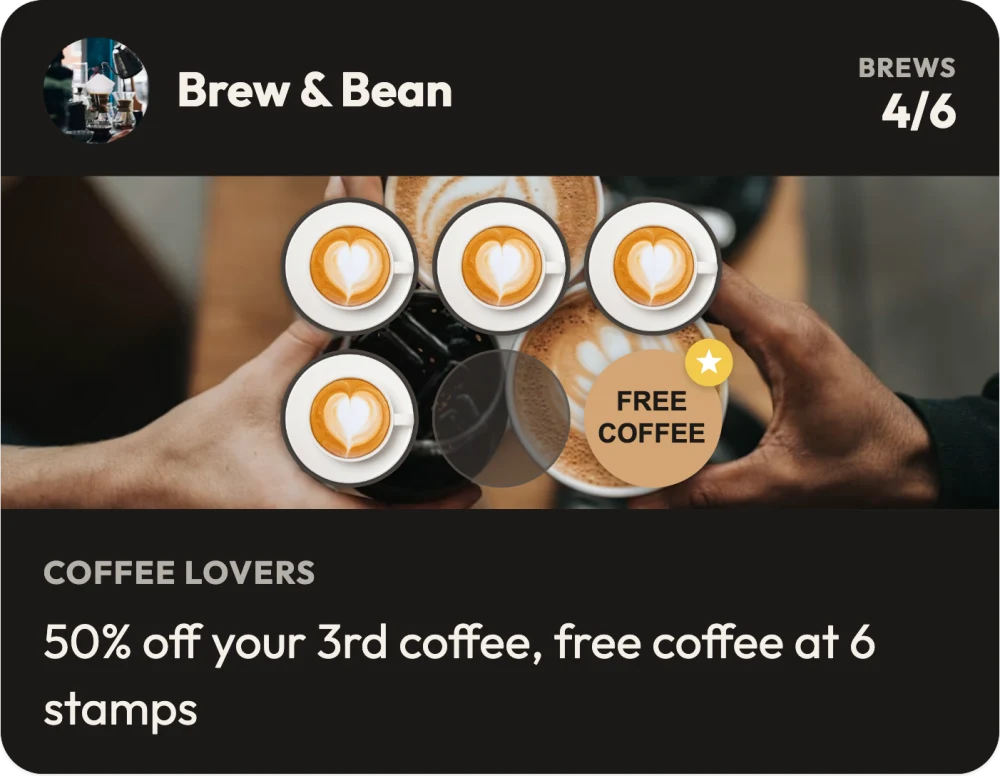
A real FaveCard card: half-price coffee at stamp 3, a free coffee at stamp 6. Rewards can sit on any stamp, on every plan.
Give a head start. Nunes and Drèze (Journal of Consumer Research, 2006) found that turning an 8-step card into a 10-step card with 2 steps already done made people more likely to finish, and faster. A bonus stamp on sign-up does the same job.
Make the card hard to lose. A paper card lives in a wallet, or in the trash. A digital card is on the phone the customer already has in hand. With FaveCard, the Free plan gives customers a card that opens in the browser with no app, and Pro puts it in Apple Wallet or Google Wallet. On the Business plan you can send a Wallet message to customers who’ve gone quiet.
When you create a card in FaveCard, you tell it how often customers visit. It suggests a stamp count (8 for near-daily visits, 6 for weekly, 5 for every two or three weeks, 4 for monthly) and shows how many weeks away the first reward is. If that’s more than 8 weeks, the card gets a yellow flag; more than 16 weeks, a red one. Adding an earlier reward clears it.
What do the big loyalty studies say?
Most loyalty statistics online come from large retailers, airlines or vendor surveys. These are the ones we could check at the source.
| Finding | Source and date | What it measured |
|---|---|---|
| Loyalty sign-up moves a guest’s return rate from 7% to nearly 30% | Toast + Resy, via CX Dive, June 2026 | US restaurants |
| Repeat guests: 7% of guests, up to 50% of order volume | Same report, Q1 2026 data | Toast POS transactions |
| Members generate 12% to 18% more revenue than non-members | Accenture, June 2016 | Interviews with 106 US retail loyalty professionals |
| 5% more retention, 25% to 95% more profit | Reichheld (Bain), via HBR, 2014 | Companies across industries |
| Loyalty programs are “surprisingly ineffective” | Dowling and Uncles, MIT Sloan Management Review, 1997 | Big consumer brands in crowded markets |
| 11.4% of short cards finished, 0.8% of long ones | FaveCard completion study, May 2026 | 1,013 small businesses, 23,296 stamps |
You may see “4.8x average ROI” quoted for loyalty programs in general. It comes from Antavo’s 2024 survey of 600 corporate loyalty leaders, and the report gives it as the average “for those with a positive ROI”. That average leaves out programs that lost money, and none of it is about small shops.
Is a loyalty program worth it for your shop? A 10-minute check
- Find your visit gap. How many days pass between a typical regular’s visits? Use your POS or your best guess.
- Run the wait formula on the card you have or plan: days × stamps ÷ 7. Over 8 weeks? Cut stamps or add an earlier reward.
- Price the reward at cost. Write down what the free item costs you to make or deliver.
- Find your break-even. Reward cost ÷ gross profit per visit = extra visits needed per finished card. Under 1 means the card is cheap to run.
- Remove the download. Customers should be able to join by scanning a QR code at the counter. For the reward itself, here are 15 punch card ideas. Still choosing a tool? See our comparison of free loyalty card apps.
- Check after one cycle. Look at sign-ups, second stamps and first rewards. Then compare how often card holders visit with how often everyone else does.
If your customers visit weekly or more, the math almost always works. If they visit a few times a year, a stamp card is the wrong tool, and a birthday message or a well-timed reminder will do more. Running a café? The coffee shop loyalty program guide has the setup.
Frequently Asked Questions
Do loyalty programs actually work for small businesses?
They work when the reward is close enough for customers to reach it. In FaveCard's study of 23,296 stamps across 1,013 small businesses (January to May 2026), cards designed to be finished in 2-4 weeks had an 11.4% completion rate. Cards that take 16 weeks or longer had completion rates under 2%. In restaurants, Toast and Resy data reported by CX Dive in June 2026 shows that getting a guest to sign up for a loyalty program shifts that guest's return rate from a baseline 7% to nearly 30%.
Is a loyalty program worth it for a small shop?
Yes, if your customers come back at least every week or two and the card doesn't make them wait more than about 8 weeks. The reward costs you what it costs to make, not the menu price. A free $4.50 coffee at 30% food cost is about $1.35. Even if the free coffee replaces one the customer would have paid for, the card breaks even at about 1.4 extra visits per finished card. It is rarely worth it for businesses that customers visit only once or twice a year.
What redemption rate should I expect from a stamp card?
FaveCard measures completion: the share of started cards that reach the reward. For well-designed cards the typical range is 4-8%, and 8% or more is good. Cards that take 2-4 weeks to finish had an 11.4% completion rate. Under 2% means the card asks customers to wait too long. Completion counts customers who earned the reward, not whether they then used it.
How do I reward regulars without giving away too much margin?
Count the reward at cost, not at menu price, and give it sooner rather than bigger. A free coffee worth $4.50 might cost you $1.35 in beans, milk and a cup. For services like hair, where a free cut costs a stylist's hour, a smaller reward such as a free blow-dry or add-on at the 4th visit protects margin better than a free cut at the 10th.
How long does it take for a loyalty program to show results?
About two full card cycles. Work out the expected wait: days between a typical customer's visits × stamps needed ÷ 7. A café card with 10 stamps and visits every 2 days takes about 3 weeks, so judge it after 6-8 weeks. A salon card with 8 stamps and monthly visits takes about 34 weeks, which is too long to judge or to work.
Do customers use loyalty cards if they don't have to download an app?
App fatigue is one of the main reasons owners give for customers ignoring loyalty programs. A card that opens in the phone's browser or saves to Apple Wallet or Google Wallet removes the download. FaveCard's Free plan gives customers a web card, and the Pro plan adds Apple and Google Wallet passes.