




Customer Satisfaction Surveys for Local Businesses
A simple guide to customer satisfaction surveys for small businesses: example questions, the right timing, and how to read the results and improve.
Key Takeaway: A customer satisfaction survey for a local business should be short (one rating plus one or two follow-up questions), asked at the right moment rather than after every visit, and used to fix problems early. Two well-timed questions beat a ten-question form nobody finishes.
FaveCard Team
Published June 1, 2026 · Updated October 8, 2026

Last updated: June 2026
A customer satisfaction survey is a short set of questions that asks how happy your customers are with your business. For a local business, the version that actually works is small: one star rating plus a question or two. Keep it short, ask it at the right moment, and use what you learn to fix problems early. That’s the whole game.
Key Takeaway: The best customer satisfaction survey for a small business is two or three questions asked at a sensible moment, not a long form after every visit. Short and well-timed beats long and ignored every time.
Most survey advice online is written for big companies with research teams and Net Promoter dashboards. If you run a cafe, a salon, or a barbershop, you don’t need any of that. You need to know, in plain terms, whether your customers are happy, what they love, and what’s quietly annoying them before it costs you a regular.
In this guide:
- What a customer satisfaction survey is (and what it isn’t)
- Example questions you can copy, by industry
- The right timing, so surveys never feel like spam
- How to read the results and turn them into action
- How to run one without buying yet another tool
What a Customer Satisfaction Survey Actually Is
A customer satisfaction survey measures how a customer feels about their experience with you. At its simplest, it’s one question: “How happy were you?” with a 1-to-5 star answer. Everything else is a follow-up.
For a local business, three things make a survey worth running:
- It’s short. One rating, then one or two questions. People answer short surveys. They abandon long ones.
- It’s well-timed. A request that lands at a thoughtful moment feels like you care. One that lands after every single visit feels like nagging.
- It’s acted on. Feedback you collect and ignore is worse than no feedback, because customers notice nothing changed.
A satisfaction survey is private feedback for you. It’s not the same as a public review. The survey helps you understand and improve. A review helps other people decide to visit. You want both, but they do different jobs.
What a satisfaction survey is NOT
- It’s not a way to screen who you let leave a review. Ask everyone, hear everyone.
- It’s not a long market-research questionnaire. If it takes more than 20 seconds, it’s too long.
- It’s not a one-off. The value comes from listening regularly and spotting trends over time.
The Three Survey Questions That Matter Most
You can run a genuinely useful survey with just three questions. Here’s the structure we recommend for any local business:
| Question | Type | What it tells you |
|---|---|---|
| ”How was your experience?“ | 1-5 star rating | Your overall satisfaction score and trend over time |
| ”What did you enjoy most?” | Short comment | What to protect and do more of |
| ”What could we do better?” | Short comment | The quiet issues you’d never hear otherwise |
The star rating gives you a number you can track. The two open questions give you the why. That’s everything a small business needs to start improving.
If you want one more, add a single question specific to your trade. But keep the total at three or four. Every extra question loses you answers.
Example Survey Questions by Industry
The right questions change by trade: a cafe asks about the coffee and the wait, a salon about the cut and the booking. The pattern stays the same: one rating, then one or two human questions in plain language a customer can answer while they put their coat on.
For a full, copy-and-paste bank of 50+ questions sorted by industry (cafe, restaurant, hair and nail salon, spa, shop) and by customer type, see customer satisfaction survey questions.
Timing: The Part Everyone Gets Wrong
Most businesses ask for feedback at the wrong time, or far too often. The wording barely matters if the timing is off.
Two moments work best for a local business:
- Early in the relationship. Once a customer has had a real experience to judge, a gentle “how did we do?” tells you whether their first impression landed. This is also when a small fix can turn a wobbly start into a loyal regular.
- A while after their last visit. If a once-regular customer has gone quiet, a thoughtful check-in can surface the reason. Sometimes it’s nothing to do with you. Sometimes it’s a fixable problem they never mentioned.
What you want to avoid is asking after every single visit. That’s the fastest way to make feedback requests feel like spam, and the fastest way to get everyone ignoring them.
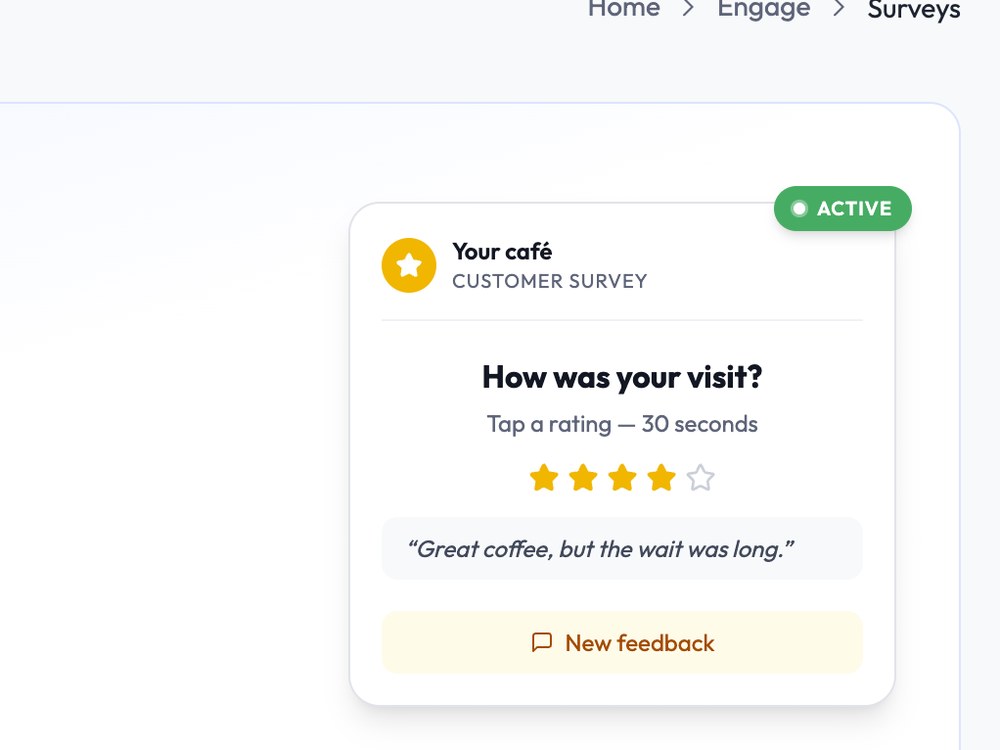
This is exactly how FaveCard’s Surveys feature is built. Feedback requests are asked at the right moment, never as spam, and they appear right on the customer’s loyalty card on their phone, the same card they open to check their stamps. There’s nothing extra for the customer to download or open, which is why on-card surveys get answered far more often than an email nobody sees.
Hear Every Customer, Fix Problems Early
Here’s the real reason a satisfaction survey is worth your time. Most unhappy customers don’t complain. They just stop coming. You never get the chance to put it right because you never hear about it.
A short, well-timed survey changes that. It gives the slightly-disappointed customer an easy, private way to tell you what went wrong, while there’s still time to fix it. This is called service recovery, and it’s one of the most useful things a small business can do. A customer whose problem you quietly sorted out often becomes more loyal than one who never had a problem at all.
So the job of a survey is not to decide who gets to leave a review. It’s to make sure no quiet issue costs you a customer. You want to hear the awkward feedback most of all, because that’s the feedback you can actually act on.
Loyalty and listening go hand in hand. A good loyalty programme keeps people coming back; good feedback makes sure they have a reason to. If you’re building both, our guide on how to get repeat customers covers the wider picture, and how to bring back inactive customers walks through reaching the regulars who’ve drifted away.
How to Read Your Survey Results
Collecting feedback is the easy half. The value is in what you do with it. Here’s a simple way to read your results without needing a spreadsheet degree.
1. Watch the trend, not the single answer
One five-star rating is nice. One one-star rating stings. Neither tells you much on its own. What matters is the direction over a few weeks. Is your average creeping up or sliding down? Note your average rating once a week and compare. FaveCard’s Surveys dashboard gathers every rating and comment in one place and shows your current average, so the number is always there to check.
2. Look for the same comment twice
If one person mentions slow service on Saturdays, note it. If three people do, you’ve found a real problem. Repeated comments are gold. They point straight at what to fix.
3. Separate “nice to know” from “act on this now”
Sort feedback into two piles: things you can fix this week (the music’s too loud, the card machine is slow) and things to consider over time (a new product, longer hours). Tackle the quick wins first. They’re the ones customers notice immediately.
4. Close the loop
When you fix something a customer flagged, tell them. “You asked, we listened” is one of the most loyalty-building messages a small business can send. It shows the survey wasn’t for show.
How to Run a Survey Without Buying Another Tool
You don’t need dedicated survey software. For most local businesses, the simplest setup is the one that sits inside something customers already use.
| Method | Effort | Response rate | Cost |
|---|---|---|---|
| Verbal (“How was everything?”) | Very low | Low (people are polite, not honest) | Free |
| Paper comment cards | Medium | Low | Printing |
| Email survey link | Medium | Low (most emails go unopened) | Email tool |
| Survey on the loyalty card | Very low | High (it’s where customers already are) | Included with FaveCard Business |
Asking out loud is friendly but rarely honest. Few people will tell you to your face that the coffee was lukewarm. Paper cards and email links work, but they ask the customer to do extra work, so most don’t bother.
Putting the survey on the digital loyalty card customers already carry removes that friction. They open the card to check their stamps and the question is right there. With FaveCard’s Surveys feature, available on the Business plan, you can build your own survey (a star rating plus the follow-up questions you choose), have it asked at the right moment, and see every rating and comment gathered in one dashboard.
Worth knowing: FaveCard’s separate Google Reviews feature asks every customer to leave a public Google review at the right moment. Different job, same goal of helping more people find a business they’ll love.
A Simple Plan to Start This Week
You don’t need to overthink this. Here’s the whole thing in five steps:
- Pick your three questions. One star rating, one “what did you enjoy”, one “what could we do better”.
- Choose the moment. Early in the relationship, and a check-in if a regular goes quiet. Not after every visit.
- Put it where customers already are. On the loyalty card beats an email nobody opens.
- Read the trend weekly. Two minutes. Is it going up or down, and what comment keeps repeating?
- Fix one thing and say so. “You asked, we listened” turns feedback into loyalty.
That’s a complete satisfaction survey programme for a local business. No research team, no jargon, no long forms.
Frequently Asked Questions
What is a customer satisfaction survey?
A customer satisfaction survey is a short set of questions that asks customers how happy they are with your business. For a local business, the most useful version is a single star rating followed by one or two open questions, such as “What did you enjoy?” and “What could we do better?”. The goal is to hear honestly from every customer, spot problems early, and learn what keeps people coming back.
What questions should I ask in a customer feedback survey?
Keep it to three questions or fewer. Start with an overall rating (1 to 5 stars), then ask one thing you’re doing well and one thing you could improve. You can add a single specific question that matters to your trade, such as “How was the wait?” for a cafe or “Did your stylist understand what you wanted?” for a salon. Long surveys get abandoned, so resist the urge to add more.
When is the best time to send a customer satisfaction survey?
Timing matters more than wording. Ask early in the relationship, once a customer has had a real experience to judge, and again a little while after their last visit if they’ve gone quiet. Asking at a sensible moment rather than after every single visit keeps the request feeling thoughtful instead of like spam.
How do I get more customers to answer a survey?
Make it short, ask at the right moment, and put it somewhere customers already are. A survey that appears on the digital loyalty card they already use gets far more responses than an email link, because there’s nothing extra to open. One rating tap plus one optional comment is enough.
Should I only ask happy customers for feedback?
No. Ask everyone. The whole point of a satisfaction survey is to hear from the customer who was a little disappointed but didn’t say anything, so you can put it right before they quietly drift away. Hearing every voice, including the unhappy ones, is how you fix problems early and keep people coming back.
What’s the difference between a satisfaction survey and a review?
A satisfaction survey is private feedback for you to act on. A public review is for other customers to read. Use the survey to understand and improve, and let genuinely happy customers leave a public review when they want to. They serve different jobs and both matter.
The Bottom Line
A customer satisfaction survey doesn’t have to be a chore for you or your customers. Three good questions, asked at the right moment, in a place they already are, will tell you more than any long form ever could. Use it to hear every customer, fix the small things early, and protect what people already love about your business.
Loyalty programmes help bring regulars back, and listening well is a big part of how you earn that. The survey is how you find out what’s working before a quiet problem turns into a lost regular.
Start small. Ask three questions. Read the trend. Fix one thing. Your regulars will notice.
Ready to start listening to your customers?
- FaveCard Free: Digital loyalty card, unlimited customers, no time limit, no credit card needed
- premium tools until the first 30 customers are on the card: Try Surveys, a feedback dashboard, Apple & Google Wallet passes, and custom branding
- 5-minute setup: Your first card and survey live by the end of your next coffee break
Create your free loyalty card and start hearing from every customer.
Related guides
Frequently Asked Questions
What is a customer satisfaction survey?
A customer satisfaction survey is a short set of questions that asks customers how happy they are with your business. For a local business, the most useful version is a single star rating followed by one or two open questions, such as 'What did you enjoy?' and 'What could we do better?'. The goal is to hear honestly from every customer, spot problems early, and learn what keeps people coming back.
What questions should I ask in a customer feedback survey?
Keep it to three questions or fewer. Start with an overall rating (1 to 5 stars), then ask one thing you're doing well and one thing you could improve. You can add a single specific question that matters to your trade, such as 'How was the wait?' for a cafe or 'Did your stylist understand what you wanted?' for a salon. Long surveys get abandoned, so resist the urge to add more.
When is the best time to send a customer satisfaction survey?
Timing matters more than wording. Ask early in the relationship, once a customer has had a real experience to judge, and again a little while after their last visit if they've gone quiet. Asking at a sensible moment rather than after every single visit keeps the request feeling thoughtful instead of like spam.
How do I get more customers to answer a survey?
Make it short, ask at the right moment, and put it somewhere customers already are. A survey that appears on the digital loyalty card they already use gets far more responses than an email link, because there's nothing extra to open. One rating tap plus one optional comment is enough.
Should I only ask happy customers for feedback?
No. Ask everyone. The whole point of a satisfaction survey is to hear from the customer who was a little disappointed but didn't say anything, so you can put it right before they quietly drift away. Hearing every voice, including the unhappy ones, is how you fix problems early and keep people coming back.
What's the difference between a satisfaction survey and a review?
A satisfaction survey is private feedback for you to act on. A public review is for other customers to read. Use the survey to understand and improve, and let genuinely happy customers leave a public review when they want to. They serve different jobs and both matter.