




How to Collect Customer Feedback (Small Business)
How to collect customer feedback with QR codes, short surveys, and your loyalty card. Simple, no-jargon steps for small businesses, plus what to ask.
Key Takeaway: The easiest way for a small business to collect customer feedback is a short, well-timed survey behind a QR code or on the loyalty card customers already carry. Keep it to one star rating and one open question, ask at the right moment, and act on what you hear fast.
FaveCard Team
Published June 1, 2026 · Updated October 8, 2026
Last updated: June 2026
The easiest way for a small business to collect customer feedback is a short, well-timed survey behind a QR code or on the loyalty card your customers already carry. Ask one star rating and one open question, keep it under 30 seconds, and gather every answer in one place so you can act on it. The simpler the survey, the more people finish it.
Key Takeaway: You don’t need a fancy research tool to understand your customers. You need one rating, one open question, the right moment to ask, and the discipline to act on what you hear.
Most small business owners run on gut feeling. You sense when things are going well and you worry when they’re not, but you rarely know why. Customer feedback closes that gap. It tells you what to keep doing, what to fix, and which quiet problem is slowly costing you regulars.
The good news: collecting feedback has never been simpler. You don’t need long email surveys or a research budget. A QR code and a 20-second form will get you further than most expensive tools.
In this guide:
- Why most small businesses fly blind
- The four simplest ways to collect feedback (with a comparison)
- How QR code feedback actually works
- Collecting feedback through your loyalty card
- Exactly what to ask (and what to skip)
- When to ask, so it never feels like spam
- What to do with the answers, especially the bad ones
Why Most Small Businesses Fly Blind
Big chains have whole teams measuring customer satisfaction. You have a shop to run. So feedback usually arrives in one of two unhelpful forms: a glowing comment from a chatty regular, or a one-star public review you find out about days later.
Both are misleading. The happy regular doesn’t represent the customer who quietly stopped coming. The angry review is one loud voice, often after the moment to fix things has passed.
What you actually want is a steady, low-effort stream of honest feedback from ordinary customers, captured while the experience is fresh. That’s what a simple system gives you. And understanding why people come back (or don’t) is time well spent.
The Four Simplest Ways to Collect Feedback
For a local business, there are four methods worth knowing. Most owners end up using two: a quick in-person ask, plus one digital method that captures answers automatically.
| Method | Effort to set up | Response rate | Captures data? | Best for |
|---|---|---|---|---|
| Asking in person | None | High, but unreliable | No | Reading the room day to day |
| QR code on a card or receipt | Low | Medium | Yes | Counter service, tables, takeaways |
| Survey on the loyalty card | Low | High | Yes | Businesses with regulars |
| Email survey | Medium | Low | Yes | Businesses with an email list |
Asking in person
“How was everything today?” is still the fastest feedback tool you own. The catch is that people are polite. They’ll say “lovely, thanks” on the way out and leave a one-star review that night. In-person asks are great for atmosphere and obvious problems, but they miss the quiet truth.
QR code feedback
A small printed QR code that opens a short form. Cheap, fast, and there’s nothing to download. We’ll cover this properly in the next section.
Survey on the loyalty card
If your customers already carry a digital loyalty card, the feedback can come to them there, on the card they open to check their stamps. No new app, no new link to remember, and it reaches the people who matter most: your returning customers.
Email survey
Useful if you’ve already collected email addresses, but response rates are low and answers arrive long after the visit. Fine as a backup, weak as your main method.
How QR Code Feedback Actually Works
QR code feedback is the most common starting point because it costs almost nothing.
Here’s the whole process:
- Create a short feedback form. One rating, one open question. Keep it to a single screen.
- Generate a QR code that links to that form.
- Print it and place it where customers naturally pause: on the receipt, a small table card, a stand by the till, or the back of your menu.
- Customers scan with their phone camera, the form opens, they tap a rating and (if they fancy it) add a comment.
- Answers land in one place for you to read.
Where to put the code
- Counter service (cafe, bakery, takeaway): on the receipt and a small stand at the till
- Table service (restaurant, bar): a card on each table
- Appointment-based (salon, barber, nail studio): on the payment screen or a card handed over at checkout
The honest limitation
A QR code on a wall asks everyone the same question at the same point. It can’t tell a brand-new customer apart from a regular of three years, and it relies on people choosing to scan. It’s a solid, simple start. Pairing it with feedback on the loyalty card fills the gap, because the card knows who the customer is and when they last visited.
Collecting Feedback Through Your Loyalty Card
If you run a loyalty programme, your best feedback channel is the card itself. Customers already open it to check their stamps and rewards, so a short survey can appear right there on their loyalty card. Nothing to install, nothing extra to carry.
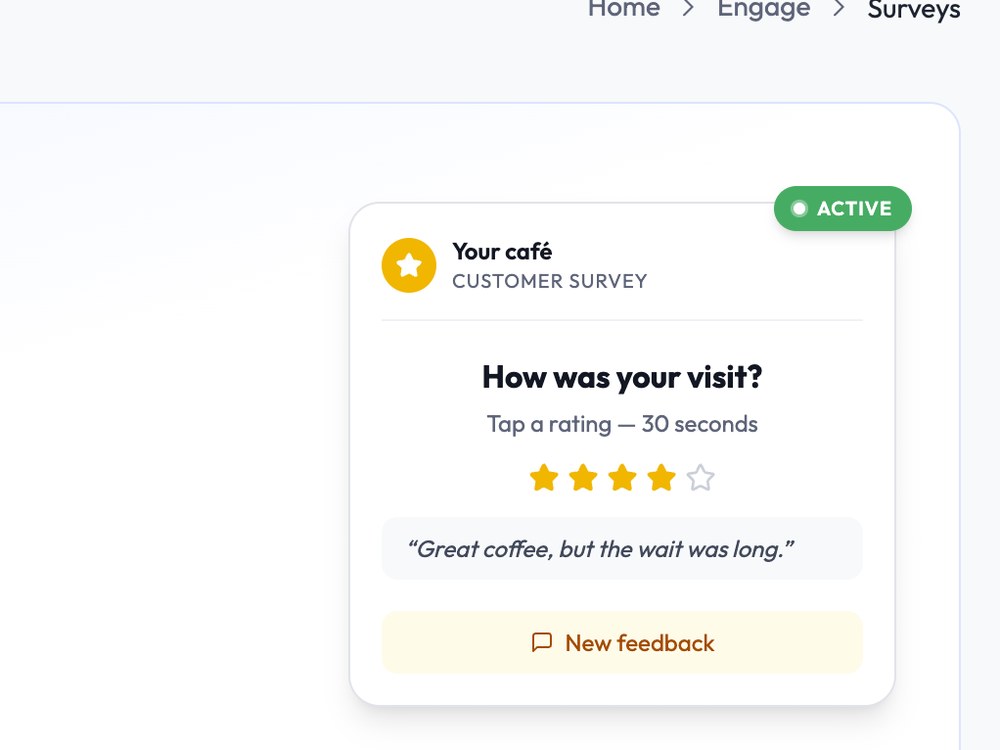
This is what FaveCard’s Surveys feature does. It asks your customers for feedback at smart, well-chosen moments, automatically, so the question turns up at a sensible time and never feels like spam. You can build your own survey (a star rating plus the follow-up questions you choose), and every rating and comment collects in one dashboard, with your average rating.
Why the loyalty card beats a wall poster for feedback:
- It reaches your regulars, the customers whose opinion shapes most of your revenue
- It’s timed, so you can hear a first impression early
- It’s personal, appearing on a card they already trust rather than a generic form
- Nothing to download or remember, which keeps response rates high
This pairs naturally with the way digital cards already let you reach customers between visits. One channel brings a quiet customer back; the other tells you why they went quiet in the first place.
A note on fairness: the point of asking through the card is to hear every customer, not to pick and choose who gets asked. Surveys help you catch a problem early so you can fix it, not hide it. More on that below.
To see how it fits with the rest of a loyalty setup, our Surveys feature page walks through it, and the guide to getting repeat customers shows where feedback sits in the bigger retention picture.
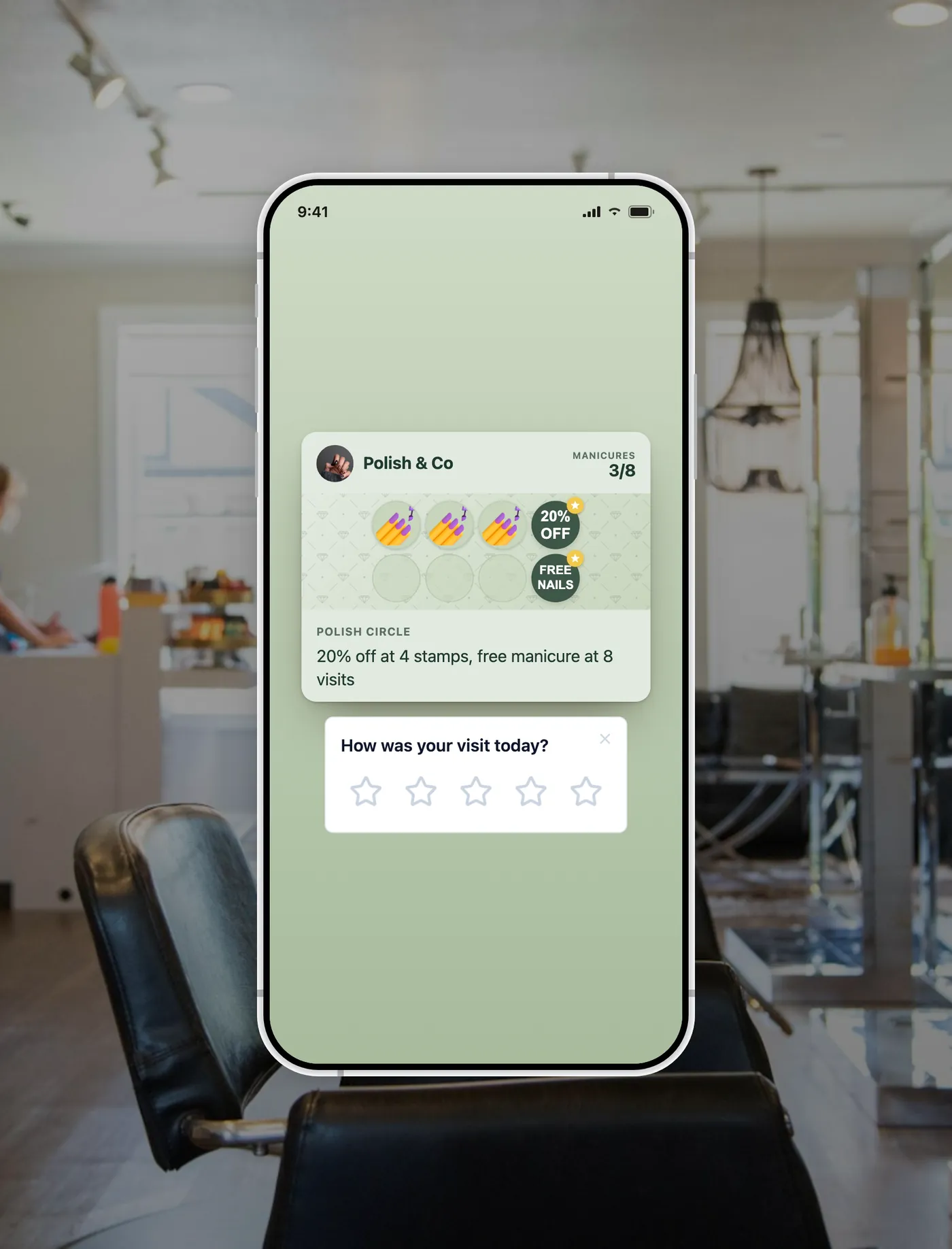
A Surveys star-rating prompt on the loyalty card, shown right after a stamp so every customer gets the same simple ask.
What to Ask (and What to Skip)
The biggest mistake is asking too much. Every extra question loses you responses. Start lean.
The two-question survey that works for almost everyone
- An overall rating: one to five stars. Fast, and easy to track over time.
- One open question: “What’s one thing we could do better?” or “How was your visit today?”
That’s it. From two questions you’ll learn your average satisfaction and the specific things people care about, in their own words.
Add a question only when you have a decision to make
If you’re weighing up a change, ask about it directly:
- Thinking of new opening hours? “When do you most want us to be open?”
- Worried about queues? “How was the wait time today?”
- Testing a new product? “How did you like the [new item]?”
Drop the question once you’ve made the decision. Don’t let your survey bloat.
What to skip
- Long demographic questions (age, postcode, income). You rarely need them and they slow people down.
- “On a scale of 1 to 10, how likely are you to recommend us?” style wording. It’s fine for big companies, but for a corner cafe a plain star rating is friendlier and gets more answers.
- Anything you won’t actually act on. If you’re not going to change your music, don’t ask about the music.
When to Ask, So It Never Feels Like Spam
Timing is the difference between feedback people are glad to give and feedback that annoys them into ignoring you.
The rule: ask at the right moment, never every time. Bombard people after every coffee and they’ll tune you out. Two moments are worth far more than constant nagging:
- Early in the relationship. A customer’s first impressions are sharp and honest. Catching them early tells you whether your onboarding, welcome, and first experience land well.
- After a gap. When a regular hasn’t been in for a while, a gentle check-in can surface the real reason: a change they didn’t like, a single bad visit, or simply life getting busy. That’s the feedback that saves a customer.
You don’t need to engineer this by hand. The point of a tool like Surveys is that it picks sensible moments for you and spaces them out, so customers feel asked, not hounded.
What to Do With the Answers
Collecting feedback is the easy half. The half that pays off is acting on it.
1. Read it weekly
Set aside ten minutes a week to read new feedback. Patterns matter more than any single comment. Three people mentioning slow service on Saturdays is a signal. One person’s off day is noise.
2. Fix the recurring problems
If the same gripe keeps appearing, it’s costing you customers you never hear from. Fix it, then watch whether the ratings move. Feedback you act on is the only feedback worth collecting.
3. Close the loop on negative feedback, fast
This is the most valuable thing feedback does for a small business. A quiet complaint, caught early, is a chance to put things right before that customer drifts away.
Reach out, apologise if it’s warranted, and tell them what you’ve changed. This is service recovery, and done well it often turns an unhappy customer into one of your most loyal. The goal is always to listen and fix, never to silence or hide. Hearing a problem and solving it is how a small business keeps the customers a big chain would have lost.
4. Celebrate and share the good stuff
Positive feedback isn’t just a morale boost. With the customer’s permission, a kind comment makes a genuine testimonial or social post. And separately, FaveCard’s Google Reviews feature asks every customer to leave a public Google review at the right moment, which turns happy customers into visible proof.
Putting It Together: A Simple Starter Plan
You don’t need all four methods on day one. Here’s a sensible order:
- This week: start asking one good in-person question and pay attention to the answers.
- Next week: create a two-question form and print a QR code for the till and receipts.
- Within the month: if you run a loyalty programme, switch on feedback through the loyalty card so it reaches your regulars at the right moments.
- Ongoing: read feedback weekly, fix what recurs, and reach out quickly to anyone unhappy.
That’s a complete feedback system for a local business, built from parts that each take minutes to set up. For a wider view of keeping customers around, the guide to bringing back inactive customers is a good next read.
Frequently Asked Questions
How do I collect customer feedback for a small business?
Use a short survey behind a QR code, or send it through the digital loyalty card your customers already have. Ask one star rating and one open question, keep it under 30 seconds, and ask at a sensible moment rather than every single visit. Gather the answers in one place so you can spot trends. The simpler the survey, the more people finish it.
What is QR code feedback?
QR code feedback is when you print a small QR code (on a receipt, table card, or near the till) that opens a short feedback form on the customer’s phone. They scan, tap a rating, maybe add a comment, and they’re done. It works because there’s nothing to download and no form to fill in by hand. The trade-off is that a code on a wall asks the same question to everyone, regardless of where they are in their journey.
What questions should I ask in a customer feedback survey?
Start with one overall rating (one to five stars), then one open question like “What’s one thing we could do better?”. That’s enough for most small businesses. Add one or two specific questions only if you have a decision to make, for example “How was the wait time today?”. Long surveys get abandoned, so resist the urge to ask everything at once.
How often should I ask customers for feedback?
Not after every visit. Asking constantly feels like spam and people stop responding. A good rhythm is to ask early in the relationship (so you catch first impressions) and again after a gap (so you understand why a regular went quiet). Smart timing matters more than frequency. The goal is to be asked at the right moment, never to be nagged.
Do I need an app to collect customer feedback?
No. A QR code that opens a web form works with no app at all. If you already run a digital loyalty card, the survey can appear on the card customers open to check their stamps, so there’s nothing extra to install or remember. Apps add friction and lower response rates, which is the opposite of what you want.
What should I do with negative feedback?
Respond quickly and fix the problem. A quiet complaint is a gift: it’s a chance to put something right before that customer drifts away for good. Reach out, apologise if needed, and tell them what you’ve changed. This is called service recovery, and it often turns an unhappy customer into a loyal one. Use feedback to listen and improve, never to hide problems.
The Bottom Line
Collecting customer feedback as a small business isn’t about surveys, scores, or software. It’s about one rating, one honest question, the right moment to ask, and the willingness to act on what you hear. A QR code gets you started for free. Feedback on your loyalty card takes it further by reaching the regulars who matter most, at moments that make sense.
Listen to every customer, fix the quiet problems early, and the feedback loop quietly becomes one of the most valuable habits your business has.
Want feedback to come to you automatically?
FaveCard’s loyalty card lives on your customers’ phones, and Surveys (a paid feature, see pricing) asks them for feedback at the right moments, with the answers gathered in one simple dashboard. Build your own survey, hear every customer, and fix the small things before they become big ones.
Start free with premium tools until the first 30 customers are on the card and see who’s coming back, and why.
Related guides
Frequently Asked Questions
How do I collect customer feedback for a small business?
Use a short survey behind a QR code, or send it through the digital loyalty card your customers already have. Ask one star rating and one open question, keep it under 30 seconds, and ask at a sensible moment rather than every single visit. Gather the answers in one place so you can spot trends. The simpler the survey, the more people finish it.
What is QR code feedback?
QR code feedback is when you print a small QR code (on a receipt, table card, or near the till) that opens a short feedback form on the customer's phone. They scan, tap a rating, maybe add a comment, and they're done. It works because there is nothing to download and no form to fill in by hand. The trade-off is that a code on a wall asks the same question to everyone, regardless of where they are in their journey.
What questions should I ask in a customer feedback survey?
Start with one overall rating (one to five stars), then one open question like 'What's one thing we could do better?'. That's enough for most small businesses. Add one or two specific questions only if you have a decision to make, for example 'How was the wait time today?'. Long surveys get abandoned, so resist the urge to ask everything at once.
How often should I ask customers for feedback?
Not after every visit. Asking constantly feels like spam and people stop responding. A good rhythm is to ask early in the relationship (so you catch first impressions) and again after a gap (so you understand why a regular went quiet). Smart timing matters more than frequency. The goal is to be asked at the right moment, never to be nagged.
Do I need an app to collect customer feedback?
No. A QR code that opens a web form works with no app at all. If you already run a digital loyalty card, the survey can appear on the card customers open to check their stamps, so there's nothing extra to install or remember. Apps add friction and lower response rates, which is the opposite of what you want.
What should I do with negative feedback?
Respond quickly and fix the problem. A quiet complaint is a gift: it's a chance to put something right before that customer drifts away for good. Reach out, apologise if needed, and tell them what you've changed. This is called service recovery, and it often turns an unhappy customer into a loyal one. Use feedback to listen and improve, never to hide problems.