




Customer Satisfaction Survey Questions (50+ Examples)
50+ customer satisfaction survey questions that work for local businesses, with ready-to-use examples by industry, plus the questions to never ask.

Key Takeaway:
A great customer satisfaction survey is short: one rating question plus one focused follow-up, asked while the visit is fresh. Use questions written in your customer's own words and specific to your business, keep the everyday survey to seconds, and act on the patterns you see. Catching problems privately through a survey lets you fix them before they become public reviews, while still inviting everyone to review you openly.
Last updated: June 2026
Most customer satisfaction surveys fail for the same reason: they’re too long. A fifteen-question form lands in someone’s inbox, they take one look, and they close it. You learn nothing, and you’ve slightly annoyed a customer in the process.
The fix isn’t a better form. It’s better questions, and fewer of them. The right single question, asked at the right moment, tells you more than a page of boxes nobody ticks.
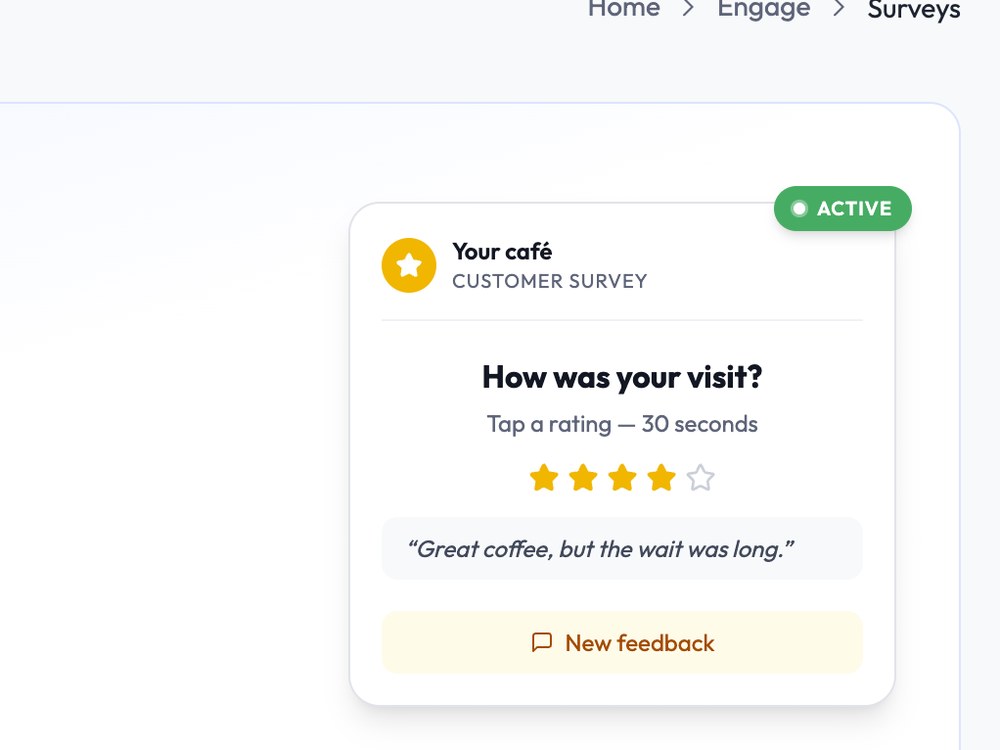
The short version: the best customer satisfaction survey questions are one rating (“How was your visit today?”) plus one short follow-up (“What’s the one thing we could do better?”), written in plain language and specific to your business. Everything below is a bank of those questions you can copy and adapt.
Key Takeaway: Keep your everyday survey to a rating plus one focused follow-up, ask while the experience is fresh, and use words your customers actually use. Longer surveys feel like work; short, well-timed ones feel like you care, and they’re the ones people actually finish.
This guide is for the cafe owner, the salon manager, the barber, and anyone running a local business who wants to know what customers really think without hiring a research firm. We’ll keep it practical, with questions you can lift straight into your next survey.
In this guide:
- What makes a survey question actually work
- The one rating question to start with
- The best follow-up questions (the ones that earn their place)
- 50+ survey questions by industry, ready to copy
- Questions for different kinds of customer
- The questions to never ask
- How many questions to use, and what to do with the answers
What Makes a Good Survey Question
Before the lists, four rules. Get these right and almost any question works.
- Ask one thing at a time. “Was the food and service good?” is two questions wearing one coat. If someone loved the food but waited too long, they can’t answer honestly. Split it.
- Use plain, specific language. “How satisfied are you with our offering?” is corporate. “How was your coffee today?” is human, and it gets answers. Write the way you’d speak across the counter.
- Don’t lead the witness. “How great was your experience?” begs for a yes. “How was your experience?” lets people tell the truth.
- Respect their time. Every extra question costs you responses. A rating plus one short follow-up is the sweet spot for everyday feedback.
A quick note on format: the questions below are built for the way most people actually answer on a phone, a quick star rating, then a short written reply. That’s exactly how FaveCard’s Surveys work: a star rating to start, then the follow-up questions you choose, right on the loyalty card the customer already has. No app, no login, and they can reply anonymously if they’d rather.
Start With One Rating Question
Every good satisfaction survey opens with a single, simple rating. It gives you a number you can track over time, and it takes one tap. Pick the wording that fits your business:
- How was your visit today? (1 to 5 stars)
- How would you rate your experience with us?
- Overall, how happy were you today?
- How likely are you to come back? (a good signal of repeat custom)
- How likely are you to recommend us to a friend?
That last one matters most for a local business, because word of mouth is a major way local businesses grow. Whichever you choose, keep it consistent so your average means something month to month.
The Best Follow-Up Questions
The rating tells you what. The follow-up tells you why, and why is where the fixes live. Add just one of these after the rating:
- What’s the one thing we could do better?
- What did you enjoy most today?
- Was there anything that let you down?
- What nearly stopped you coming in (or coming back)?
- If you could change one thing about today, what would it be?
- What made you choose us over somewhere else?
- Is there anything you wish we offered?
The single most useful follow-up for most local businesses is “What’s the one thing we could do better?” It’s gentle, it assumes you can improve, and it usually surfaces something specific and fixable.
50+ Customer Satisfaction Survey Questions by Industry
Lead with a star rating, then pick a follow-up or two from your industry below. These are written to be asked the way customers think, not the way a survey tool defaults.
Cafe or coffee shop
- How was your coffee today?
- Was your order made the way you wanted it?
- How was the wait at the counter?
- How comfortable was the space to sit in?
- Did our staff make you feel welcome?
- How did our prices feel for what you got?
- What’s your usual order, and did we get it right?
- What would make you choose us over the chain down the road?
- Is there a drink or snack you wish we had?
Restaurant or takeaway
- How was your meal tonight?
- Was your food the temperature and quality you expected?
- How was the time from ordering to being served?
- How was the service from your server?
- Was your table ready close to your booking time?
- Was the bill clear and correct?
- How was the atmosphere for the occasion?
- What’s the one dish we should never take off the menu?
- What would have made tonight a five-star visit?
Hair salon or barbershop
- How happy are you with your cut today?
- Did your stylist understand what you wanted?
- How was the wait for your appointment?
- Did you feel relaxed and looked after in the chair?
- Was the booking process easy?
- How likely are you to book with the same stylist again?
- Is there a service or product you wish we offered?
- What’s the one thing that would make your next visit better?
Nail salon or beauty studio
- How happy are you with your treatment today?
- Did the result match what you asked for?
- How clean and comfortable did the studio feel?
- Did your technician explain the aftercare clearly?
- How was the time your appointment took?
- Would you book the same treatment again?
- Is there a treatment you’d love us to add?
- What’s one thing that would make you recommend us to a friend?
Spa, wellness, or fitness
- How was your session today?
- Did you feel welcomed and looked after from the moment you arrived?
- Was the space clean, calm, and well kept?
- Did your instructor or therapist meet your expectations?
- How easy was it to book the time you wanted?
- How likely are you to keep coming regularly?
- What would help you get more out of your visits?
- Is there a class, time slot, or treatment you wish we offered?
Shop or retail
- How was your visit to the shop today?
- Did you find what you came in for?
- How helpful were our staff if you needed them?
- Was the shop easy to move around in?
- How were the prices for what you bought?
- How was the checkout experience?
- What nearly stopped you buying today?
- Is there a product you wish we stocked?
- How likely are you to shop with us again?
That’s more than fifty questions across six common local trades. Don’t use them all, that’s the whole point. Pick the rating and the one or two follow-ups that match what you’re trying to learn this month, and rotate them as your questions change.
Questions for Different Kinds of Customer
The same person needs a different question depending on where they are in their journey with you. Tailor the follow-up to who you’re asking: ask new customers why they came, regulars what keeps them, and quiet ones what would bring them back.
- A first-time customer: “What made you decide to give us a try?” and “Is there anything that nearly put you off?” These tell you why people walk in, and what’s leaking at the front door.
- A loyal regular: “What keeps you coming back?” and “Is there anything we’ve slipped on lately?” Regulars notice changes first and will tell you the truth if you ask kindly.
- Someone who’s gone quiet: “We’ve missed you, is there anything that would bring you back in?” A gentle, honest question to a lapsing customer often does double duty: it gathers feedback and re-opens the door. For more on this, see how to bring back inactive customers.
- After a promotion or a busy event: “How was your visit during [the event]?” and “Would you come back at a normal time?” This tells you whether a one-off brought in keepers or just bargain-hunters.
The Questions to Never Ask
A few patterns quietly ruin survey results. Avoid these:
| Don’t ask | Why it backfires | Ask instead |
|---|---|---|
| ”Was the food and service good?” | Two questions in one, impossible to answer honestly | Split into two, or pick the one that matters |
| ”How great was your visit?” | Leading, it fishes for a positive | ”How was your visit?" |
| "How satisfied are you with our products and services?” | Corporate and vague | ”How was your [coffee / cut / meal] today?" |
| "Rate us on quality, value, speed, ambience, and staff” | Too many ratings, people give up | One overall rating plus one open question |
| ”Why didn’t you have a good time?” | Assumes the worst, feels accusatory | ”Was there anything that let you down?” |
The golden rule: if a question takes more than a few seconds to read and answer, it’s costing you responses.
How Many Questions Should You Use?
For everyday feedback, one rating plus one or two short follow-ups. That’s it. A single star rating gives you a trend line you can watch month to month; one open question tells you the story behind the number.
Save longer surveys for rare, specific moments, a menu overhaul, a refit, a new location, when you genuinely need detail and customers understand why you’re asking for more of their time. The rest of the year, short wins. For the full method behind timing and reading your results, see our guide to customer satisfaction surveys for local businesses and how to collect customer feedback.
Turning Answers Into Action
Questions are only worth asking if you act on the answers. A simple rhythm works:
- Read responses regularly. A quick daily or weekly glance is enough.
- Look for patterns, not one-offs. One person mentioning slow service is a data point. Five is a problem to fix this week.
- Recover at-risk customers. When someone flags a genuine issue, reach out and put it right. Fixing a problem for a customer who raised it, known as service recovery, often makes them more loyal than if nothing had gone wrong.
There’s a quieter benefit, too. A private survey gives unhappy customers a way to tell you first, so you can fix the problem before it turns into a public one-star review. To be clear, this isn’t about steering anyone away from leaving a public review, that would be review gating, and it breaks Google’s rules. You still invite everyone to review you openly. A survey simply gives people a private channel as well, so you often hear about a problem in time to fix it. For the public side, see how to respond to negative reviews and our guide to customer feedback and reviews.
Tools That Make This Effortless
You can run a survey with a notebook by the till, but a digital loyalty card makes it far easier, because the customer is already holding the card when you ask.
| Approach | Cost | What you get |
|---|---|---|
| Paper comment cards | Near £0 | Sporadic, hard to track, easy to lose |
| Standalone survey tool | Varies | Powerful, but disconnected from your customers and their visit history |
| FaveCard Free | Free, unlimited customers | Digital loyalty card, QR code, visit history, and premium tools until the first 30 customers are on the card |
| FaveCard (Business plan) | See pricing | Adds Surveys (a star rating plus your own follow-up questions, on the loyalty card, with an anonymous option and every response in one dashboard), Google review requests, Apple & Google Wallet passes, and customer messages |
Because FaveCard’s surveys live on the same loyalty card customers already use, you’re not asking anyone to download an app or hand over a phone number. The question appears on their card at a smart moment, they tap a star and add a few words, and the response lands in your dashboard, next to your average rating. For a wider comparison, see our roundup of the best free digital loyalty card apps.
The Bottom Line
The secret to a useful customer satisfaction survey isn’t a clever platform. It’s asking the right question, in plain words, at the right moment, and keeping it short enough that people actually answer. Start with one rating, add one focused follow-up from the lists above, and write it the way your customers speak.
Then do the part most businesses skip: read the answers, spot the patterns, and fix what several people mention. Asked well and acted on, a two-question survey will tell you more about keeping customers than any report you could buy.
Frequently Asked Questions
What questions should be on a customer satisfaction survey?
Start with one rating question (“How was your visit today?” on a 1 to 5 scale), then add one short follow-up that fits your business, such as “What’s the one thing we could do better?” That two-question format takes seconds and gets far more responses than a long form. Only add more questions when you have a specific decision to make, like choosing new opening hours or a new product. The best questions are short, ask one thing at a time, and use plain language a customer would actually use.
How many questions should a customer satisfaction survey have?
As few as possible, usually one rating plus one or two short follow-ups. Response rates tend to drop with every extra question, and a survey nobody finishes tells you nothing. A single star rating already gives you a trend to watch; one open question tells you why. Save longer surveys for rare, specific moments (a menu change, a refit) and keep your everyday survey to seconds, not minutes.
What is a good customer satisfaction survey question for a small business?
“How likely are you to come back?” and “What’s the one thing we could do better?” are two of the most useful for a local business, because they predict repeat custom and surface fixable problems. Pair them with a simple star rating on the overall visit. Keep the wording natural and specific to your business, for example “How was your coffee today?” works better for a cafe than a generic “How satisfied are you with our products and services?”
When is the best time to send a satisfaction survey?
When the experience is still fresh, ideally the same day or shortly after the visit. Feedback given a week later is vaguer and rarer. The trick is to ask at a natural moment in the customer’s journey rather than on a fixed schedule, and not to ask after every single visit, which causes fatigue. A well-timed request feels like care; a constant one feels like spam.
Should customer satisfaction surveys be anonymous?
Often, yes. Letting customers reply anonymously tends to bring more honest answers, especially about service or staff, because people worry less about offending anyone. The trade-off is you can’t follow up directly with that person. A good middle ground is to make answering anonymous by default but give people the option to leave contact details if they’d like you to get back to them.
How do I act on customer satisfaction survey results?
Read responses regularly, look for patterns rather than reacting to single comments, and fix the things several people mention. When someone flags a genuine problem, reach out and put it right, that’s called service recovery and it often makes the customer more loyal than if nothing had gone wrong. Catching issues privately through a survey also means you can fix them before they ever turn into a public review, without ever steering anyone away from leaving an honest public one.
Ready to hear from every customer?
- FaveCard Free: Digital loyalty card, unlimited customers, no time limit, no credit card needed
- premium tools until the first 30 customers are on the card: Try Surveys, Google review requests, Apple & Google Wallet passes, and customer messages
- 5-minute setup: Your first card live by the end of your next coffee break
Create your free loyalty card and start asking the questions that actually help you grow.
Related guides
Frequently Asked Questions
What questions should be on a customer satisfaction survey?
Start with one rating question ("How was your visit today?" on a 1 to 5 scale), then add one short follow-up that fits your business, such as "What's the one thing we could do better?" That two-question format takes seconds and gets far more responses than a long form. Only add more questions when you have a specific decision to make, like choosing new opening hours or a new product. The best questions are short, ask one thing at a time, and use plain language a customer would actually use.
How many questions should a customer satisfaction survey have?
As few as possible, usually one rating plus one or two short follow-ups. Response rates tend to drop with every extra question, and a survey nobody finishes tells you nothing. A single star rating already gives you a trend to watch; one open question tells you why. Save longer surveys for rare, specific moments (a menu change, a refit) and keep your everyday survey to seconds, not minutes.
What is a good customer satisfaction survey question for a small business?
"How likely are you to come back?" and "What's the one thing we could do better?" are two of the most useful for a local business, because they predict repeat custom and surface fixable problems. Pair them with a simple star rating on the overall visit. Keep the wording natural and specific to your business, for example "How was your coffee today?" works better for a cafe than a generic "How satisfied are you with our products and services?"
When is the best time to send a satisfaction survey?
When the experience is still fresh, ideally the same day or shortly after the visit. Feedback given a week later is vaguer and rarer. The trick is to ask at a natural moment in the customer's journey rather than on a fixed schedule, and not to ask after every single visit, which causes fatigue. A well-timed request feels like care; a constant one feels like spam.
Should customer satisfaction surveys be anonymous?
Often, yes. Letting customers reply anonymously tends to bring more honest answers, especially about service or staff, because people worry less about offending anyone. The trade-off is you can't follow up directly with that person. A good middle ground is to make answering anonymous by default but give people the option to leave contact details if they'd like you to get back to them.
How do I act on customer satisfaction survey results?
Read responses regularly, look for patterns rather than reacting to single comments, and fix the things several people mention. When someone flags a genuine problem, reach out and put it right, that's called service recovery and it often makes the customer more loyal than if nothing had gone wrong. Catching issues privately through a survey also means you can fix them before they ever turn into a public review, without ever steering anyone away from leaving an honest public one.