




Coffee Shop Loyalty Card Rules: Stamps, Free Drinks, Extras
The house rules a café loyalty card needs: a stamp per visit or per drink, what the free coffee includes, stamps on rewards, food, and how to change them.
Key Takeaway:
A coffee shop loyalty card needs five written rules: what earns a stamp (per paid drink or per visit), how many stamps one visit can earn, exactly what the free drink includes (for example any coffee or tea, extras at their usual price), when the reward can be used or expires, and whether the free drink earns a stamp. Each should fit in one sentence a barista can apply at a busy counter.
Last updated: October 2026
A coffee shop loyalty card needs five rules, written before the first stamp: what earns a stamp, how many stamps one visit can earn, exactly what the free drink includes, when the reward can be used, and whether the free drink earns a stamp. Each rule should fit in one sentence that a barista can apply during the morning rush without calling the owner over. When a rule isn’t written down, two baristas will apply it two different ways, and regulars notice.
How many stamps the card should have is a separate question with its own answer: 8 if your regulars come in every few days, 6 if they come weekly. For setting up the whole programme, see our coffee shop loyalty program guide.
| Rule | One common café version | Write it like this |
|---|---|---|
| What earns a stamp | Each paid drink | “1 stamp for every drink you buy.” |
| Stamps per visit | Every paid drink counts | “Buying for friends? Every drink gets a stamp.” |
| What the reward is | Any coffee or tea, extras charged | “Free drink: any coffee or tea, any size. Oat milk, syrups and extra shots as usual.” |
| When it can be used | Any visit, no expiry | “Use your free drink whenever you like. It doesn’t expire.” |
| Stamps on the reward | None | “The free drink doesn’t earn a stamp.” |
What rules does a coffee shop loyalty card need?
A coffee shop loyalty card needs a written rule for every moment where a barista could otherwise hesitate: earning, counting, giving the reward, timing and the next round. If one is missing, staff decide on the spot.
The gaps show up in owners’ questions. On the Square Seller Community, an owner whose customers “receive a free coffee after purchasing eight coffees” asked in 2026 how to limit the free coffee to the Coffee & Tea category. Another, in 2025, was trying to “discount the main drink but not the modifiers”, such as cold foam and extra espresso. Both owners knew what the reward should cover and needed their checkout system to apply it. A written rule is what staff fall back on when the system can’t.
Two habits keep café rules workable. Write each rule as one sentence, keeping the exceptions you really need (an exception that matters is better than a short rule nobody follows). And use the same words on the card, on the sign by the till and in what staff say.
One stamp per visit or one per drink?
For a coffee card, one stamp per paid drink and one stamp per visit both work; the choice depends on how often your customers buy for other people. One stamp per drink matches how customers count coffee and rewards the regular who picks up the office order. One stamp per visit stops a large group order from earning several stamps at once, but gives the buyer less credit for spending more.
Before you choose, do the sum for your own menu: what the reward costs you, against what a customer spends to earn it under each rule. Some shops combine the two: one stamp per paid drink, up to a set number per visit. If you set a cap, write the number on the card (“up to 4 stamps per visit”) instead of leaving it to staff.
A group order doesn’t have to slow the line. In FaveCard, staff can add several stamps in a single scan, so “every drink gets a stamp” is one scan, not four.
Does the free coffee include oat milk, extra shots or a large size?
The free coffee includes exactly what your written rule says, so name the drinks, the size and the extras. A clear version for most cafés is “one free coffee or tea, any size; oat milk, syrups and extra shots at their usual price”. It gives the customer the drink they actually order and keeps paid extras paid.
Three common versions, each with a trade-off:
| Free drink rule | Good for | Watch out for |
|---|---|---|
| Any coffee or tea, any size, extras at their usual price | Most independent cafés | Cost out your largest drink before offering it |
| Any coffee or tea, regular size, extras at their usual price | Shops where large drinks cost much more to make | Customers who always order large may feel short-changed |
| One set drink (“a free filter coffee or Americano”) | Very busy shops, kiosks, drive-thrus | Feels small to a customer who never orders it |
Write the choice on the card. The owner on the Square forum who wanted a free drink without free modifiers was told that a percentage discount can’t skip the modifiers, and was given a workaround: an open-amount discount for the base drink price. A written rule makes a workaround like that easy to apply, because staff know what “free” covers before they key it in.
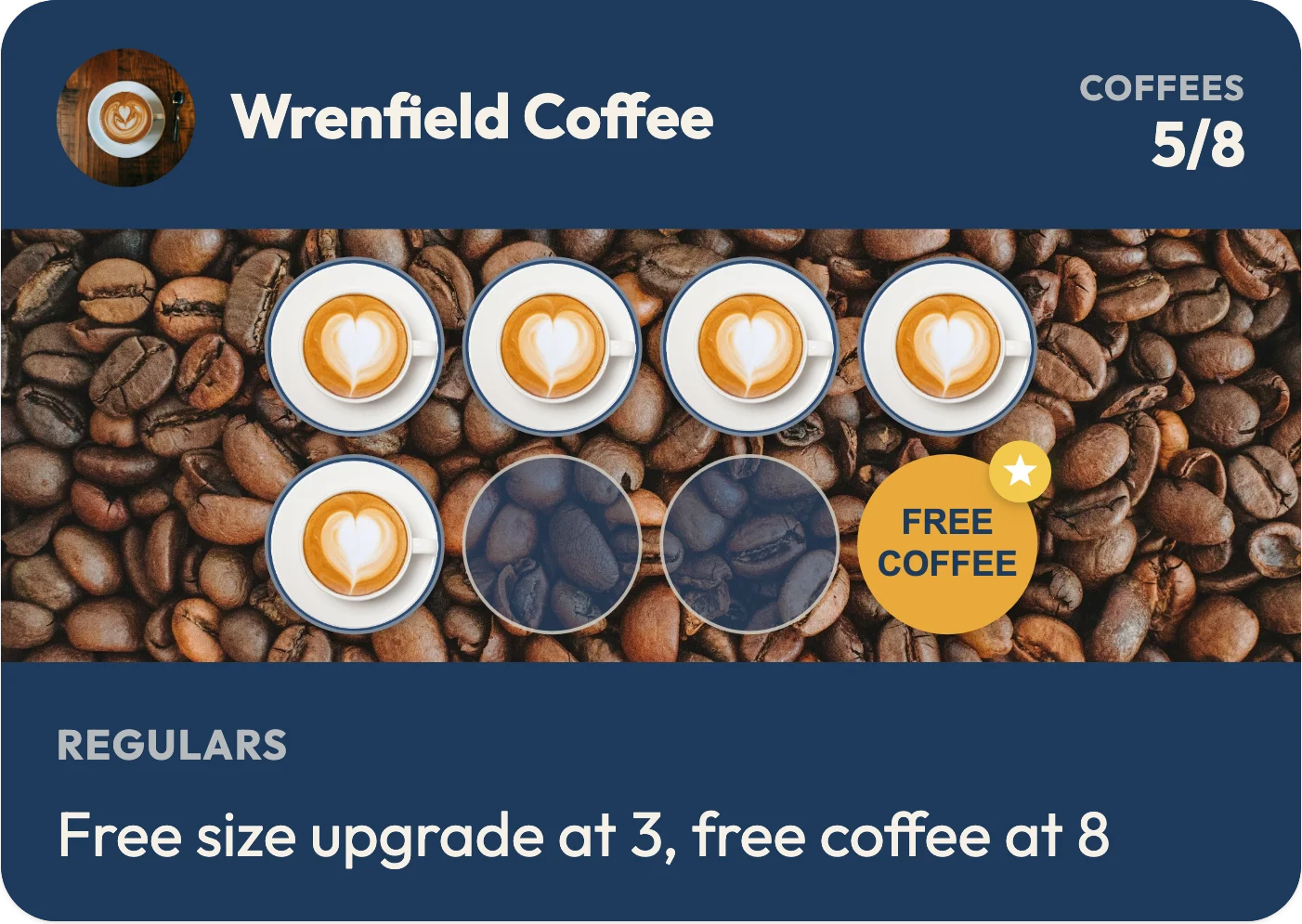
Example card: a free size upgrade at stamp 3 and a free coffee at stamp 8, for regulars who come in every few days. The card line states the rewards; the terms say what the free coffee includes.
Should the free drink earn a stamp?
Most cafés say no: the free drink is the reward, so only paid drinks earn stamps. Write “the free drink doesn’t earn a stamp” in your terms. Without that line, a customer can reasonably expect a stamp for every drink, and staff will split on it.
Till systems don’t always count it the way the owner intends. In 2025 a coffee shop owner asked how to stop customers “earning points when redeeming a reward” and was told there was no built-in way to exclude them. Another owner found that a free coffee claimed through their online store added an extra stamp. Whatever you use, test it once: ring up a free drink on its own and a free drink with a paid one, and check the stamps.
On a FaveCard card, claiming a reward and giving a stamp are separate steps. When staff mark the reward as claimed, no stamp is added; if the customer also buys a paid drink, staff give that stamp on purpose.
Do rewards have to be used right away, and should they expire?
Many cafés let customers use the free drink on any later visit, with no expiry; if you want one, write the exact rule in your terms. A saved reward is still a reason to come back. Asking a customer in a hurry to take the free coffee “now or never” turns a reward into a small loss.
On FaveCard, an earned reward waits on the card until staff mark it claimed. Customers can keep collecting in the meantime: stamps after a full card start the next round, so nothing they earn while a reward waits is lost. If you do want an expiry, for example because the menu is changing, make it generous (such as six months after the reward is earned), write it in your terms and tell customers when they reach the reward.
The other timing question is how quickly the reward comes. In FaveCard’s completion study (128 cards and 5,277 customer cycles, January to May 2026), 11.4% of cycles were completed on cards with an estimated 2 to 4 weeks to the reward (worked out from the stamp count and how often the business said its customers visit), against 4.0% on cards estimated at 8 to 16 weeks. Shorter waits went with more finished cards in that sample; it is an observation from FaveCard cards, not a guarantee for yours.
Should pastries and food count toward a coffee stamp card?
Count food if you want regulars to add a pastry to their coffee; keep earning to drinks if stamps on food would let customers reach the free drink too cheaply. Three common versions:
- Drinks only. “1 stamp for every hot or cold drink you buy.” Food buyers aren’t rewarded, and the reward cost stays predictable.
- Every item. “1 stamp for every drink or pastry.” Generous and simple, but a family breakfast can fill half a card.
- Drinks plus food spend. “1 stamp per paid drink, plus 1 for every full $5 spent on food in one purchase.” It rewards bigger baskets without counting every cookie. Say whether food spend carries over between visits (usually not).
Food can also be the reward. A coffee founder asked about loyalty perks in a Square community Q&A answered in 2023 that they avoid discounting coffee, their thinnest-margin item, and give food rewards instead, because “the margins on food are a bit more forgiving”. Check that against your own costs: a pastry at stamp 3 is a good early reward only if it’s cheap for you to give.
How do you stop people gaming a coffee loyalty card?
Write the rule that closes the gap you actually see, and let staff apply it at the counter. Two house rules cover most cases: stamps are given by staff, and each customer collects on their own card. Write them so staff can apply them without making a regular feel accused.
The gap depends on your earning rule. A shop owner on the Square forum wrote in 2023 that “a few people like to try and abuse the program, and will do multiple transactions”, and wanted to add “one point per day”. Splitting one order into several payments only pays off when each payment or visit earns a stamp. Under a per-visit rule, say what a visit is; FaveCard’s example for the terms field reads “One stamp per visit, however many payments.” Under a per-drink rule, splitting payments changes nothing, because each paid drink earns one stamp either way.
For staff-side mistakes (extra stamps for friends, stamps without a purchase) and how to spot them in your numbers, see our guide to loyalty stamp card cheating.
How do you change the rules without upsetting regulars?
Explain the real reason, give a start date, and let every card in progress finish under the old rule. Regulars accept a change they understand; what they resent is losing progress they’ve already earned.
An owner of “a couple coffee shops” who had “done loyalty the same way for years” asked in 2025 whether switching from 9 stars for a free drink to a points-for-money system would cause pushback. The advice from other owners was to “be honest about the reasons for your change” and to explain its benefits. In order:
- Change one rule at a time.
- Announce it at the counter and on the card three or four weeks before it starts.
- Let every card in progress finish under the old rule.
- Update the wording everywhere on the same day: card, sign and what staff say.
- A month later, look at stamps and claimed rewards and decide whether to keep it.
On FaveCard, editing the terms text doesn’t change anyone’s stamps. Changing the card itself (for example from 10 stamps to 8) usually means a new card while customers finish the one they have; our guide on how many stamps a loyalty card should have covers when that’s worth it.
Where should customers see the rules?
Customers should be able to read the rules on the card, and staff should be able to point to the same words at the counter. A card that only says “Free coffee at 8” leaves every edge case to the barista. Put the short version on the card face and the full terms one tap away.
On paper cards, the terms go on the back. On a digital card, look for a terms field in the card settings. In FaveCard it’s called Program terms: you write the rules in your own words, and customers see them on the card’s Rewards tab and on the back of the card in Apple Wallet and Google Wallet. The text is for customers; staff apply the rules when they give stamps, as they would with a paper card.
A set of terms for a café can fit in four lines:
1 stamp for every drink you buy. Stamps are given by our staff. Free drink at 8 stamps: any coffee or tea, any size. Oat milk, syrups and extra shots at their usual price. Use your free drink whenever you like; it doesn’t expire. It doesn’t earn a stamp. One card per person.
Doing this in FaveCard
If you run your café card on FaveCard, here is where each rule lives and which plan it’s on:
| What | What the customer sees | Plan |
|---|---|---|
| Program terms in your own words | The rules on the card’s Rewards tab, and on the back of the card in Apple Wallet and Google Wallet | Every plan (Wallet cards on Pro and Business) |
| Rewards on any stamp, such as a size upgrade at 3 and a free coffee at 8 | Each reward on its stamp, with your own line on the card | Every plan |
| Scanning the card with the FaveCard app, one or several stamps at a time | The stamps appear on their card | Every plan |
| Team members scanning with their own phones | The same | Business |
| Earned rewards wait until claimed; stamps after a full card start the next round | Rewards ready to use on any visit | Every plan |
| The card in Apple Wallet and Google Wallet, with your logo and colors | Your card in their Wallet app | Pro and Business |
| A Slow Day campaign, such as “2x stamps” until closing | A notification and new text on the card until the campaign ends | Business |
The Slow Day campaign is for days when you want to bend the earning rule on purpose. Its suggestions for an empty afternoon include “2x stamps” and “Free pastry with any drink”: the line appears on customers’ cards with a notification, staff give the extra stamp or pastry at the counter, and the card returns to normal when the campaign ends (at closing, tomorrow or after three days). Plans and what each includes are on the pricing page, and the coffee shop page shows the card the way customers see it.
Frequently Asked Questions
What rules should a coffee shop loyalty card have?
Five: what earns a stamp, how many stamps one visit can earn, exactly what the free drink includes, when it can be used, and whether the free drink earns a stamp. Write each one as a short sentence a barista can apply without asking a manager, and use the same words on the card and at the counter.
Should a coffee loyalty card give one stamp per visit or one per drink?
Both work. One stamp per paid drink matches how customers count ("my ninth latte") and rewards the person who buys for the office. One stamp per visit stops a large group order from earning several stamps at once. Before you choose, work out what the reward costs against the sales a customer needs to earn it, then write the rule on the card.
Does the free coffee on a loyalty card include oat milk or extra shots?
Only if you say so. A clear version is "one free coffee or tea, any size; oat milk, syrups and extra shots at their usual price". If your largest drinks cost much more to make, limit the reward to a regular size instead. Whatever you pick, write it on the card so staff and customers read the same rule.
Should customers earn a stamp on their free drink?
Most cafés say no: the free drink is the reward, so only paid drinks earn stamps. Write "the free drink doesn't earn a stamp" in your terms, and test a free drink and a free-plus-paid order on your system to check it counts them the way you intend.
Should coffee loyalty rewards expire?
Decide it and write it down. Many cafés let a free drink wait for any later visit, because a saved reward is still a reason to come back. If you set an expiry, put the date rule in your terms, for example six months after the reward is earned, so staff don't have to make one up at the counter.
How do I change my café's loyalty card rules without upsetting regulars?
Explain the real reason, announce the date the new rule starts, let every card in progress finish under the old rule, and update the wording on the card and at the counter on the same day. Review the results a month later.