
How Many Stamps Should a Loyalty Card Have? (2026 Data)
8 stamps if regulars come a few times a week, 6 if weekly, 5 every 2–3 weeks, 4 monthly. Here's the rule, the data behind it and examples by business.
Key Takeaway: Base the number of stamps on how often your regulars come back, not on what is common in your industry. A regular should reach the first reward in about 8 weeks or less. FaveCard's card editor suggests 8 stamps when customers visit every 1–4 days, 6 for every 5–10 days, 5 for every 11–21 days and 4 when visits are more than 3 weeks apart. In our study of 1,013 small businesses, cards that paid out in 2–4 weeks were completed in 11.4% of cases; cards that took 8–16 weeks, in 4.0%. If even 4 stamps takes longer than 8 weeks, add a smaller reward at stamp 2 instead of cutting further.
FaveCard Team
Published September 29, 2026 · Updated September 29, 2026
Last updated: September 2026
Give your loyalty card as many stamps as a regular can collect in about 8 weeks. For most small businesses that means 8 stamps if customers come a few times a week, 6 if they come weekly, 5 if they come every two to three weeks and 4 if they come once a month. The wait matters more than the count. In our study of 1,013 small businesses, cards that paid out within 2–4 weeks were completed 11.4% of the time. Cards that took 8–16 weeks: 4.0%.
Those four numbers come from FaveCard’s card editor, which suggests a stamp count when you create a card, based on how often you tell it your customers visit. Below is the rule, the data behind it and what it means for a café, a barbershop, a nail salon and a restaurant.
The quick answer:
| How often a regular comes back | Stamps to suggest | Weeks to the reward |
|---|---|---|
| Every 1–4 days (cafés, bakeries, lunch spots) | 8 | 1 to 5 |
| Every 5–10 days (restaurants, gyms, car washes) | 6 | 4 to 9 |
| Every 11–21 days (nail salons, other every-other-week services) | 5 | 8 to 15 |
| More than 3 weeks apart (barbers, hair salons, beauty) | 4 | 13 to 20+, so add a reward at stamp 2 |
How many stamps should a loyalty card have?
Pick the number of stamps that gets a regular to the first reward in about 8 weeks. Work it out with one line of arithmetic:
Days between visits × stamps ÷ 7 = weeks to the reward
A café regular who comes every 3 days and needs 8 stamps waits 3 × 8 ÷ 7 = 3.4 weeks. A barbershop client who comes every 4 weeks and needs 10 stamps waits 28 × 10 ÷ 7 = 40 weeks, which is ten months of carrying a card around. The formula counts one visit gap per stamp, so it runs slightly long, but it’s the same yardstick our study measured the 8-week line with, and the one the card editor uses.
FaveCard’s card editor runs this math for you. When you set up an account it asks “How often do your customers visit?” and offers “A few times a week”, “Every 1-2 weeks”, “Every 3-6 weeks” or a custom number of weeks. When you then create a card, the “Number of stamps” field (1 to 10) marks one value as recommended and explains what the choice means in time:
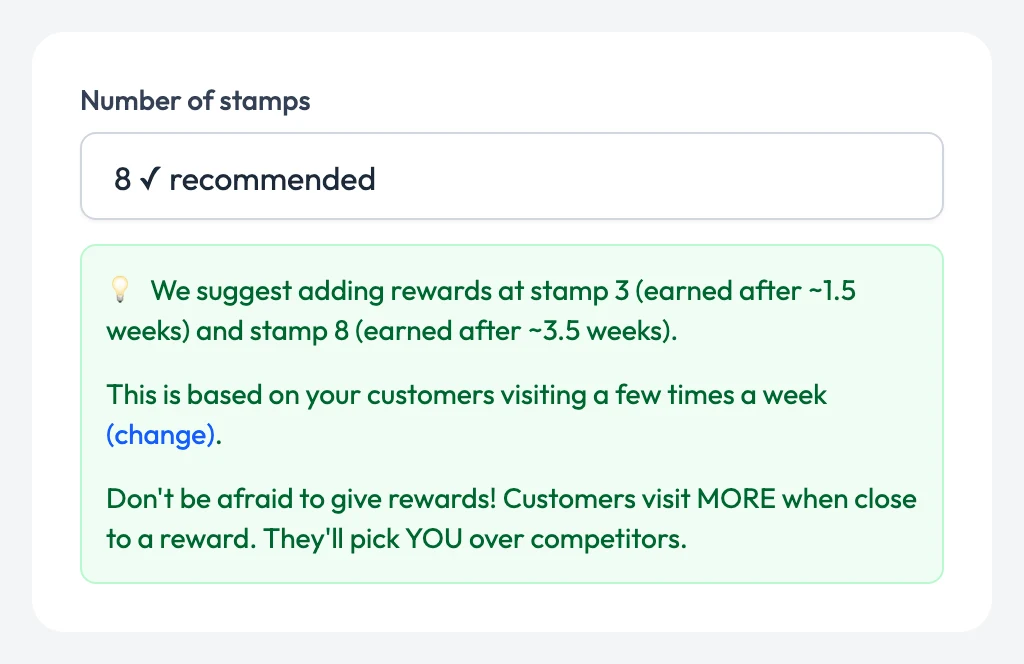
Behind the suggestion are four tiers built into the editor:
| Days between visits | Suggested stamps |
|---|---|
| 4 or fewer | 8 |
| 5 to 10 | 6 |
| 11 to 21 | 5 |
| More than 21 | 4 |
The editor also judges the card by when the first reward arrives, not the last one. Up to 8 weeks, or up to the time the suggested card itself would take, the tip stays green. Beyond that, up to 16 weeks, it turns yellow, and past 16 weeks it turns red. Both warnings carry the same line: “Most customers give up after 4 months.”
Why do weeks matter more than the number of stamps?
The longer it takes to earn a reward, the fewer customers ever reach it. A café card with 10 stamps and a salon card with 10 stamps look identical, but one pays out in three weeks and the other in most of a year. By month four, plenty of people have simply stopped carrying the card around, or stopped thinking about it.
We measured this in our loyalty card completion rate study: 23,296 stamps from 10,690 customers at 1,013 small businesses between January and May 2026. A “completion” is a customer reaching the last stamp of a card.
| Weeks a regular waits for the reward | Completion rate |
|---|---|
| 2–4 weeks | 11.4% |
| 4–8 weeks | 9.3% |
| 8–16 weeks | 4.0% |
| 16–32 weeks | 1.2% |
| More than 32 weeks | 0.8% |
Up to 8 weeks, about one card in ten gets finished. Between 8 and 16 weeks it falls to 4%, less than half. After 16 weeks it almost disappears. Those last two rows are a minimum, though: the study covered four months, so some long cards were still in progress when it ended. The drop from 11.4% to 4.0% happens well inside that window. The same pattern shows up by type of business: cards at businesses with near-daily visits were completed 10.2% of the time, cards at businesses with monthly visits 1.1%.
Most owners don’t do this arithmetic. Of the cards in our data whose owner told us how often customers visit, 56% needed more than 8 weeks of visits to complete. The full tables are on the loyalty card completion rate benchmark, which also has a calculator for your own card.
Is 10 stamps too many?
Ten stamps works when regulars come every few days. At weekly visits it’s a 10-week card, already past the 8-week line; at monthly visits it’s ten months. Ten is a common number on printed punch cards, and it often gets copied without the arithmetic. One coffee shop owner on the Shopify Community described their setup as “1 free drink after the purchase of 10”. For a café, that’s reasonable.
The problem is businesses that copy the café number. In our data, 118 of the 514 active cards at monthly-visit businesses had 10 stamps. At one visit a month, the first reward is ten months away.
Here is what FaveCard’s editor shows a barber who picks 10 stamps after saying clients visit every 3–6 weeks:
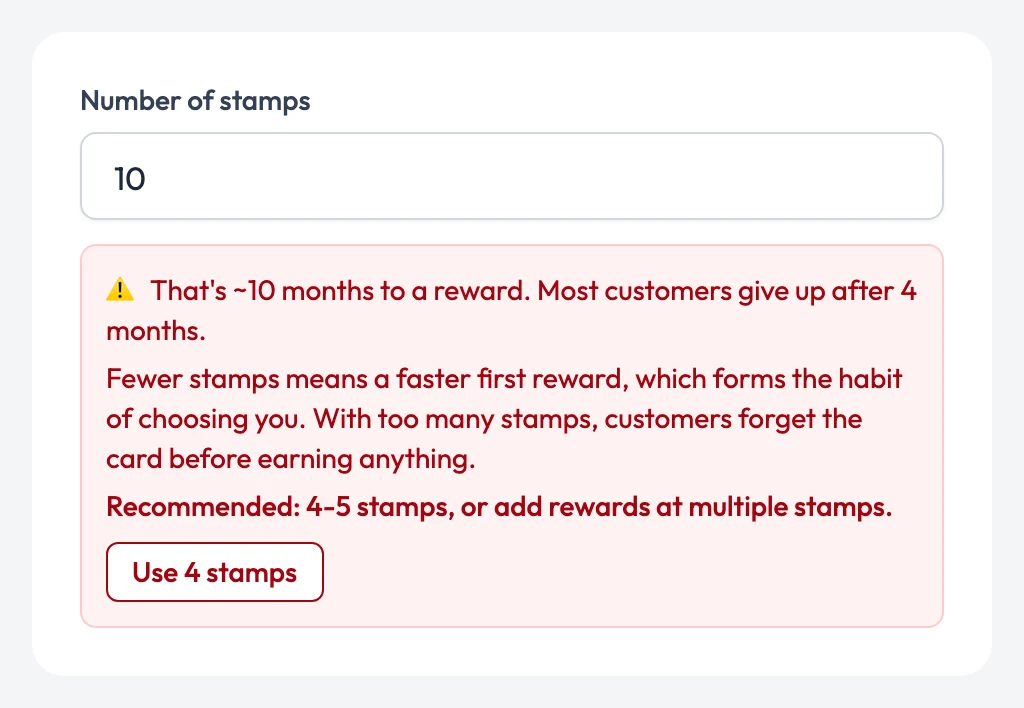
The stamp-count view of the same data points the same way: 5-stamp cards were completed 27.9% of the time and 10-stamp cards 5.6%. Much of that gap is the wait-time effect again, and the 5-stamp figure comes from only 8 loyalty programs, so read it as a direction, not a precise number.
How many coffees before a free one?
Eight, if your regulars come in a few times a week. At one visit every 3 days, 8 stamps is a free coffee in about 3.5 weeks, well inside the 8-week line. A café whose regulars come daily can use 10 and still pay out in under two weeks.
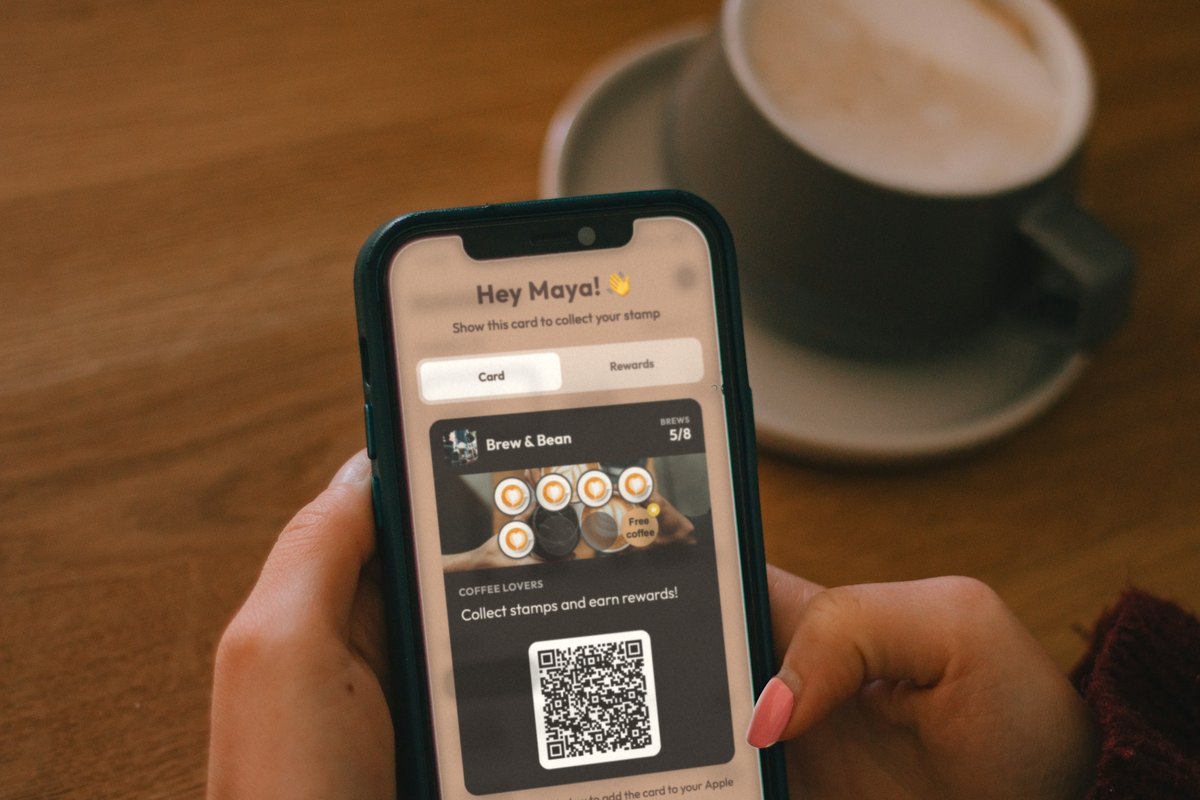
To keep people going between the first stamp and the last, add a small reward partway. On an 8-stamp card the editor suggests the first one at stamp 3, which a regular reaches in about a week and a half. Brew & Bean, the example café below, gives a free cookie at stamp 3 and a free coffee at stamp 8.
If you’re choosing between 8 and 10, go with the one you can afford to give away more often. The coffee shop loyalty program guide covers what the reward itself should be.
How many visits for a free haircut?
Four at most, and put a smaller reward at the second visit. A client who comes every 4 weeks needs 16 weeks to fill a 4-stamp card. That’s right at the four months after which the editor warns that most customers give up, and 4 is the lowest count the rule ever suggests.
Barbershops usually start from “10th cut free”, the classic offer, and it’s a ten-month wait at monthly visits. Cutting to 4 stamps helps, but the first payoff is still four months away. The fix is to make the first reward come earlier, not only to cut stamps:
- 4 stamps: a free beard trim at visit 2, a free cut at visit 4
- at 4-week visits: the trim after about 8 weeks, the cut after about 16
- at 6-week visits: the trim after 12 weeks, the cut after 24. The early reward matters even more here
This is also what FaveCard’s editor suggests for a 4-stamp card at “Every 3-6 weeks”: a reward at stamp 2 (earned after about 2 months) and at stamp 4 (about 4 months). The same barbershop card at 4, 6 and 8 stamps shows how far away the free cut feels after two visits:
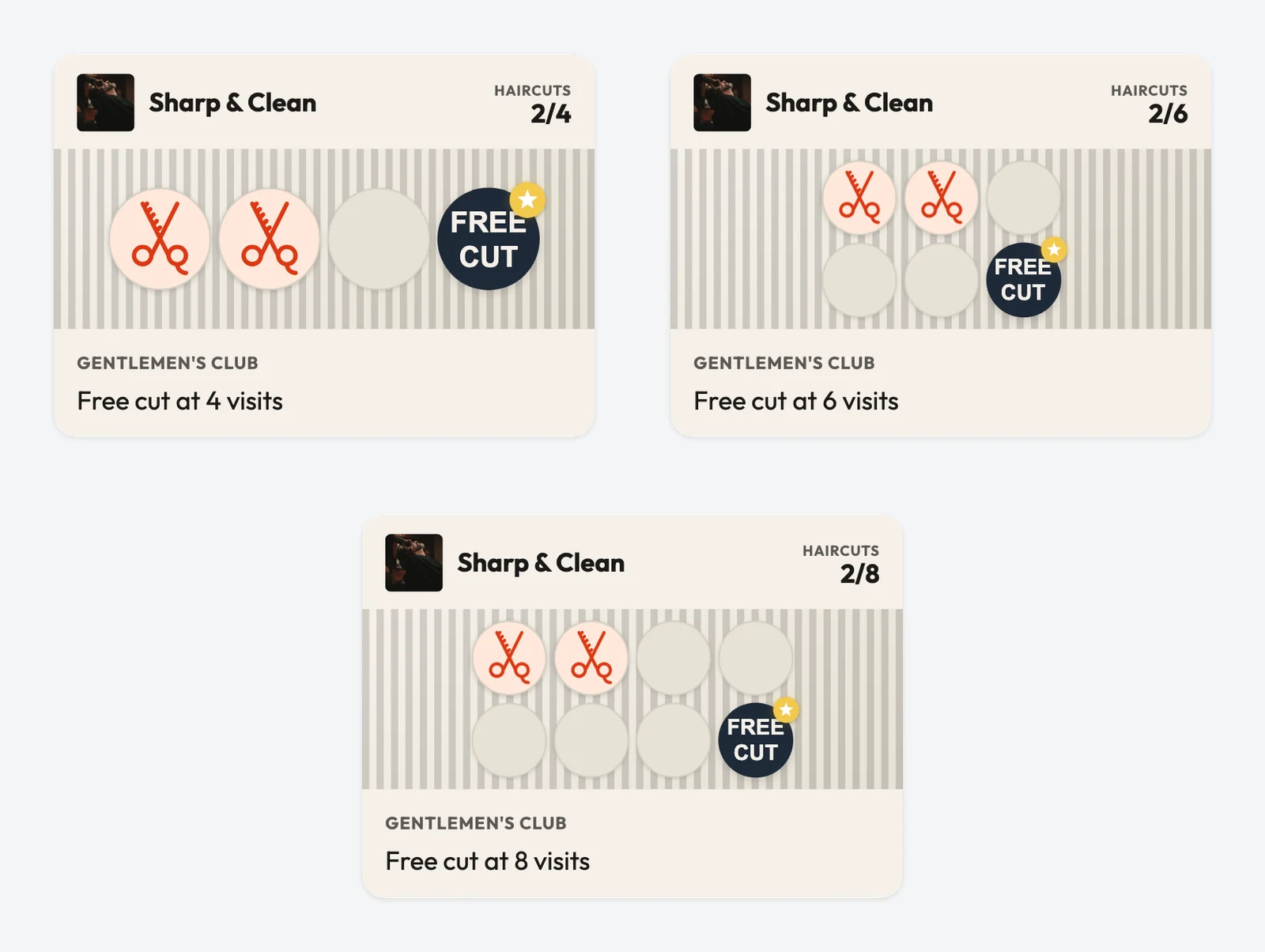
Two stamps out of four looks like halfway there. Two out of eight looks like the start. The barbershop loyalty program guide has reward ideas that suit a short card.
How many stamps for a nail salon?
Five, with a small reward at the second visit. Nail clients who come every 2 to 3 weeks fill a 5-stamp card in 10 to 15 weeks. That’s past the 8-week line, so the earlier reward does most of the work: at stamp 2 it arrives after 4 to 6 weeks.
Compare that with a plan a nail tech posted on SalonGeek: “25% off 5th and the 10th free”. At a visit every 2 weeks, 25% off comes after 10 weeks and the free manicure after 20. At every 3 weeks, the free one takes 30 weeks. A 5-stamp card with a small freebie at visit 2 pays out months sooner. More ideas are in the nail salon loyalty program guide.
How many stamps for a restaurant?
Six, if your regulars come about once a week. Weekly visits and 6 stamps means a reward in 6 weeks. If your typical guest comes back every 10 days, the same card takes about 8.5 weeks, which is still the suggestion for that frequency.
Owners who set the bar too high often lower it later. A taco shop owner on the Square Community started with “spend $100 and get a free taco”. A few replies later he wrote: “Now I have taken the lead from El Pollo Loco and it’s simply ‘Spend $50 and get $5 off.’” He halved the distance to the first reward. For restaurant reward ideas, see the restaurant loyalty program guide.
When should you put two rewards on one card?
Put a second, smaller reward on the card whenever the main reward is more than about 8 weeks away. For a barber, a nail salon or any business with visits two or more weeks apart, that means almost always.
FaveCard’s editor suggests where to put it. The first extra reward goes at about 30% of the card, rounded up. Cards with 8 or more stamps get a suggestion at about 60% too, and 10-stamp cards one at about 80%:
| Stamps on the card | Suggested extra rewards at stamp |
|---|---|
| 4, 5 or 6 | 2 |
| 7 | 3 |
| 8 | 3 and 5 |
| 9 | 3 and 6 |
| 10 | 3, 6 and 8 |
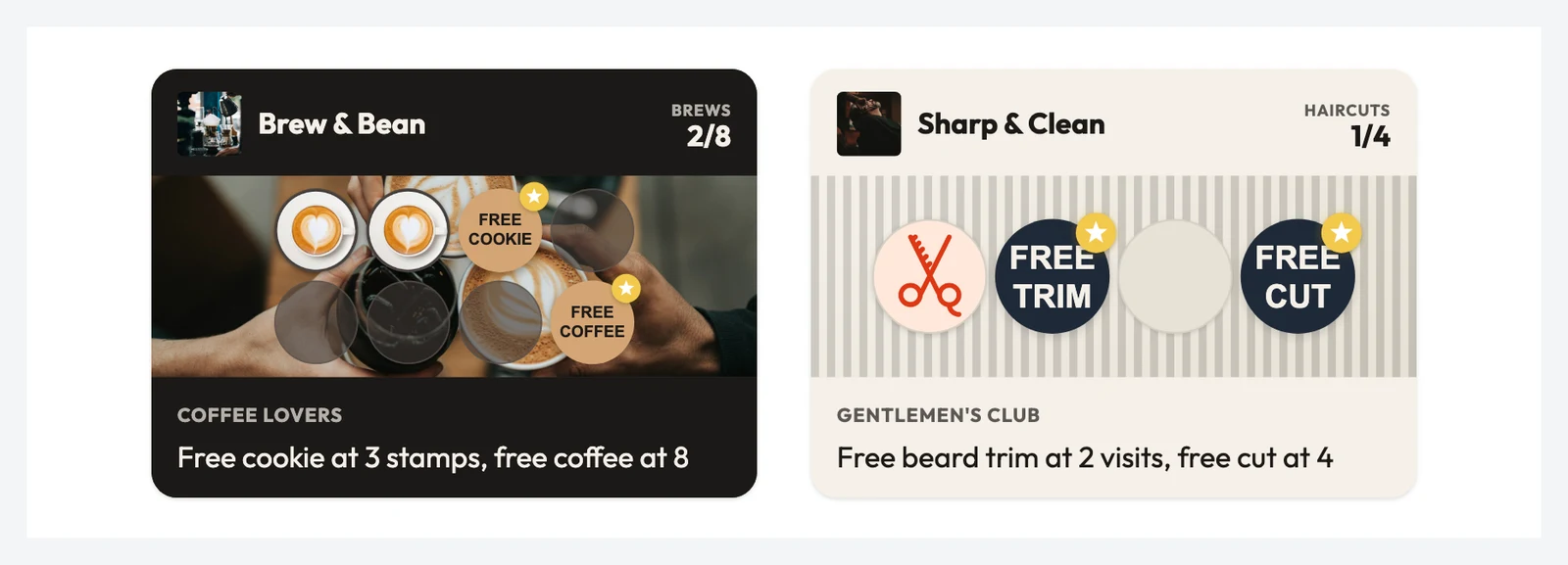
Keep the early reward small, and make it an item or a service rather than a percentage: a size upgrade, a cookie, a beard trim, nail art on one finger. The editor’s tip is blunt about it: free rewards “work better than discounts.” Multiple rewards on one card are included on every FaveCard plan, including Free. Our punch card ideas post has reward pairs for different businesses.
Can a loyalty card have too few stamps?
Yes, when the reward comes so fast that it eats your margin. If a card pays out within a week, FaveCard’s editor shows a blue note instead of a warning: “Your customers will earn a reward in about [time]. Make sure the reward cost is OK to give that often!”
On a 5-stamp card, a daily regular pays for five drinks and gets the next one free. One drink in six is on you, about 17% off everything your best customers order. The 8-week line tells you when a card is too long; your margin tells you when it’s too short. In our data, the cards with the best completion rates paid out in 2 to 8 weeks.
Should you give a free stamp when someone signs up?
A head start helps. In a 2006 study, Joseph Nunes and Xavier Drèze found that people given a 10-step task with 2 steps already done were more likely to finish than people given an empty 8-step task, even though both had 8 steps left (The Endowed Progress Effect, Journal of Consumer Research).
FaveCard lets you give 0, 1 or 2 stamps to every new customer the moment they save the card. Starter stamps count toward the total: a 6-stamp card with 1 starter stamp takes 5 visits. Rewards can only sit on stamps after the starter ones.
What if my card already has too many stamps?
Make a new, shorter card and retire the old one. Don’t try to rescue a ten-month card with a bigger reward; the wait is the problem.
If an active card takes more than 16 weeks to complete at your customers’ usual visit frequency, the FaveCard dashboard shows this:
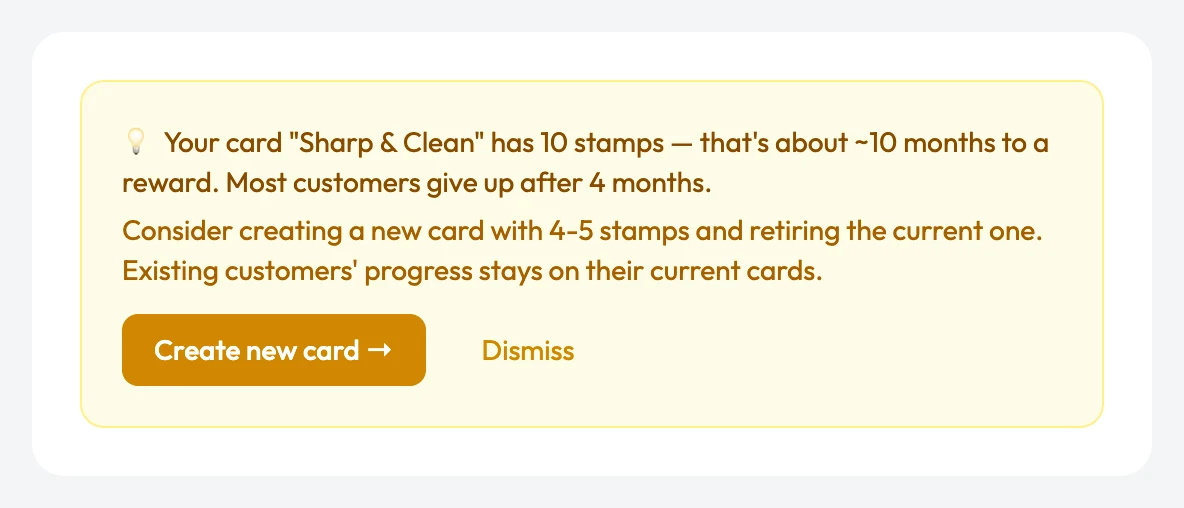
Customers who already have stamps keep their progress on the old card, so nobody loses anything. New customers get the shorter card. For the design side of a new card, see loyalty stamp card and the loyalty cards feature page.
How to set this up in FaveCard
- Tell FaveCard how often your customers visit. It’s one of the first questions when you sign up, and you can change it in Settings.
- Create a card. The “Number of stamps” field opens on the suggested count and marks it ”✓ recommended”.
- Add rewards. With fewer than two rewards on the card, the editor shows where an early one would go and how many weeks each takes.
- Choose 0–2 starter stamps if you want new customers to start with a head start.
The card editor, multiple rewards and starter stamps are on the Free plan. Adding the card to Apple Wallet and Google Wallet, and your own logo, come with a paid plan; see pricing for what each plan includes.
The completion figures come from FaveCard platform data (20 January – 18 May 2026) and describe cards on FaveCard, not the whole industry. Rates for cards over 16 weeks are floors, because the observation window was four months. Method and caveats are in the full study.
Frequently Asked Questions
How many stamps should a loyalty card have?
Use the number of stamps a regular can collect in about 8 weeks. Multiply the usual days between visits by the number of stamps and divide by 7 to get the weeks to the reward. FaveCard's card editor suggests 8 stamps for customers who come every 1–4 days, 6 for every 5–10 days, 5 for every 11–21 days and 4 for anything less often.
How many punches should a punch card have?
The same rule applies to paper punch cards: pick the number of punches a regular can fill in about 8 weeks. A coffee shop whose regulars come every few days can use 8 to 10 punches. A barbershop whose clients come once a month should use 4 and add a smaller reward at the second punch.
Is 10 stamps too many for a loyalty card?
Yes, unless your regulars come every few days. Ten stamps at a café where regulars come every 2 days is a 3-week card. At weekly visits the same card takes 10 weeks, past the 8-week line; at monthly visits it takes 10 months. In our data, cards that took 8–16 weeks were completed less than half as often as cards that took 4–8 weeks.
How many haircuts before a free one?
For clients who come every 3 to 6 weeks, 4 haircuts is the most we'd suggest, and even that is about 4 months at 4-week visits and 6 months at 6-week visits. Add a smaller reward, such as a free beard trim, at the second visit so the first payoff arrives in 8 to 12 weeks.
Can a loyalty card have more than one reward?
Yes. You can put a small reward partway through the card and the main reward at the end, for example a free cookie at stamp 3 and a free coffee at stamp 8. FaveCard lets you place rewards on any stamp, on every plan including Free, and its editor suggests the first extra reward at about 30% of the card.
Can I change the number of stamps after customers have the card?
On FaveCard you create a new card with the new stamp count and retire the old one. Customers who already collected stamps keep their progress on the card they have. Plan the count before launch so you don't have to switch.