




Salon Promotion Ideas for Hair and Beauty Salons
Salon promotion ideas that bring in new clients without cutting prices: first-visit extras, quiet-morning offers, thank-yous and a 12-month calendar.
In short
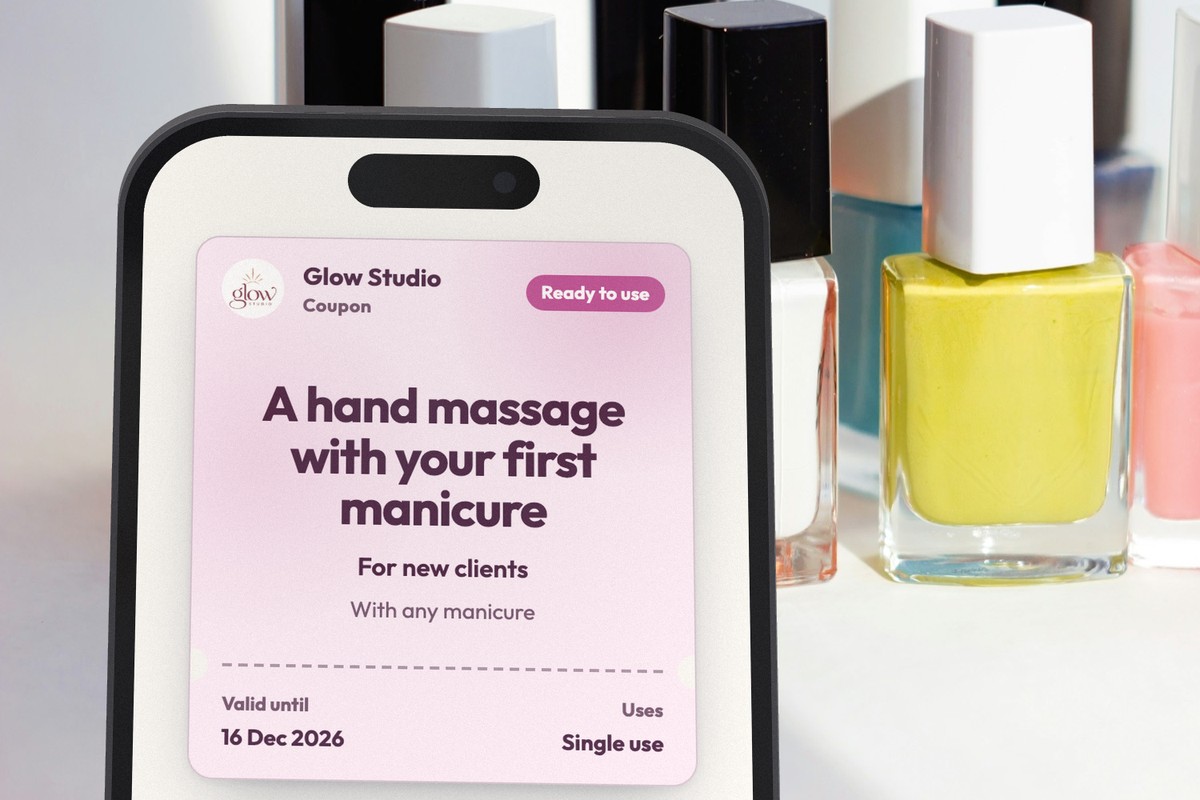
The salon promotions that work best give something small and free with a service clients already book, aimed at one goal at a time: a hand massage with a first manicure for new clients, a free extra on Tuesday to Thursday mornings for quiet hours, and a personal thank-you for clients who recommend you. Limit welcome offers to new clients, one per person, with an end date and a cap for each place you share them, and offer a short stamp card on the first visit. A coupon brings new clients in and invites past ones back. Your card rewards regulars.
Last updated: November 2026
A salon promotion has two jobs: get a new client into the chair, then give them a reason to book again. Money off helps with the first and hurts the second: the next appointment costs more.
Instead, the seven hair salon promotion ideas below give something free with a service clients already book. You’ll find versions for barbershops, nail and brow studios and beauty salons, then a worked example and a 12-month calendar.
What promotions work best for a hair or beauty salon?
The salon promotions that work best give something small and free with a service clients already book, aimed at one goal at a time. A hand massage with a first manicure brings in a new client and leaves your price list alone; a percentage off changes the price clients remember.
| Goal (ideas below) | What to offer | Example |
|---|---|---|
| New clients (1, 2) | A free extra with a first service | A hand massage with a first manicure |
| Quiet weekday mornings (3) | A free extra with any service, in set hours | Free brow shaping, Tuesday to Thursday, 10 am to 1 pm |
| Thank-yous (4, 5, 6) | Something free at the next visit, for one person | A free brow tint with your next treatment |
| Regulars (7) | A short stamp card from the first visit | Four stamps for hair clients |
A first-visit extra brings new clients in; a short stamp card brings them back. Start with whichever your salon lacks.
How do you get new clients to try your salon without discounting?
To get new clients without discounting, offer a small free extra with the service they would book anyway, for new clients only, with an end date. It costs a few minutes of a stylist’s time, and the haircut’s price stays where it is. Our guide on how to get new customers covers other trades.
1. A welcome extra with a first appointment
Rows 1 and 2 are FaveCard’s ready-made “New customers” ideas, as of October 2026; row 3 is one you could make.
| Trade | Welcome extra | Valid for |
|---|---|---|
| Nail studio or beauty salon | A hand massage with your first manicure | 45 days after a client gets it |
| Hair salon or barbershop | A free scalp massage with your first haircut | 45 days |
| Hair salon that also does brows | A brow tidy with a first color appointment | Your choice |
- Set: new clients only, single use, one per person, with an end date. Make one link for each place: an Instagram post, your window and your Google Business Profile. Google says its Offer posts can include “a description, photo, video, coupon code, link, and terms and conditions”.
- Say: “New here? Your first manicure comes with a hand massage.” In the post and on the window.
- Watch: how many people used it and what they booked besides the free extra. Many refused attempts: check which of your places regulars see before you move the link.
In FaveCard (Business): A coupon for new customers only is for people who haven’t had a card or a coupon from you yet. We check their email.
FaveCard marks both welcome ideas “Works best: in your Instagram bio or story, or in a Facebook post”. For more on Instagram and Facebook, see our salon marketing ideas.
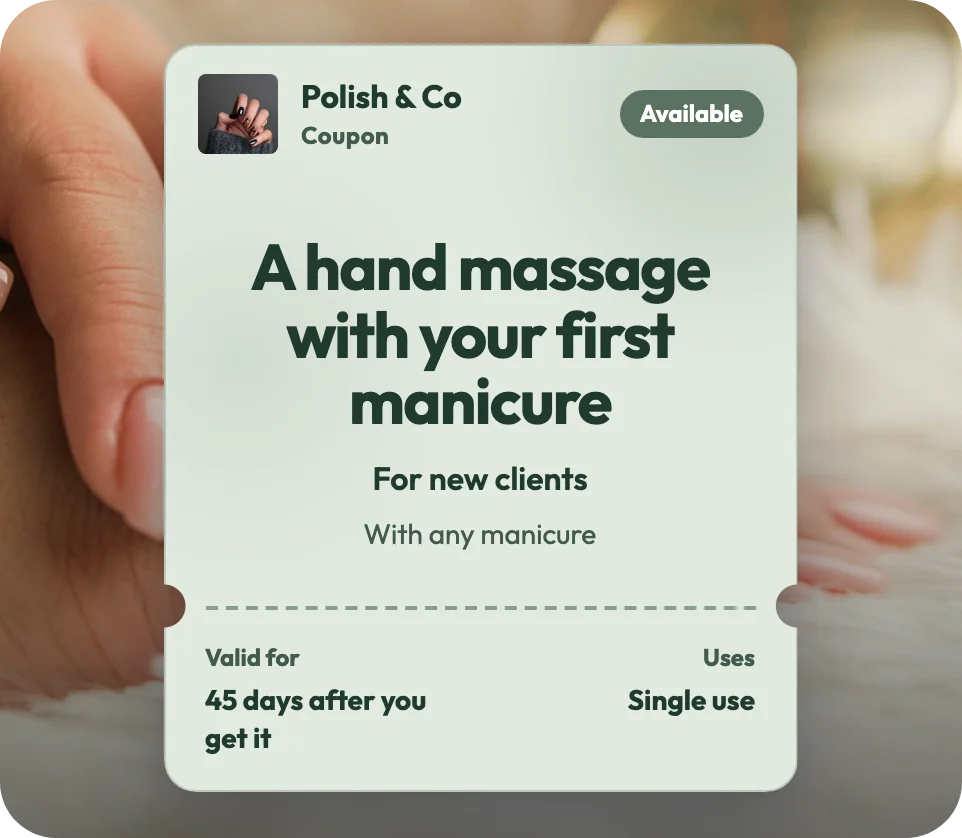
A FaveCard coupon for new clients, before anyone gets it. The nail studio is an example.
2. A capped link at the business next door
A bridal shop, gym or yoga studio nearby hands its clients your welcome extra.
- Set: a link for that partner, a cap such as 20, and a last day to get it at the end of the season. Print its QR code for the partner’s desk.
- Say (to the partner): “Your members get a free hand massage with their first manicure here. Could this sit on your desk? I’ll put yours at our reception.”
- Watch: the link’s count, such as “12 given, 8 of 20 left”. At “All 20 given”, nobody new can get it there; decide whether the partner gets a new link.
How do you fill quiet weekday mornings at a salon?
To fill quiet weekday mornings at a salon, offer a free extra that works only in those hours, such as Tuesday to Thursday, 10 am to 1 pm. Clients who can choose their time move into the empty slots, and your Saturdays stay as they are.
3. A quiet-morning extra, open to everyone
FaveCard’s ready-made quiet-hours ideas for beauty and hair use that window, as of October 2026, and go to everyone with the link by default. All four are ones you could make.
| Trade | Quiet-morning extra |
|---|---|
| Nail and brow studio | Free brow shaping with any treatment |
| Nail studio | Free nail art on two nails with any gel set |
| Barbershop | A hot towel finish with any cut |
| Hair salon | A deep conditioning treatment with any color |
- Set: the days and hours, open to everyone, valid 30 days after a client gets it. If clients pay at the end of a booked treatment, end the hours after your last morning appointment finishes.
- Say: the hours in the title, “Free brow shaping, Tuesday to Thursday mornings”, so nobody books a Saturday expecting it.
- Watch: morning bookings against comparable weeks before, not only the coupon’s uses.
In FaveCard (Business): choose the days and hours a coupon works. Outside them, it can’t be used: the FaveCard app shows “This coupon can’t be used at this time.”
How would a nail and brow studio run a quiet-morning coupon?
A nail and brow studio can fill empty Tuesday to Thursday mornings with free brow shaping on any treatment. The studio shares the coupon through three capped links. At reception, staff book the client’s next visit and offer a stamp card. Glow Studio (two technicians) and every number in this worked example are made up to show how it works, not real results.
The empty appointments. Tuesday to Thursday, 10 am to 1 pm, two chairs, one-hour appointments: 18 slots a week, about 8 usually empty. The goal: fill half of them for four weeks, around 16 bookings.
The extra time. About 10 minutes of brow shaping per use, on a treatment the client pays for.
The coupon settings.
| Setting | Glow Studio’s choice |
|---|---|
| Offer | Free brow shaping, with any treatment |
| Days and hours | Tuesday to Thursday, 10:00 to 13:00; the last appointment ends by 12:50, so clients pay inside the hours |
| Who can get it | Everyone |
| Valid for | 30 days after a client gets it, single use, one per person |
| Links and caps | Instagram, up to 20 · At checkout or reception, up to 10 · Partner business (the yoga studio downstairs), up to 10 |
| Last day to get it | Four weeks after the start, on every link |
The caps add up to 40, so at most 40 people can get the coupon: under seven hours of technician time in all, known before the first post. People can get it for four weeks, and the last coupons stay valid for 30 days after that.
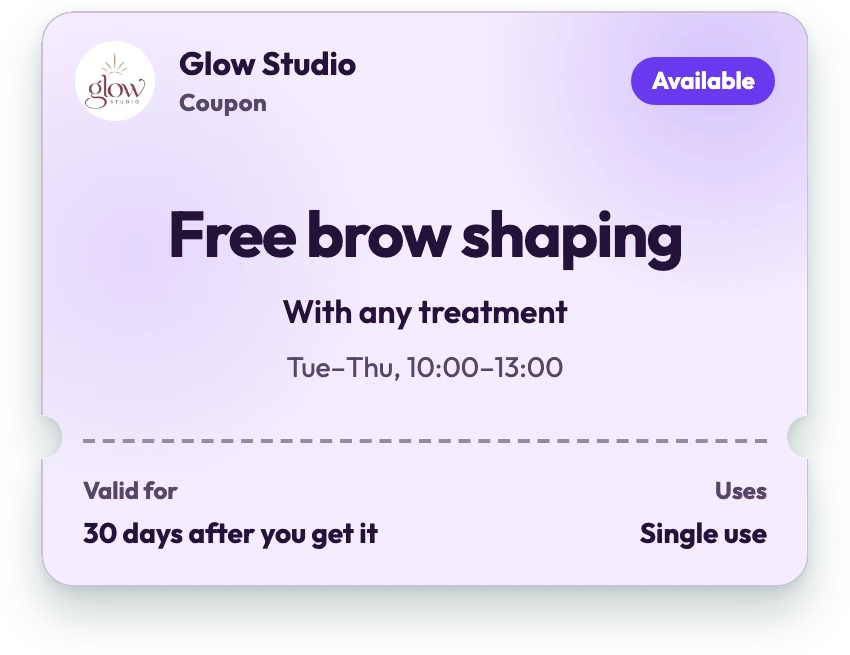
The example’s coupon before anyone gets it. Glow Studio is a sample business.
Where it’s shared. The Instagram link goes in a post and the bio, the reception QR code by the till, and the partner QR code on the yoga studio’s desk, with its flyer at Glow Studio in return.
The booking message. The post reads: “Tuesday to Thursday mornings are our calm hours. Book a morning appointment that ends by 12:50 and your brow shaping is on us. Coupon at the link in our bio, one per person.” The booking confirmation adds: “Bring your coupon on your phone or in your Wallet.”
At reception.
- On arrival: “Morning! Got the brow coupon? Great, we’ll do your brows after your nails.”
- At the end, staff scan the coupon in the FaveCard app, tick “Buys 1 × treatment” and tap Mark as used.
- Then: “Shall we book your next set? Mornings are calmer, if that suits you.”
The rebooking follow-up. Nail clients return every two to three weeks, so the next set is booked before they leave, on a morning if it suits. The coupon was single use, so the stamp card takes over: staff show your stamp card’s QR code in the FaveCard app so they can join.
What to check at two weeks.
- Instagram reads “All 20 given” while the coupon shows few used: clients may not have booked yet (it’s valid 30 days), or can’t find a slot. Put the booking link in the post.
- The partner link shows “2 given, 8 of 10 left”: that counts coupons given there, not people who saw it. Ask the partner where the QR code hangs and whether staff mention it, and fix that for a week. That week is about the placement only: a low count is not a reason to drop the partner. Decide on its link with the rest, once its coupons have had their 30 days: keep it if they are used and pay for the free extras.
- Morning bookings against comparable weeks before: that, not the coupon count, shows whether mornings filled.
- The decision, with assumed numbers: say morning bookings are up 6 from comparable weeks before, while the rest of the week held steady, and the coupon shows 9 used. That’s 6 extra paid treatments for 90 minutes of brow shaping, because every use costs about 10 minutes, including uses by clients who would have booked anyway. If what you make on those 6 treatments, after costs, beats what 90 minutes of a technician’s time costs you, keep it going, and decide when the last day to get it has passed and the coupons have had their 30 days. If bookings are flat by then, or the extra treatments don’t cover the technician’s time, stop. A two-week comparison points a direction; it doesn’t prove one.
How do you thank clients who recommend you, or say sorry?
Thank a client who recommends you, or who waited too long, with something free at their next visit, given to that one person. Keep it apart from reviews: Google’s content policy bars “incentives – such as payment, discounts, free goods and/or services - in exchange for posting any review” (see our guide on incentives for Google reviews).
4. Bring a friend, then thank the client who sent them
- Set: the friend gets your welcome extra (idea 1). After their visit, make a personal link, set to Only this person, for the client who sent them: a free brow tint with their next treatment, or a beard trim with their next cut.
- Say: “Thank you for sending [friend’s name] to us. Your next brow tint is on us.”
- Watch: a friend who already has your card, or had a coupon from you, can’t get the welcome extra. Thank the client anyway.
5. Sorry for the wait
- Set: a personal link, no hours, an end date far enough out to book.
- Say: “I’m sorry we kept you waiting today. Your next hand massage is on us.” Show the QR code, or send the link.
- Watch: how often you give it. One a week means the schedule needs fixing.
6. A December thank-you that works in January
- Set: a coupon for existing customers, valid between two dates, such as 4 January to 28 February, with its QR code at reception through December.
- Say: “Thank you for this year. Here’s a treat for your first visit in the new year.”
- Watch: how many are used in January, when many salons have room.
In FaveCard (Business): a personal link gives the coupon to one person, once. Choose Only this person and add their email, and it works only with that email.
Won’t new-client offers upset your regulars?
New-client offers upset regulars when regulars get nothing of their own. Pair every welcome extra with something only regulars get: a short stamp card that rewards every visit, and now and then a treat like idea 6.
7. A short stamp card, started on the first visit
- Set: four stamps for hair clients who come every six to ten weeks, five for nail clients who come every two to three.
- Say: “Want our card? Every visit counts toward a free brow tint.”
- Watch: how many cards get finished. In our study of 23,296 loyalty stamps from 1,013 small businesses (January to May 2026), businesses whose customers visit about monthly finished 1.1% of their cards, against 10.2% for daily-visit businesses. See our guides to a hair salon loyalty program and a salon loyalty program.
What are good monthly promotion ideas for a salon?
Good monthly promotion ideas for a salon follow the calendar: a weekday-morning extra in the months clients book less, a bring-a-friend offer on dates when people book together (Galentine’s, Mother’s Day), and a partner offer around events like prom season or weddings.
| Month | Promotion | Goal |
|---|---|---|
| January | The weekday-morning extra (idea 3); December’s thank-yous start working | Quiet hours |
| February | Galentine’s (Saturday 13 February 2027) and Valentine’s: bring a friend (idea 4) | New clients |
| March | A fresh Google Offer post with the welcome extra; a treat for regulars around International Women’s Day, 8 March | New clients, regulars |
| April | Prom season (US): a capped link at a formalwear shop (idea 2) | New clients |
| May | Mother’s Day (9 May 2027, US and Australia): a client brings their mom, who gets the welcome extra | New clients |
| June | Weddings: a capped link at a bridal shop. Barbers: a client brings their dad for Father’s Day (20 June 2027, US) | New clients |
| July | Summer holidays: move the quiet-morning hours to last July’s emptiest days | Quiet hours |
| August | Back to school (US): mornings free up for many parents; restart the quiet-morning extra | Quiet hours |
| September | Back to routine (Europe): a capped link at a gym or yoga studio | New clients |
| October | Halloween: free nail art on two nails with any gel set, Tuesday to Thursday mornings | Quiet hours |
| November | Small Business Saturday (US, 27 November 2027): the welcome extra in your window | New clients |
| December | Thank-yous for regulars, valid 4 January to 28 February (idea 6) | Thank-you |
How do you know a salon promotion worked?
A salon promotion worked when what you make on the extra bookings, after costs, beats what the free extras cost you in technician time. Count the bookings in the offer’s hours, or from the clients it was for, and compare them with similar weeks before. The coupon’s counts show how many people got and used it, and where they got it: how far it spread, not whether it filled chairs.
Your booking system shows the bookings and what clients spent; the worked example shows the sum.
In FaveCard (Business): each coupon shows how many were given and used, and the kind of place each person got theirs from. With a cap on a link, you see how many people got it there, like “24 given – 6 of 30 left”.
How to read refused attempts. A refused attempt is someone trying to get a “New customers only” coupon with an email address that already has your card or a coupon from you, and one person can try more than once. FaveCard counts them for the whole coupon, not per link. So when there are many, check which of your places regulars see before you move a link. To treat regulars too, give them their own coupon, like idea 6.
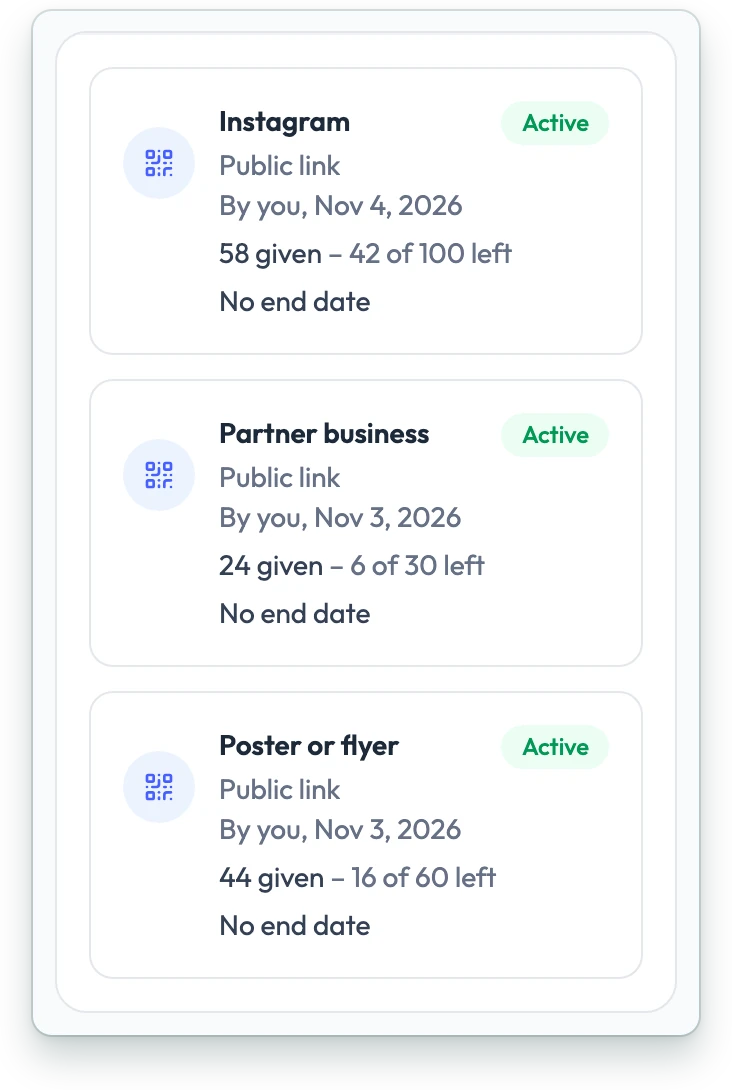
A coupon’s links in FaveCard, with sample data: one link per place, each with its own cap and count.
How do you run salon promotions in FaveCard?
FaveCard is a digital loyalty card for cafés, salons and other local businesses. Here is how it runs these ideas, as of October 2026. A FaveCard coupon is one specific offer with an end date, such as a discount or a free item. A local business shares it by link or QR code, and its staff use it at the counter.
- Sign up, then open the FaveCard app at reception. Download or update it on each phone your team scans with, and sign in. Open it once, then you’ll find Coupons in FaveCard.
- Pick a salon idea, then choose who and when. Start from the beauty or hair ideas, or from scratch.
- Share it. One link and QR code per place, with a cap if you want one, or a personal link for one client.
- No app for your clients. Customers get the coupon on a web page with their email and first name, no app needed, and can add it to Apple Wallet or Google Wallet. They confirm their email first.
- Staff scan it and tap Mark as used. Staff tick any checks you added, like “Buys 1 × manicure”. Each coupon belongs to one person, so a screenshot doesn’t give an extra use.
- Offer the card. When clients come in, staff show your stamp card’s QR code in the FaveCard app so they can join.
To put a quiet-morning offer on the cards your regulars already carry, use Campaigns instead. See also how FaveCard works for salons.
Coupons are part of the Business plan, with no monthly limit. New accounts get premium tools free for the first 30 days, coupons included. Coupons your customers already have keep working on every plan. See the Business plan on our pricing page.
Where to start
Start with one coupon for the problem you have now: empty weekday mornings, or too few new clients. Give it a capped link for each place and a last day four weeks out. At two weeks, do the sum from the worked example as a check. Decide once the coupons have had their full time to be used (30 days for the morning coupon, 45 for the welcome one): keep it only if what you make on the extra bookings, after costs, beats what the free extras cost you in technician time. More for barbershops and nail studios, and for other trades in our 24 promotion ideas for small business.
Frequently Asked Questions
What is a good new client offer for a hair salon?
A small free extra with the first appointment, for new clients only, with an end date: a hand massage with a first manicure at a nail studio, or a scalp massage with a first haircut at a barbershop. The client pays the usual price for the service, so your prices stay where they are. FaveCard's ready-made welcome ideas for salons stay valid for 45 days, which leaves time to book.
How do I get more salon clients on weekday mornings?
Offer a free extra that works only in your quiet weekday hours, such as free brow shaping with any treatment, Tuesday to Thursday, 10 am to 1 pm, and put the hours in the offer's name. Open it to new and regular clients alike. If clients pay at the end of a booked treatment, end the hours after your last morning appointment finishes.
Should a salon offer discounts?
Not as a standing promotion. A percentage off lowers the price clients remember, and deep discounts sold to anyone draw bargain hunters: in a Rice University survey of 150 Groupon merchants, reported in October 2010, 40% said they wouldn't run another deal, though spas and salons fared better than restaurants. A free extra with a service, like a hand massage with a manicure, keeps your prices as they are.
How do I reward clients who refer friends?
Give the friend your first-visit extra. Once the friend has been in, thank the client who sent them with something free at their next visit, given to them alone, such as a free brow tint with their next treatment. Keep both separate from reviews.
Can I give clients something for a Google review?
No. Google's policy doesn't allow merchants to offer incentives, such as payment, discounts, free goods or services, in exchange for posting a review. Ask every client for a review the same way, and keep your offers for first visits, quiet hours and recommendations.
Do clients need an app to get a FaveCard coupon?
No. Customers get the coupon on a web page with their email and first name, no app needed, and can add it to Apple Wallet or Google Wallet. They confirm their email first. At reception, staff scan it in the FaveCard app and tap Mark as used.
Which FaveCard plan includes coupons?
Coupons are part of the Business plan, with no monthly limit. New accounts get premium tools free for the first 30 days, coupons included. Coupons your customers already have keep working on every plan.