



How to Get New Customers for a Local Business
How cafés, salons, barbers, bakeries and gyms get new customers: where people find you, a first-visit offer for each trade, and how to earn a second visit.
In short
A local business gets new customers by being easy to find where people nearby look (Google Maps, its own window, the business next door). Give first-timers one small, free reason to try you, tied to a purchase. Limit that offer to new customers, one per person, with an end date, and to your quiet hours if you like. Then offer your loyalty card on the first visit. A coupon brings new customers in and invites past ones back. Your card rewards regulars.
Last updated: November 2026
Most advice on how to get new customers is written for companies with a sales team. A café, a salon or a barbershop gets them another way. Someone walks past, looks you up on Google Maps or hears your name from a friend, and then decides whether today is the day to try you.
This guide covers what you control in that moment, with examples from cafés, restaurants, bakeries, salons, barbershops and gyms.
The short answer:
- Be easy to find where people choose: your Google Business Profile, your window and the business next door.
- Give people new to you one small, free reason to try you, tied to something they buy anyway: a pastry with a first coffee, a dessert with a first meal.
- Put limits on it. New customers only, one per person, an end date. Quiet hours only, if you want.
- Plan the second visit before the first one ends. Offer your loyalty card at the counter.
How do you get new customers for a local business?
A local business gets new customers by being easy to find where nearby people make their choice, and by giving them one small reason to try it. For a café, a salon or a barbershop, those places are Google Maps, the street outside and the people and businesses around you. Paid ads come after these, not before.
| Where people find you | What it does | What it costs you |
|---|---|---|
| Your Google Business Profile | Answers “near me” searches with your hours, photos and reviews | Your time |
| Your window, sidewalk sign and counter | Turns people walking past into a first visit | A printed sign |
| A business next door | Puts you in front of its customers, with its trust | A small extra for each person who comes |
| Your regulars’ friends | Brings people who already trust you | A thank-you for each friend who comes |
| Paid local ads | Reaches people who have never passed you | A budget per click or view |
Your Google profile can carry an offer too. Google’s own help page says an Offer post can include “a description, photo, video, coupon code, link, and terms and conditions”, so a first-visit offer can sit where people already look you up.
What you say in each of these places is usually an offer.
What’s a good first-visit offer?
A good first-visit offer is something small and free that goes with what people already buy, such as a pastry with a first coffee. The customer still pays for the main thing, and your prices stay as they are. A percentage off the whole bill lowers your price and tells people it’s negotiable.
A salon owner put it plainly on the UK forum SalonGeek in October 2010: “It will cost me a whole lot less to give away a freebie than to offer a discount.”
Here is one first-visit offer per kind of business. All eight are FaveCard’s ready-made “New customers” coupon ideas, as of November 2026, so they’re for new customers only. The last column shows how many days each stays valid after someone gets it:
| Business | First-visit offer | Valid for |
|---|---|---|
| Café | A pastry with your first coffee | 30 days |
| Restaurant | A dessert with your first meal | 30 days |
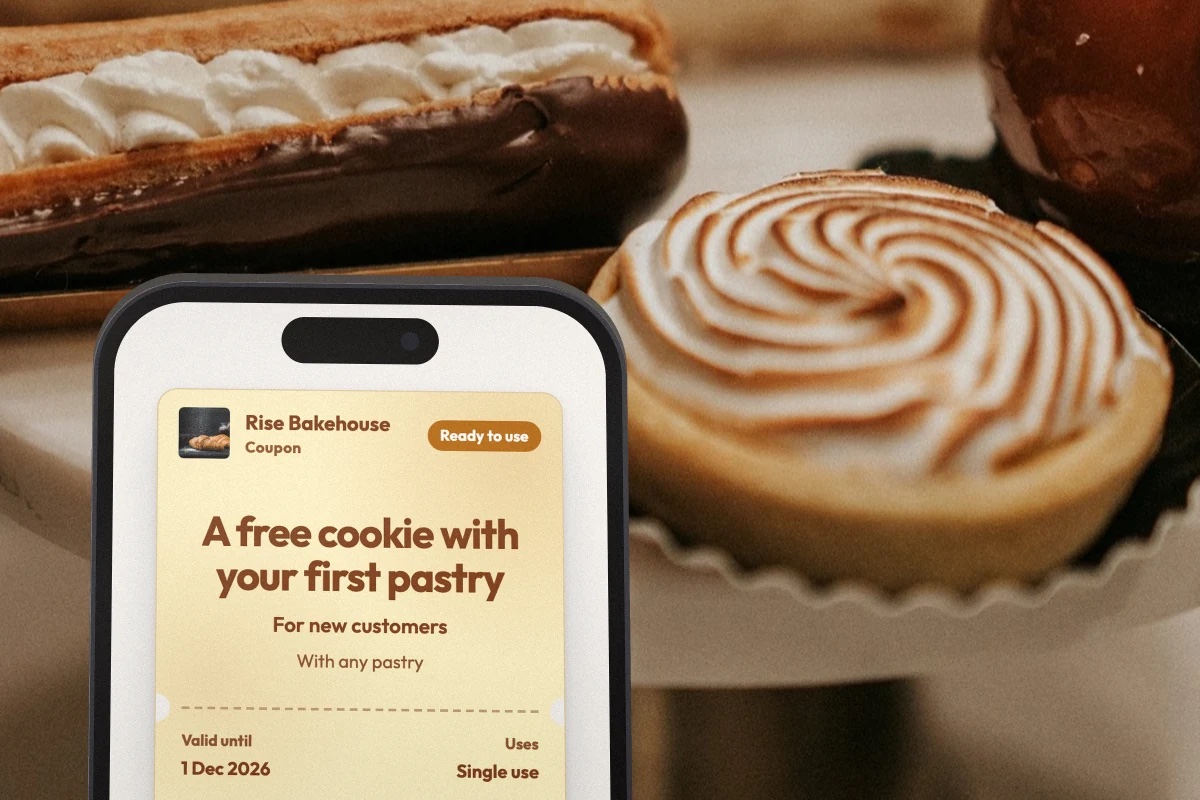
| Bakery | A free cookie with your first pastry | 30 days |
| Hair salon or barbershop | A free scalp massage with your first haircut | 45 days |
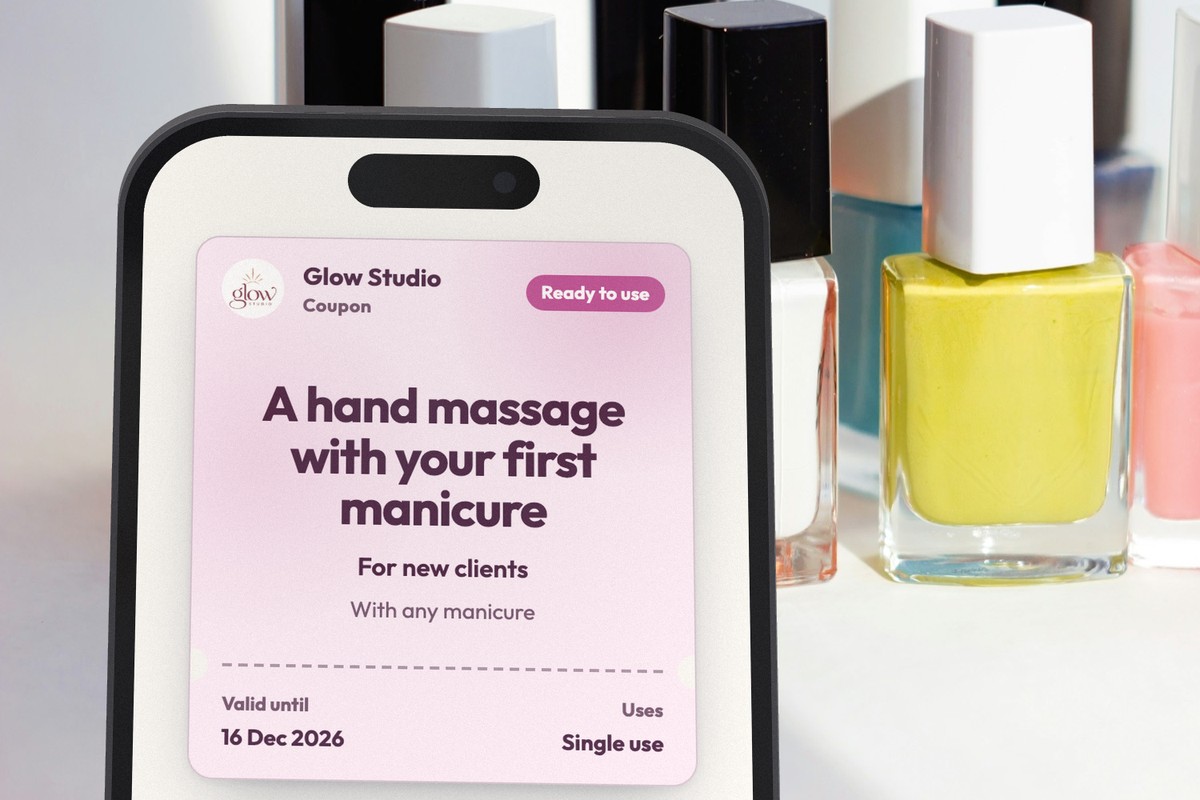
| Beauty or nail salon | A hand massage with your first manicure | 45 days |
| Gym or yoga studio | Your first class on us | 30 days |
| Shop | A gift with your first purchase over a minimum spend | 30 days |
| Repair or car service | A free check-up with your first repair | 60 days |
The longer windows suit businesses people visit less often, such as every five weeks for a haircut. The quiet-hours, thank-you and past-customer ideas for the same eight kinds of business are in our 24 promotion ideas for small business.
Pick an extra that costs you little but that people value at its menu price: a pastry you bake anyway costs you its ingredients. And tie it to a purchase (“with your first coffee”), so nobody comes in for the free part alone.
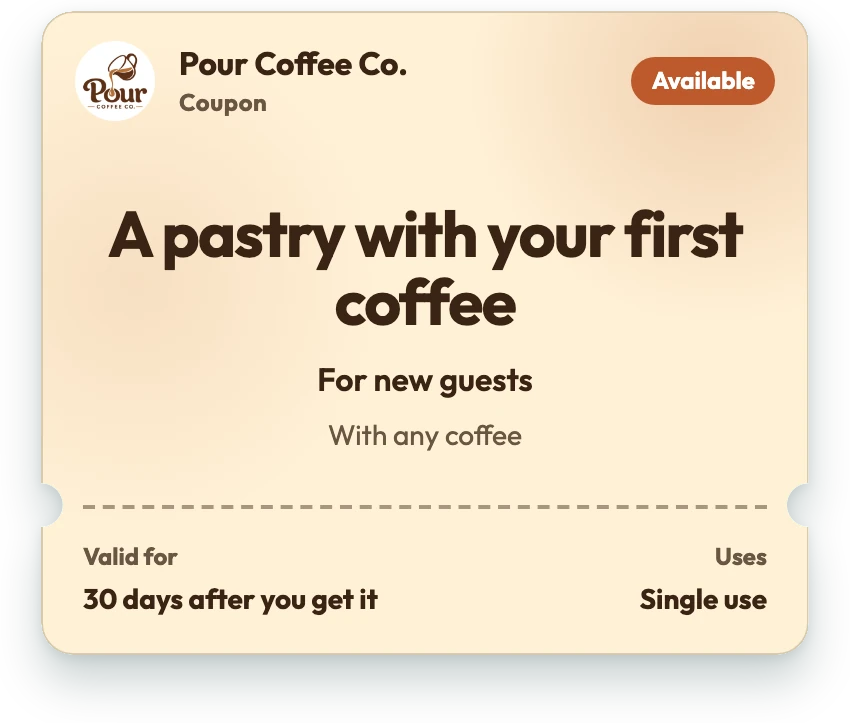
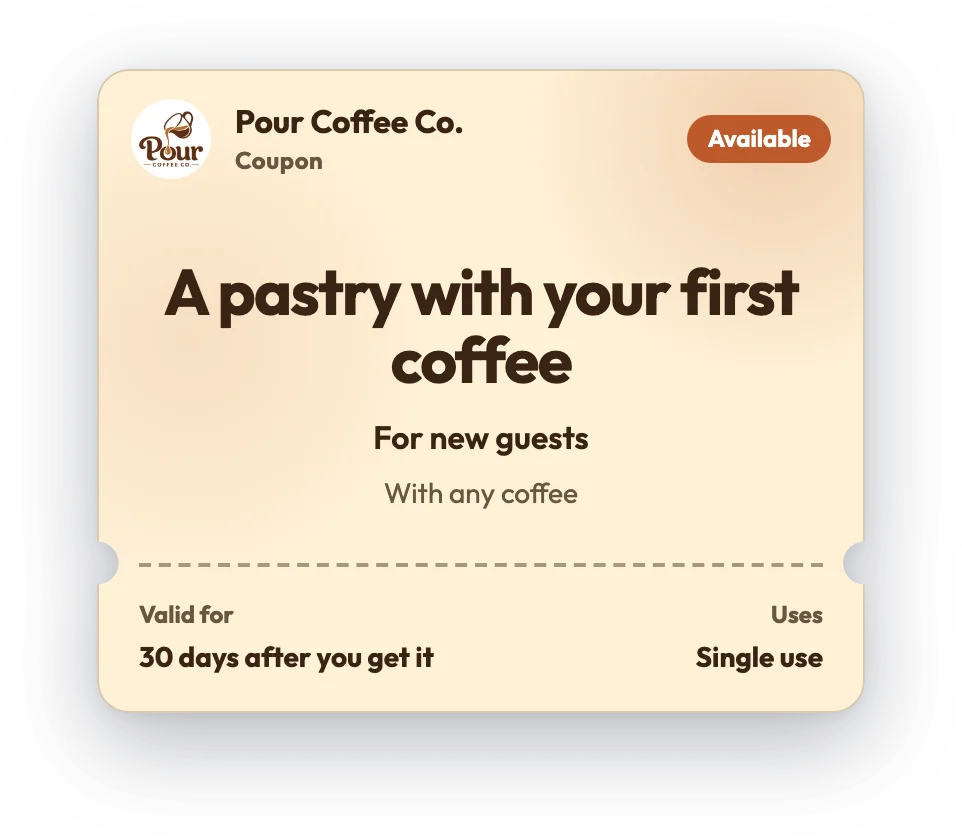
A FaveCard coupon for new guests, the way a customer sees it before getting it. The café is an example.
Do first-visit offers just attract bargain hunters?
First-visit offers attract bargain hunters when they are deep discounts that anyone can buy, in any number. A small free extra for new customers only, one per person and with an end date, keeps the cost of each new customer small and known before you start.
The daily-deal years show where it goes wrong. In a Rice University survey of 150 businesses that had run a Groupon deal, reported in October 2010, 66% said the deal made money, 32% said it didn’t, and 40% said they wouldn’t run another one. Restaurants had the hardest time; service businesses such as spas and salons fared better. Those deals were discounts sold to anyone. Here is what they lacked:
- New customers only. It goes only to people who haven’t had a card or a coupon from you yet, checked by their email.
- One per person, so nobody gets it twice.
- A cap for each place you share it, so a flyer can’t cost you more than you planned.
- An end date, so the offer never turns into your normal price.
In the US, the end date matters for a second reason. The FTC’s guide on the word “free” (16 CFR 251.1) asks you to set out the terms of a free offer “clearly and conspicuously at the outset of the offer”. The same FTC guide says not to advertise a free offer on one product or service in the same area for more than six months in any 12. Check the rules where you trade.
How do you keep a new-customer offer away from your regulars?
You keep a new-customer offer away from regulars by checking who gets it, not where you share it. The offer goes only to people who haven’t had a card or a coupon from you yet, checked by their email. The check isn’t watertight: a regular who never had your card, or who uses another email, can still get it. With a small offer, that costs you one pastry.
Regulars notice. On SalonGeek in August 2014, a client wrote that she “changed my hairdresser because they had cracking deals for new customers but absolutely nothing for loyal clients” and asked: “Where was my incentive to stay loyal?”
Two habits keep both groups happy:
- Check people, not places. Share the offer wherever new people will see it: your window, a partner business, an Instagram post. The email check turns away anyone who already got a card or a coupon from you with the same email.
- Give regulars something of their own. A stamp card that rewards every visit, and now and then a thank-you meant only for them. Our customer incentive ideas have 18 of those, with what each costs.
In FaveCard (Business): A coupon for new customers only is for people who haven’t had a card or a coupon from you yet. We check their email. Each coupon belongs to one person, so a screenshot doesn’t give an extra use.
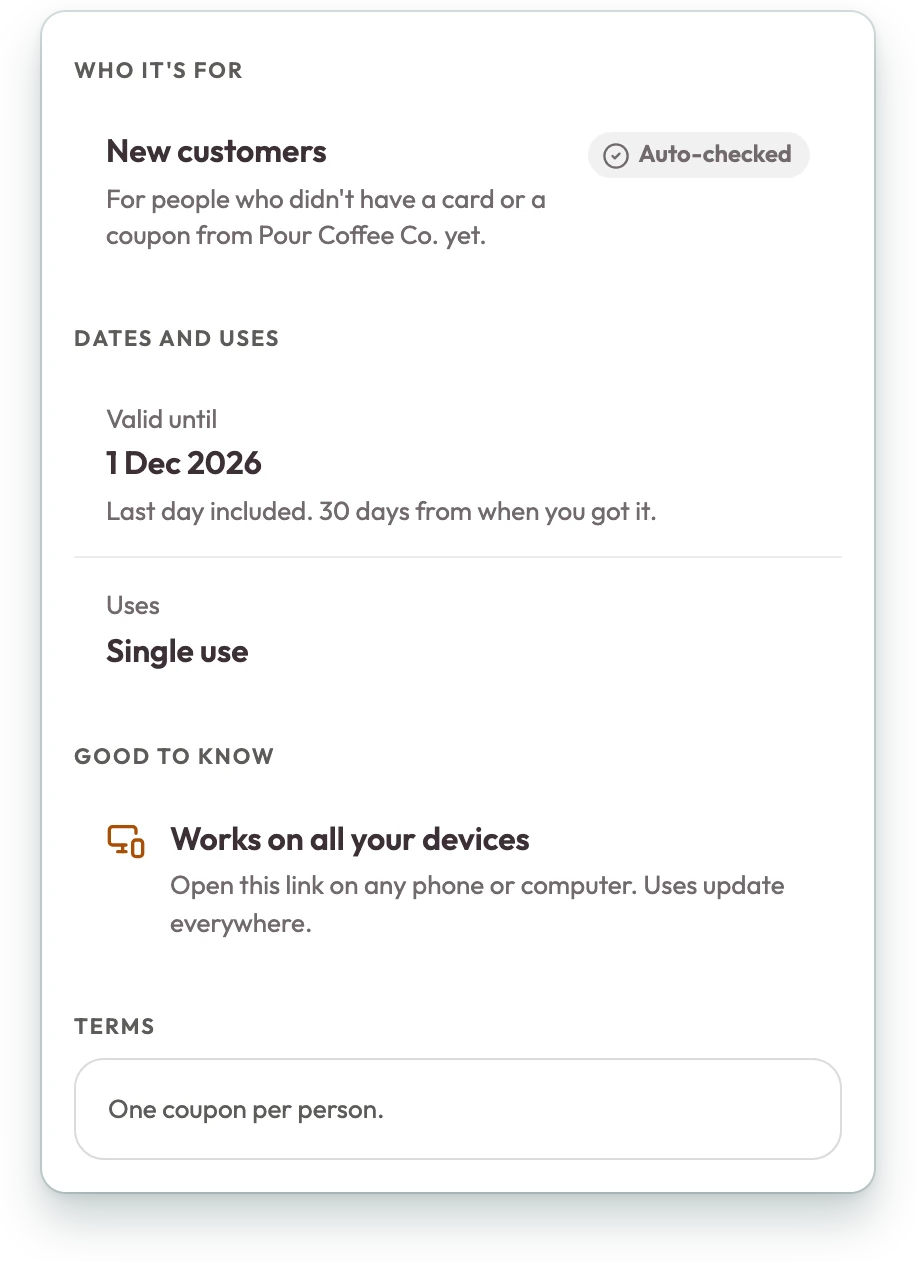
What customers read before they get a FaveCard coupon for new customers. The café and the dates are an example.
How do you get new customers in your quiet hours?
To bring new customers in during quiet hours, make your first-visit offer work only at those times. A first visit goes better when nobody is rushed, and your busy hours stay as they are.
FaveCard’s ready-made “Quiet hours” coupon ideas use these windows, as of November 2026. They’re open to everyone by default, and you can limit one to new customers:
| Business | Quiet window |
|---|---|
| Café | Weekdays, 2 to 5 pm |
| Restaurant | Monday to Thursday, 3 to 5 pm |
| Bakery | Weekdays, 1 to 3 pm |
| Hair salon, barbershop, beauty or nail salon | Tuesday to Thursday, 10 am to 1 pm |
| Gym or yoga studio | Weekdays, 6 am to 4 pm |
| Shop or car wash | Monday to Wednesday |
If you take bookings, put the hours in the offer itself. “A hot towel finish with a first cut, Tuesday to Thursday mornings” tells a new client when to book, and your Saturdays stay untouched. If clients pay at the end of a booked treatment, end the hours after your last morning appointment finishes.
The year has quiet stretches too. Resy’s booking data for 2024, published in January 2025, found that the five slowest days of the year outside holidays were Mondays and Tuesdays in January and February, and that the first three weeks of January were the slowest of all. A first-visit offer limited to those days is aimed at tables and chairs that would otherwise stand empty. For more quiet-hours ideas by trade, see our coffee shop promotion ideas, restaurant promotion ideas and salon promotion ideas.
How do you get new customers through the business next door?
A business next door brings you new customers when it hands your offer to the people who come through its door. Pick a gym, an office, a hotel or a shop on your street that doesn’t compete with you. Its people already trust it, and they don’t know you yet. Give it its own link with a cap, and you can count how many people got the offer there.
A coffee shop owner wrote in the Square Seller Community in August 2024: “I own a coffee shop and am partnering with local service providers to let them have their own unique coupon code that they can share with their customers to offer them a free item at my shop.” The same owner could count the codes used, but couldn’t see who had used them.
Two things make a partner offer work:
- Its own link and QR code, separate from the one in your window.
- A cap on that link. A busy gym can’t send more people than you planned for, and the cap gives you a running count, like “24 given, 6 of 30 left”.
Your regulars can be the partner too. A bring-a-friend offer gives the friend the first-visit extra. Thank the regular separately, once the friend they sent has been in.
In FaveCard (Business): each place you share a coupon gets its own link and QR code. With a cap on a link, you see how many people got the coupon there, and the list of given coupons shows the kind of place each person got theirs from, such as “Partner business”. Pause a link any time; coupons people already got keep working.
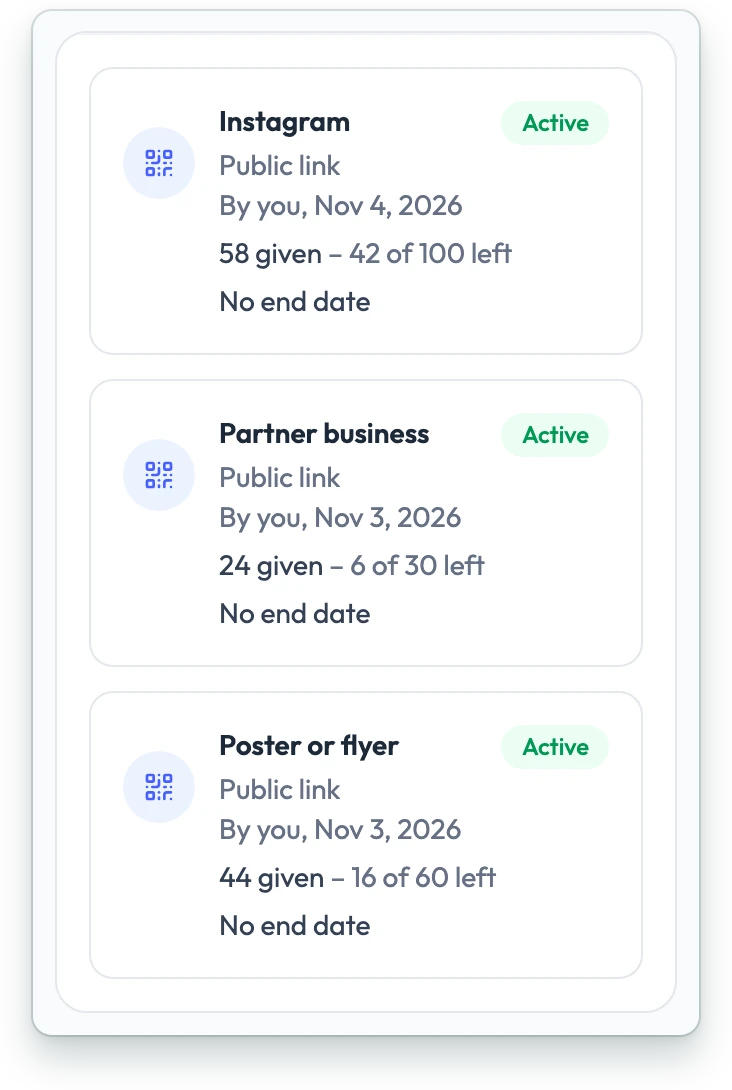
A coupon’s links in FaveCard, with sample data: one link per place, each with its own cap and count.
What’s a good grand opening offer?
A good grand opening offer brings people in during your first weeks and gives them a reason to come back a second time. Make it a free extra with a first purchase, for the opening weeks only, and offer every new customer your loyalty card at the counter. Then the opening turns into regulars, not a one-day queue.
- Set a last day to get it, such as the end of your first two weeks.
- Let it stay valid a little longer, so someone who gets it on the last day can still come in the week after.
- Show it before you open: on the window, on your Google profile and on the opening-day sign.
- Ask one or two neighbors to hand it to their customers.
Example (bakery): “A free cookie with your first pastry”, for new customers, during your first two weeks only.
How do you welcome a new customer so they come back?
Welcome a new customer by learning their name, telling them what’s good, and offering your loyalty card before they leave. A first visit that ends with a started card has a reason for a second. One that ends with a receipt doesn’t.
Keep the card short. In our study of 23,296 loyalty stamps from 1,013 small businesses on FaveCard (January to May 2026), cards designed to be completed in 2 to 4 weeks were finished 11.4% of the time, against under 2% for cards that take more than 16 weeks. Start the card with a stamp and keep the first reward close; our guide on how many stamps a loyalty card should have has the numbers by trade.
A line for the counter: “That’s your pastry on us. Want our card? Your first stamp is already on it.”
A coupon brings new customers in and invites past ones back. Your card rewards regulars. More in our guide to getting repeat customers.
How can you tell whether an offer brought in new customers?
You can tell whether an offer brought in new customers by counting how many people used it, then working out what the extra sales left after costs, minus what the free extras cost you. How many people got it, and where, tells you where it was seen. A code printed on a flyer usually tells you how often it was used, not by whom. Your till or booking system shows what those customers spent.
A simple monthly check:
- Compare how many people used the offer with how many new customers you usually see in the same weeks.
- Look at which place brought the most people who used it, not the most who got it, and put your effort there.
- Work out what it earned: take the extra sales against the same weeks before, keep what they leave after the cost of the goods, and subtract what the free extras cost you. Some people who used it would have come anyway, so your till has the last word, not the coupon count.
- If many people got the offer but few used it, it may ask too much, or end too soon.
For example, a café’s QR code on the door gives out 50 coupons and 6 are used. The gym next door gives out 15 and 12 are used. Say the coffee each new customer buys leaves about 2.50 after its cost, and each free pastry costs you 1.20 (every number here is an assumption, in dollars or euros). The door made 6 × 1.30 = 7.80, the gym 12 × 1.30 = 15.60: twice as much from fewer coupons, if those customers wouldn’t have come anyway, so the gym gets the next batch. Check it against your till before you scale it up.
Whether new customers return is your loyalty card’s job, and its stamps show it visit by visit.
In FaveCard (Business): each coupon shows how many were given and how many were used. Its Given coupons list shows who has one, the kind of place they got it from and whether it’s used.
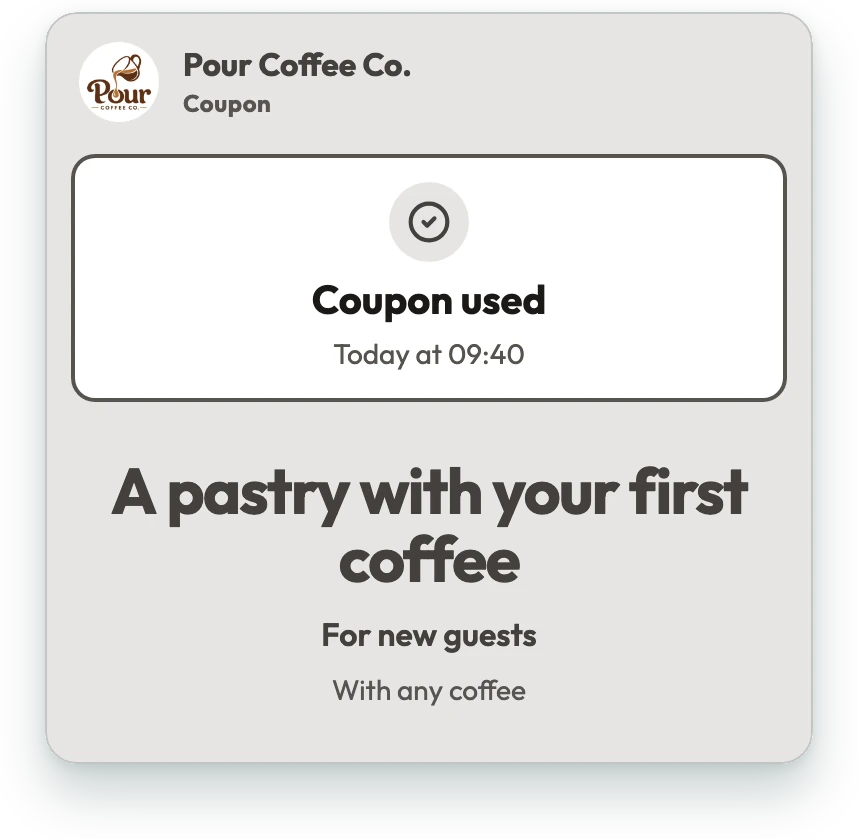
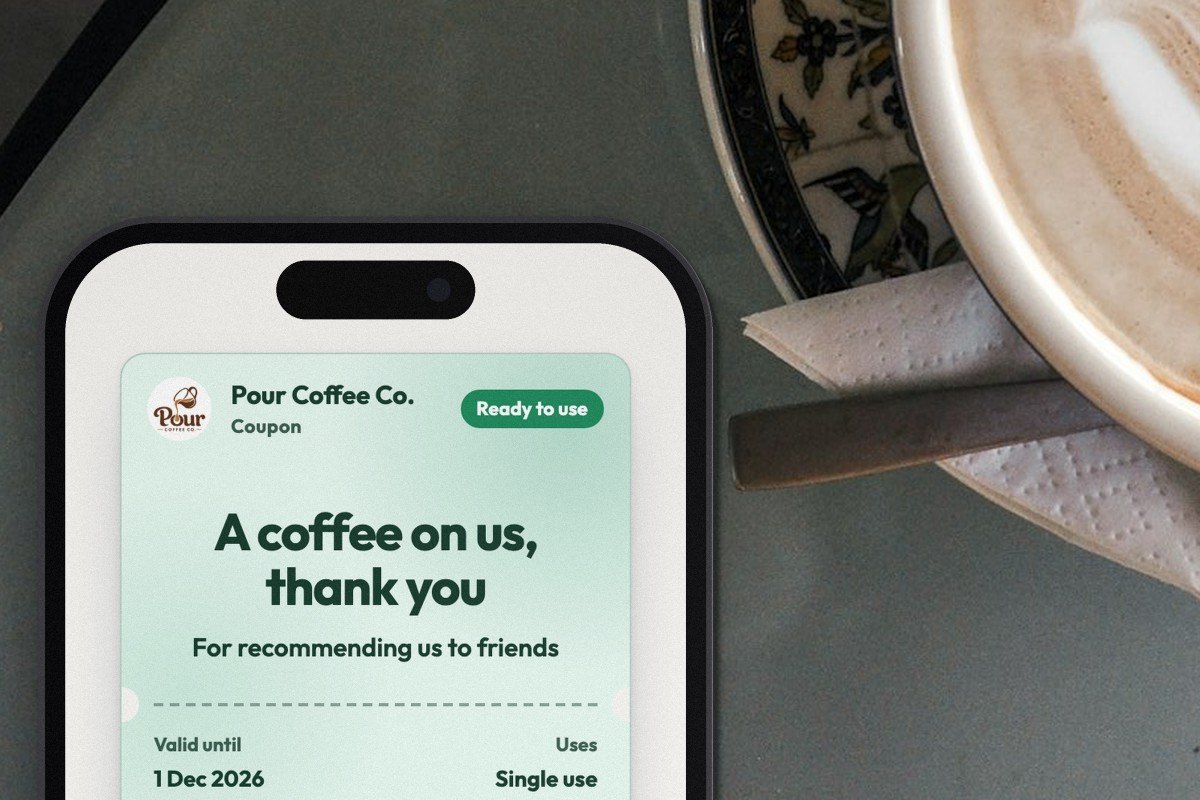
The same coupon after staff confirmed the use. The café and the date are an example.
How do you set up a first-visit coupon in FaveCard?
FaveCard is a digital loyalty card for cafés, salons and other local businesses. Here is how its coupons handle the ideas above, as of November 2026. A FaveCard coupon is one specific offer with an end date, such as a discount or a free item. A local business shares it by link or QR code, and its staff use it at the counter.
- Sign up, then open the FaveCard app at your counter. Download it, or update it, on each phone your team scans with, and sign in. Your own phone works too. Open it once, then you’ll find Coupons in FaveCard.
- Pick an idea, then choose who and when. Start from a ready-made idea for your type of business, or from scratch. Choose who can get it, the days and hours it works and its end date.
- Put the link or QR code where people will see it. Your window, a flyer or the gym next door: each place gets its own link and QR code. Set how many people can get it from each link. For one person, make a personal link.
- No app for your customers. Customers get the coupon on a web page with their email and first name, no app needed, and can add it to Apple Wallet or Google Wallet. They confirm their email first.
- Staff scan it and tap Mark as used. Staff tick any checks you added, like a minimum purchase. You see how many were given and used, and the kind of place each person got theirs from.
- Offer the card. When they come in, staff show your stamp card’s QR code in the FaveCard app so they can join.
Coupons bring new customers in and invite past ones back through a link or post from you, your stamp card rewards regulars, and Campaigns put a limited-time deal on the cards your customers already carry. For a slow-day offer to people who already have your card, use Campaigns instead.
Coupons are part of the Business plan, with no monthly limit. New accounts get premium tools free for the first 30 days, coupons included. Coupons your customers already have keep working on every plan. See the Business plan on our pricing page.
Where to start
Pick one offer, one place and one end date this week. A free extra with a first purchase, a QR code in your window, a last day four weeks from now. Check it after two weeks, decide once the last coupons have had their 30 days, then move the offer to the place that worked, or try your quiet hours next.
Frequently Asked Questions
What is the best way to get new customers for a small local business?
Be easy to find where nearby people choose: a complete Google Business Profile, your window, and a business next door that recommends you. Then give people new to you one small, free reason to try you, tied to a purchase, such as a pastry with a first coffee. Offer your loyalty card on that first visit.
Is giving new customers something free worth it?
It usually is when the free thing is small, tied to a purchase and limited to new customers, one per person, with an end date. The losses owners report from daily deals came from discounts sold to anyone: in a Rice University survey of 150 Groupon merchants, reported in October 2010, 40% said they wouldn't run another deal.
How do I stop regulars or their friends from using a new-customer offer?
Don't hide the offer: the coupon checks who gets it, not where they saw it. A coupon for new customers only is for people who haven't had a card or a coupon from you yet. We check their email. A regular who never had your card, or who uses another email, can still get it, so keep the offer small. Each coupon belongs to one person, so a screenshot doesn't give an extra use.
How long should a first-visit offer run?
Give it an end date: the opening weeks, a month, or a season. An offer that never ends becomes your normal price. In the US, the FTC's guide on the word 'free' (16 CFR 251.1) says a free offer on one product or service shouldn't be advertised in the same area for more than six months in any 12.
Can I give customers a free coffee or a coupon for leaving a Google review?
No. Google's policy doesn't allow discounts, free goods or services, or other incentives in exchange for a review. Keep first-visit offers and thank-yous separate from reviews, and ask every customer for a review the same way, whether or not they used an offer.
Do customers need an app to get a FaveCard coupon?
No. Customers get the coupon on a web page with their email and first name, no app needed, and can add it to Apple Wallet or Google Wallet. They confirm their email first. Staff scan it at the counter and tap Mark as used.
Which FaveCard plan includes coupons?
Coupons are part of the Business plan, with no monthly limit. New accounts get premium tools free for the first 30 days, coupons included. Coupons your customers already have keep working on every plan.