



Bakery Loyalty Program: How Many Stamps, What to Give
A bakery loyalty program regulars finish: 8 stamps if they come in a few times a week, 6 for weekly bread buyers, and rewards that cost you ingredients.
Key Takeaway:
A bakery loyalty program works best as a stamp card: one stamp per visit and something you bake as the free reward. Size it to how often your regulars come in: 8 stamps with a small free extra at the 3rd for customers who come in a few times a week, 6 stamps with the extra at the 2nd for weekly bread buyers. In FaveCard's benchmark of 159 active cards (January to May 2026), cards that paid out within 2 to 4 weeks were finished 11.4% of the time, against 4.0% for cards that took 8 to 16 weeks.
Last updated: October 2026
A bakery loyalty program works best as a simple stamp card: one stamp per visit and something you bake as the free reward, with the card length set by how often your regulars come in. For customers who come in a few times a week, use 8 stamps with a small free extra at the 3rd. For once-a-week bread buyers, use 6 stamps with the extra at the 2nd.
Bakery regulars run on routine. The same croissant on the way to work, the same sourdough every Saturday. A short card rewards that routine without cutting your prices, and it’s easy to explain while the queue moves.
The numbers below come from FaveCard’s completion data (23,296 stamps), the settings FaveCard’s card editor suggests, and the programs of real bakeries in the US, Scotland and Australia. To see a bakery card set up in FaveCard, go to the bakeries page.
What is the best loyalty program for a small bakery?
The best loyalty program for a small bakery is a stamp card with one stamp per visit and a free bake as the reward, sized to how often regulars come in. A stamp card needs no connection to the till, because staff add the stamp when the customer pays. Points programs suit chains and bakeries with large, uneven orders.
A stamp card fits in one sentence (“every visit gets a stamp, eight stamps get you a free pastry”), and the customer always knows how far they are from the reward. Points reward bigger spenders more fairly, but the customer has to do sums, and you need software that records every sale.
Chains often pay back by spend instead. Bakers Delight, an Australian bakery chain, gives members of its Dough Getters program $5 of “dough” every time they spend $55, in Australian dollars. By our sum that is about 9% back, plus a free welcome gift with the next purchase of $5 or more.
| Option | Best for | What the customer carries | What you learn |
|---|---|---|---|
| Paper punch card | A one-counter bakery that wants to start this week | A card in a wallet or purse, easy to lose or forget | Nothing, unless you count returned cards by hand |
| Digital stamp card | Independents with near-daily or weekly regulars | A card on their phone: Apple Wallet, Google Wallet or the browser | Who your regulars are and when each one last came in |
| Loyalty add-on in your till (e.g. Square) | Bakeries already on that till, with mixed baskets | Usually nothing: they give a phone number at checkout | Spend per customer, straight from the till |
| A chain’s own app | Multi-shop chains with a marketing budget | An app they had to download | Whatever the app tracks |
If your till already has a loyalty add-on and customers give their phone number at checkout anyway, try that first: it’s one less thing at the counter. Our Square Loyalty review covers the most common one.
In FaveCard, customers save the card by scanning a QR code at the counter, and staff add each stamp by scanning the QR code on the customer’s card with the FaveCard app. Scanning is free on every plan. On the Free plan the card opens in the phone’s browser; on Pro and Business, and during the free trial, it saves to Apple Wallet or Google Wallet. Plans and current prices for your country are on the pricing page.
How many stamps should a bakery loyalty card have?
A bakery loyalty card should pay out within a few weeks, well inside eight. For customers who come in a few times a week, that means 8 stamps, with a small free extra at the 3rd. For customers who buy bread once a week, it means 6 stamps, with the extra at the 2nd.
The wait decides whether people finish. In FaveCard’s loyalty card completion benchmark (159 active cards with at least 15 customer cycles, 20 January to 18 May 2026), cards that paid out within 2 to 4 weeks were finished 11.4% of the time. Cards that took 8 to 16 weeks: 4.0%.
The same data split by visit rhythm points the same way. On cards at businesses whose owners said customers come in at least every three days, 10.2% of started cards were completed; where customers come about weekly (every 4 to 14 days), 3.9%.
That’s the problem with the 10-stamp card many bakery loyalty guides suggest. A customer who buys one sourdough loaf a week needs 10 weeks to finish it, which lands the card in the 8-to-16-week group. Six stamps gets the same customer to a free loaf in six weeks.
| How often your regulars come in | A typical bakery customer | Stamps | Small free extra at | Weeks to the main reward |
|---|---|---|---|---|
| Every day | Coffee and a croissant on the way to work | 8 | 3rd visit | about 1 to 1.5 |
| Every 2 to 4 days | Bread twice a week, a pastry after the school run | 8 | 3rd visit | about 2 to 4.5 |
| Once a week | The Saturday sourdough, the family loaf | 6 | 2nd visit | about 6 |
| Every 2 to 3 weeks | Cakes, an occasional treat | 5 | 2nd visit | about 10 to 15 |
Count your own weeks with the formula the benchmark uses: days between visits × stamps on the card ÷ 7. Customers who come in only every two to three weeks can’t finish any useful card within 8 weeks; for them, the small extra at the 2nd visit is what keeps the card going.
Short cards work for chains too. In 2023 Harry Gow, a family-run Scottish bakery with 18 shops, rolled out a loyalty card on which six stamps earn a free cake (British Baker, June 2023).
In FaveCard (as of October 2026), the Dashboard asks “How often do your customers visit?” when you set up. The first answer, “A few times a week”, gives “e.g. coffee shops, bakeries, lunch spots” as examples. Pick it, and the card editor marks 8 stamps as ”✓ recommended” and suggests “Stamp 3: small reward (free add-on, upgrade, or sample)”. The tip under the field reads: “We suggest adding rewards at stamp 3 (earned after ~1.5 weeks) and stamp 8 (earned after ~3.5 weeks).” “Every 1-2 weeks” gives 6 stamps, with the small reward at stamp 2. If your first reward ends up more than about 8 weeks away, the editor suggests placing it earlier, and past 16 weeks the warning turns red. The same rule for other trades is in how many stamps a loyalty card should have.
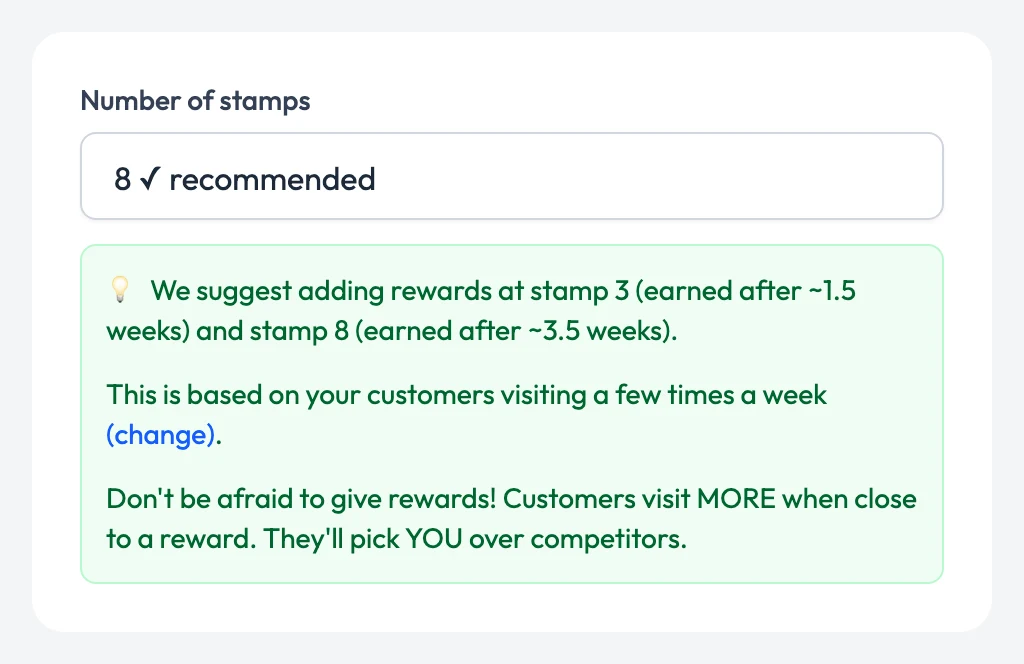
What the owner sees in the card editor after picking “A few times a week”: 8 stamps marked as recommended, and rewards suggested at stamp 3 and stamp 8.
Coffee-and-croissant regulars or weekly bread buyers: one card or two?
For a bakery that also sells coffee, one loyalty card with two rewards is simplest when the same people buy both. Two separate cards make sense only when they are different crowds, for example commuters who stop for coffee every morning and families who buy a loaf on Saturdays. Watch a normal week at the till before you decide.
The question comes up as soon as a shop sells two things people come back for. On Square’s seller forum in August 2023, an olive-oil shop adding a small café asked for a second card and wrote: “Square wont allow 2 loyalty programs.” A bakery-café owner faces the same choice.
Two cards double the effort for the customer. For a mixed crowd, one 8-stamp card with a free coffee at the 3rd and a free pastry at the 8th rewards both habits. If the crowds really are separate, give each its own card at its own rhythm: 8 stamps for the morning coffee crowd, 6 for the weekly bread buyers.
In FaveCard, one card can hold several rewards at different stamps, and each reward name can be up to 50 characters. Whether a second card, such as one for coffee and one for bread, fits your plan is on the pricing page. If coffee is most of what you sell, the coffee shop loyalty program guide fits your shop better than this one.
What rewards should a bakery loyalty card give?
A bakery loyalty card should give something you bake anyway, for free: a cookie or a coffee as the small early reward, and a pastry, a loaf or a slice of cake as the main one. A free item costs you only its ingredients, while a discount costs you the full menu price.
Customers rate free items highly. In a Morning Consult survey of 4,416 US adults in July 2024, 53% ranked a free item as a top-3 feature of a restaurant rewards program. The survey asked about restaurants, not bakeries specifically.
Here is the sum, with sample numbers in whatever currency you use. A pastry that sells for 3.50 costs you about 1.20 for ingredients and packaging. On an 8-stamp card the customer pays for eight visits, say 28 in total, to earn it (leaving the small extra at the 3rd aside). They see 3.50 back on 28, or 12.5%. You pay about 1.20 on 28: about 4%, or 0.15 a visit. Most started cards are never finished, so the real cost per visit is lower still.
| Reward | Where it goes on the card | What it costs you | Why it works |
|---|---|---|---|
| A cookie or a mini pastry | 2nd or 3rd stamp | A small bake | Arrives in the first week or two, so the card proves itself early |
| A filter coffee or a tea | 3rd stamp, if you sell coffee | Coffee, milk and a cup | Rewards the morning habit |
| A croissant or a pastry | Last stamp on an 8-stamp card | About 1.20 in the sample above | It’s what they come in for |
| A loaf of bread | Last stamp on a 6-stamp bread card | The ingredients for one loaf | Matches what weekly customers buy |
| A slice of cake | Last stamp | One slice | Feels like a treat rather than a discount |
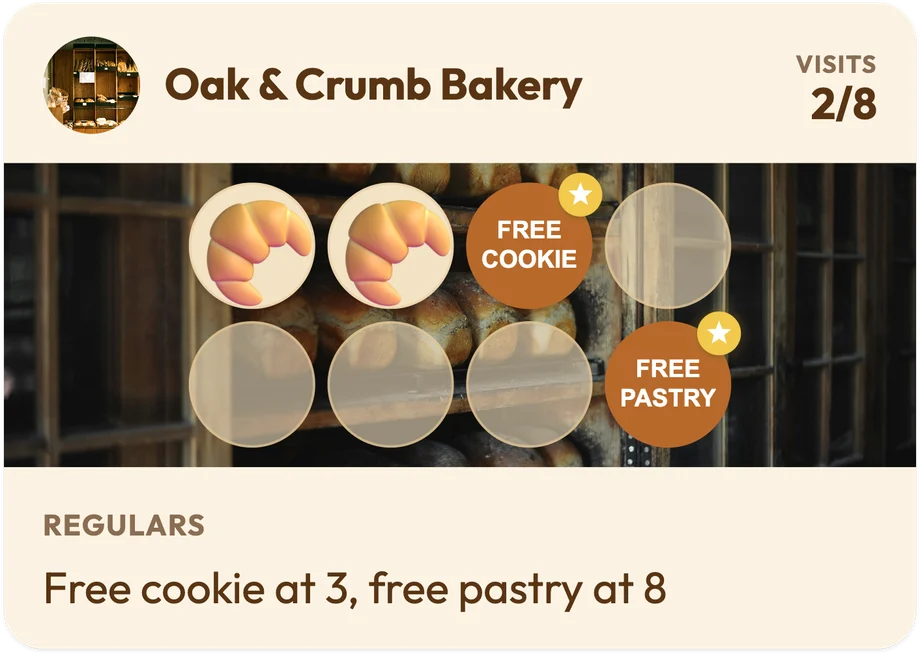
An example card for regulars who come in a few times a week: 8 stamps, a free cookie at the 3rd and a free pastry at the 8th. This customer has 2 stamps, so the next visit earns the cookie.
Skip “10% off your next order”. It lowers your price in the customer’s head, and on a big cake order it gives away far more than a free pastry costs you. FaveCard’s card editor gives owners the same advice: “‘Free’ rewards work better than discounts.” Ready-made card wording for a bakery, such as “Free cookie at 2 visits, free loaf at 6”, is in our punch card ideas.
Should a bakery give stamps per visit or per amount spent?
A bakery should give one stamp per visit when most sales are small and similar, like a loaf, a coffee or a couple of pastries. Use stamps per amount spent, or a minimum spend per stamp, when order sizes vary a lot, for example when the same card has to cover a single croissant and a celebration cake.
Real bakeries do both. A bakery owner on Square’s seller forum (March 2024) gives one punch for every $20 spent and $15 off after 15 punches, about 5% back by the owner’s own estimate. The card stays on paper because “the tactile of it being in their hand and purse/wallet seems to keep it in their mind better.” Bakers Delight’s $5 per $55 is the chain version of the same idea.
Spend-based cards suit bakeries like these, where one customer buys a roll and the next a party order. They ask more of staff, though: someone has to work out the punches at every sale. If most of your customers buy roughly the same thing each time, per visit is simpler and fair enough. Treat big orders as a house rule (see the FAQ below).
How do you run a loyalty card through the morning rush?
To run a bakery loyalty card through the morning rush, keep the pitch to one sentence at the till, put a QR sign where people queue, and stamp as they pay. Beforehand, agree two rules with staff: what counts as a visit (one stamp per visit, even for a group order) and who hands over the reward.
The queue is where customers have their phone out and a minute to wait, so the sign goes there, not on the door. Staff mention the card once, while taking payment, and the customer scans while the order is bagged.
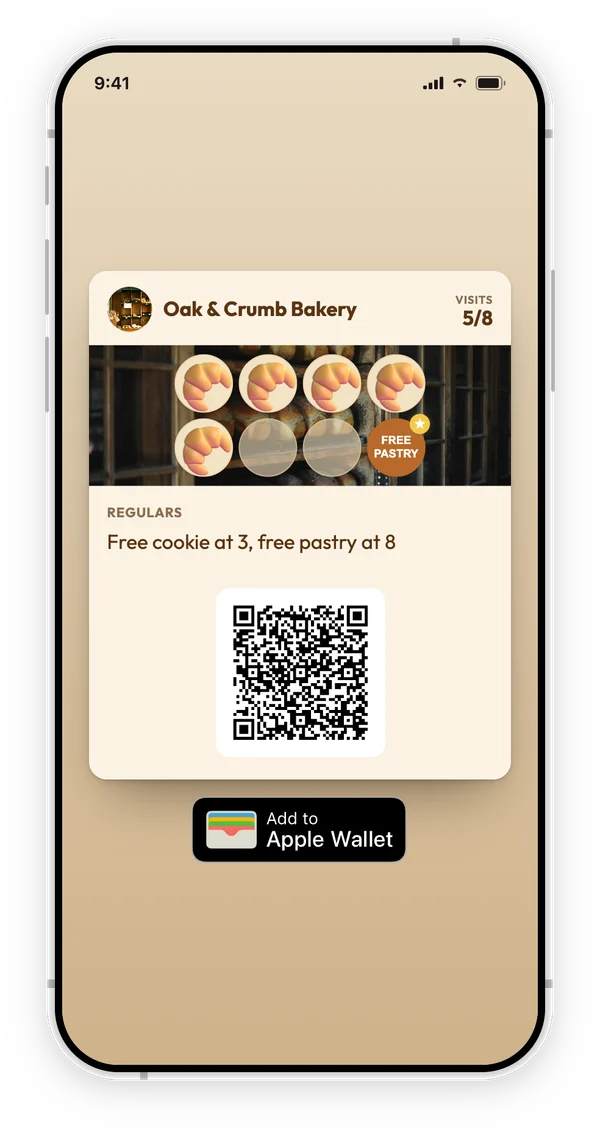
The same card on a regular’s iPhone after five visits: the cookie is already earned and the pastry is three visits away. Staff add the stamp by scanning the QR code on the card.
Paper cards add two risks in a busy shop. Cards get lost or left at home, and a stamp can go to a friend without anyone noticing. One bakery owner, quoted in our guide to stamp card cheating, found staff a bigger risk than customers: a free item claimed on a card and sold at full price. That guide covers the rules that stop it.
In FaveCard, the Share Card page in the Dashboard has the QR code for your counter sign and a ready sentence for staff: “We have a loyalty program! You collect stamps with us and get rewards. Just scan this code with your phone to get your card.” Where to put the sign and how big to print it is in how to promote a loyalty program.
How can a bakery fill quiet afternoons and move end-of-day bakes?
A bakery can fill the post-lunch lull with a timed offer, such as a second pastry free on weekdays from 1 to 3 pm. It uses bakes that would otherwise be left at closing, and only people who come in at those hours get it. For end-of-day leftovers, bake closer to demand, donate, or use a surplus-food app.
Pick the hours from your own till: the two weakest hours on a normal weekday. Announce the offer where people see it before they set out, such as an Instagram post or your Google profile, and give it an end date so it stays an offer and doesn’t become your new price. The afternoon visit still earns a stamp.
How do you get new customers to try your bakery?
To get new customers to try a bakery, offer a small free taste with a first purchase, such as a free cookie with a first pastry, and show it where newcomers look: on the door and on your Google profile. Then hand them the stamp card on the way out, so their second visit already has a goal.
The second visit is where a newcomer becomes a regular. What to do on it is in how to get repeat customers.
Is a loyalty program worth it for a small bakery?
A loyalty program is worth it for a small bakery when regulars come back at least once a week and the reward costs you ingredients rather than menu price. Judge it by completion: FaveCard’s benchmark counts it a good rate when 8% or more of started cards are finished, and 4 to 8% is typical for a well-designed card.
It is worth less where most trade is passing: a station kiosk or a bakery on a tourist street. Few customers come back often enough to finish a card, and your effort is better spent on reviews and on being easy to find.
Cost is the other half. Some sellers stay on paper for that reason alone: “Yeah, we still use punch cards because square loyalty is just so much more expensive,” one replied on Square’s food and beverage forum in October 2021. To check whether extra visits would cover the rewards at your prices, see the break-even sums in do loyalty programs work.
In FaveCard, the Free plan has one stamp card with unlimited cardholders, saved as a card in the phone’s browser. New accounts get the premium tools free for the first 30 days, including Apple and Google Wallet passes. Current prices for your country are on the pricing page.
How to set up a bakery loyalty program this week
To set up a bakery loyalty program, start with how often your regulars come in: that one number sets the card length and where the free extra goes. Then choose the rewards, put up the sign, brief your staff and look at the numbers four weeks later.
- Find your rhythm. For one normal week, have whoever is on the till note how often familiar faces come in. You may well see two groups: near-daily coffee-and-pastry regulars and weekly bread buyers.
- Pick the card length. 8 stamps with a small extra at the 3rd for the near-daily group, 6 with the extra at the 2nd for weekly bread buyers. If one group brings in most of your sales, size the card for them.
- Write the two rewards as one line for the sign and the card, such as “Free cookie at 3, free pastry at 8”.
- Put the QR sign where people queue, then teach staff the one-sentence pitch and the house rules: one stamp per visit, and what happens with big orders and pickups.
- Check after four weeks. How many customers reached the small extra? How many the main reward? If almost nobody reached the first one, shorten the card or move the extra earlier.
The bakeries page shows how the card looks for a bakery.
Size the card to the routine your regulars already have, and give them something you bake.
Frequently Asked Questions
Do bakery customers need an app for a digital loyalty card?
No. With FaveCard, the customer scans a QR code at the counter and saves the card on their phone. On Pro and Business, and during the free trial, it goes into Apple Wallet or Google Wallet; on the Free plan it opens in the phone's browser. Staff add stamps by scanning the card's QR code with the FaveCard app, which is free on every plan.
Can a home bakery or market stall run a loyalty card?
Yes. Give one stamp per order and size the card to how often people order: 6 stamps for weekly customers, 5 for customers who order every two to three weeks, with a small free extra at the 2nd. A digital card needs no till, because you scan the customer's card with your phone when they collect.
Should pre-orders and click-and-collect orders earn a stamp?
Yes. Stamp at pickup, when the customer is at the counter with their phone, and count the whole order as one visit however many items it has. Write that rule down for your staff so nobody has to decide it in the queue.
How should a bakery loyalty card handle celebration cakes and big orders?
Count a big order as one visit, or add one simple house rule, such as one extra stamp for orders over an amount you choose. Don't let a single wedding cake fill a card: a bakery card is there to reward the weekly or daily routine, not one large purchase.
Is a free item better than a discount for a bakery loyalty card?
Usually, yes. With sample numbers, a free pastry that sells for 3.50 costs you about 1.20 in ingredients and packaging, while 3.50 off the bill costs you the full 3.50. In a Morning Consult survey of 4,416 US adults (July 2024), 53% ranked a free item as a top-3 feature of a restaurant rewards program.
How do I know if my bakery loyalty card is working?
Check how many started cards reach the main reward. FaveCard's completion benchmark calls 8% or more a good rate and 4 to 8% typical for a well-designed card. If almost nobody has reached even the small first reward after four weeks, the card is too long or staff aren't mentioning it.