




CRM for Spa Businesses: What You Actually Need
What a spa CRM does, when a day spa genuinely needs one, and why two optional questions on your loyalty card usually solve the real problem instead.
Key Takeaway:
A spa CRM is a marketing system that needs somebody to run it. Most day spas want something narrower: for whoever is on the desk to know who a guest usually sees, what they usually book and when they can come. FaveCard is a digital loyalty card rather than a CRM. Two optional questions at signup, answered by the guest in their own language, cover that without adding a system to your week.
Last updated: August 2026
A CRM for a spa is software that keeps a record of each guest and uses it to market to them: a guest profile with contact details and visit history, segments such as lapsed or high spend, email and SMS campaigns aimed at those segments, and reporting on what came back. In most spas it arrives bundled inside the booking system rather than bought separately. It pays back for an operation with several locations or a marketing person, and it becomes a monthly bill for a guest list nobody opens for everyone else.
Key Takeaway: Check your booking system before you buy anything, because it probably already does most of this. Then decide which job you actually have. Mailing a list is a CRM job. Knowing who a guest sees and what they book is a recognition job, and it is solved at signup rather than in a campaign builder.
Where FaveCard sits in this, so you can skip ahead if it is not what you came for. FaveCard is a digital loyalty card, not a spa CRM. No segments, no campaign builder, no marketing reporting. It asks a new guest a couple of optional questions when they take your card, in their own language, and shows the answers to whoever is on the desk next time. If you need to market to a list, you need a CRM. If you need the desk to know a guest always books with the same therapist, read on.
What a spa CRM does, and where yours probably already lives
Four jobs sit under the category name:
- The guest record. One row per guest: contact details, visit history, spend, and whatever your team has typed into the notes.
- Segmentation. Grouping that list by behaviour. Everyone who has not rebooked in three months. Everyone who buys retail. Everyone who only ever books massage.
- Campaigns. Email or SMS to a segment, usually with an offer.
- Reporting. Answering “did that work”, in money.
Only the first is about the guest on the treatment table. The other three are about the list, and the list is the part that needs an operator.
Before you buy: open your booking system. Most spa diaries now include guest records, notes, rebooking prompts and a marketing module, and most spas have never switched half of it on. Buying a second system to do a job the first one already does is an easy and expensive mistake in this category.
When a spa genuinely needs one
Four signals. If two describe you, a CRM is a reasonable purchase.
- More than one location, and you want a single record for a guest who visits both.
- A guest list in the thousands that you actively mail, not a list you merely have.
- Retail, gift vouchers, packages or memberships to sell, which are campaign-shaped products.
- Somebody with marketing in their job description, even a day a week. A CRM is a tool, not a service.
If none of those describe you, the rest of this is about the problem you probably do have.
The problem a day spa actually has
A spa guest is typically on a four to eight week cycle, and that gap is the whole difficulty. Nobody can hold six weeks of small detail about a full book of guests, and the person expected to write it down is the person already in the treatment room.
An owner in r/smallbusiness put the software half of it in one sentence, in a thread about keeping track of regular customers:
“Every CRM I’ve looked at is built for big teams and feels like way too much for a shop our size.”
That is a fit objection rather than a budget one, and it is right. What is being described is a memory problem at the front desk, and CRM software is built around a marketing operation.
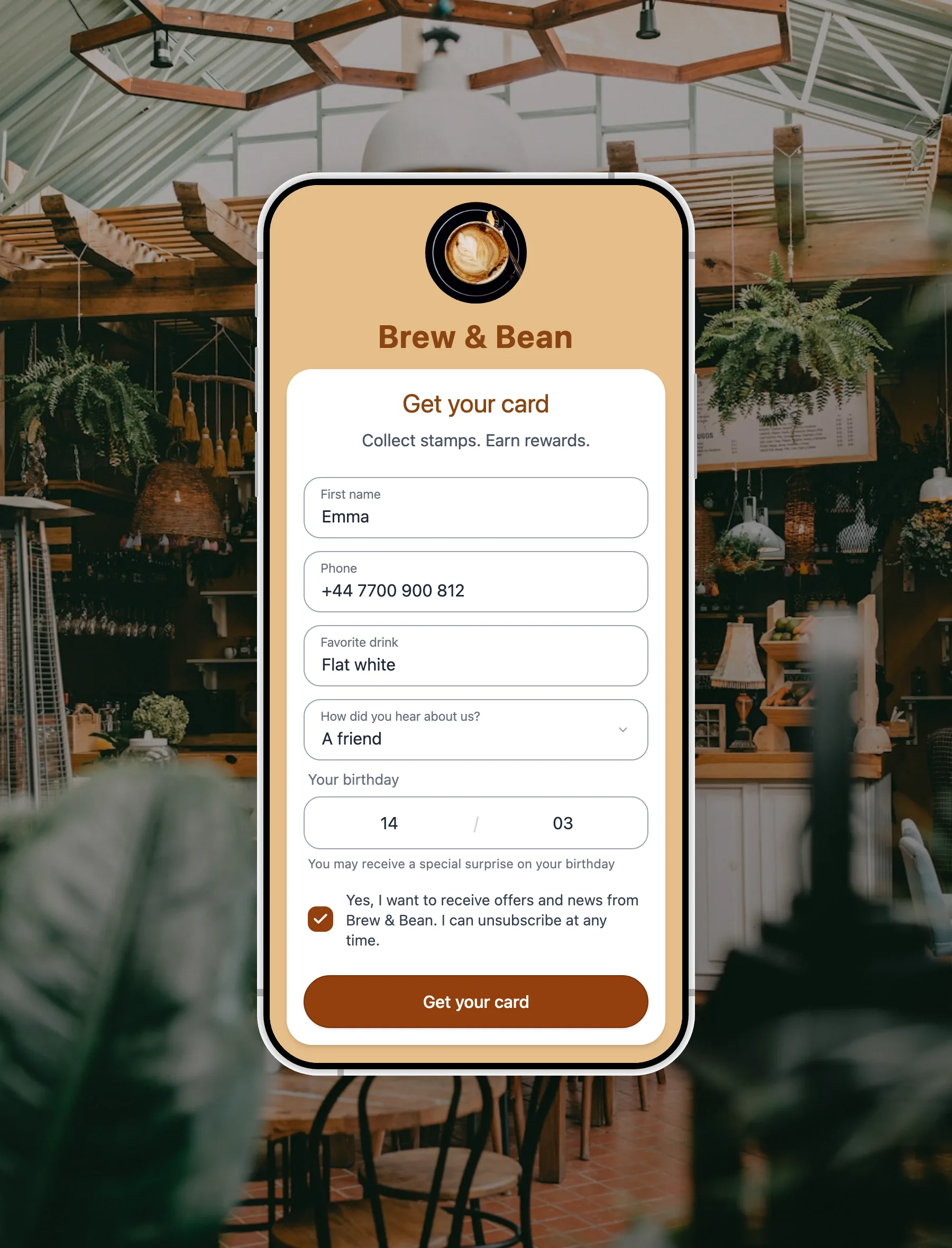
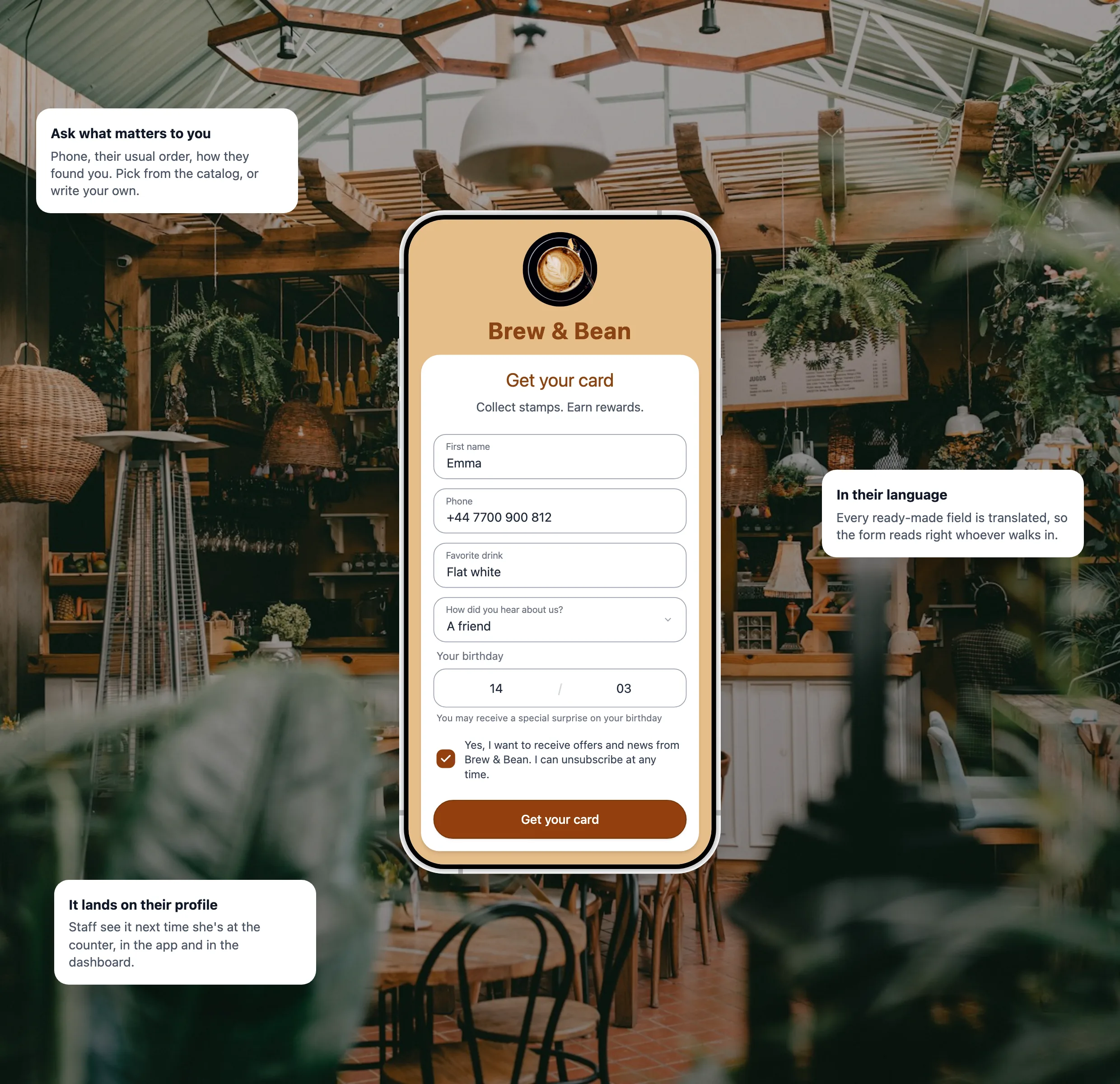
There is a simpler way in, and if you already run a loyalty card you own it. When a guest takes your card they are standing at your desk with a phone in their hand, filling in a short form, with a reward on the other side of it. That is the one moment in the relationship when somebody will happily tell you about themselves, and it costs your team nothing at all. Our guide to spa loyalty programmes covers the reward side of it.
The two questions worth asking, and a third
Ask two or three, never more than five, and leave every one optional. A required question does not get you an answer, it costs you the signup and the card was the point.
| The question | What it changes | Answer type |
|---|---|---|
| Who you usually see | The desk books the guest with their own therapist without asking, which is the detail most easily got wrong on a phone booking. | Typed |
| Best time for you | You know when a guest can actually come, so you can offer a genuinely quiet slot instead of guessing. | Fixed choice: mornings, afternoons, evenings, weekends |
| What you usually book | The treatment before they say it, so the slot is the right length. For day spas and beauty rooms only, for the reason below. | Typed |
Add Anniversary if you sell couples’ treatments or gift days. Your form already carries the birthday, and the anniversary is the date people plan a spa day around.
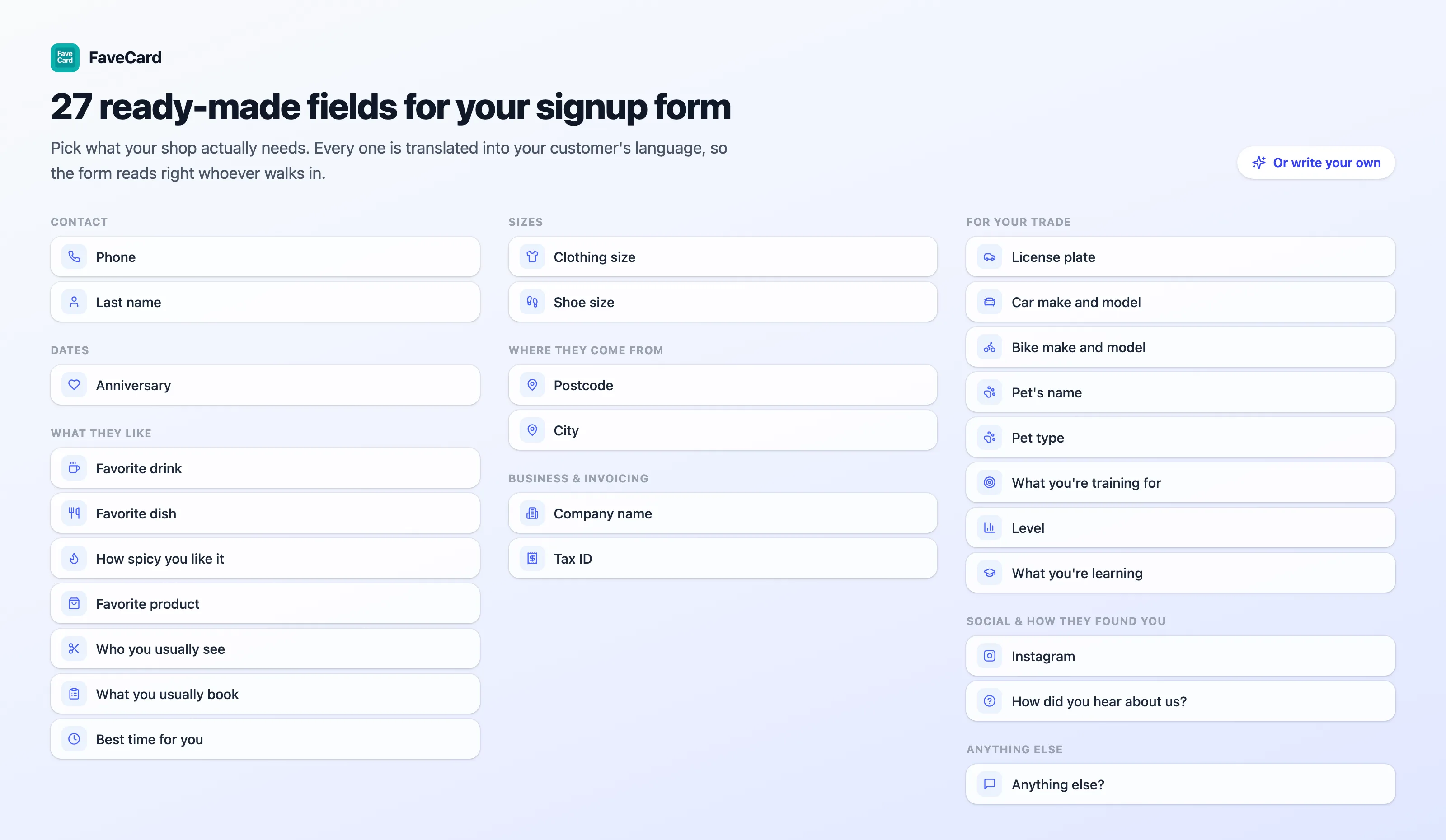
There are more than twenty ready-made questions grouped by trade in our guide to loyalty card signup questions. You should be using two or three of them.
Worth knowing if you take visitors or hotel guests: every ready-made question, and every option inside it, ships translated into 30 languages, and the language is chosen by the guest’s own phone rather than by you. Someone who does not read your language still understands what you are asking. You can also write up to five questions of your own, and one you write yourself reaches guests exactly as you typed it, in your language.
The line between a day spa and a medical spa
This distinction is the one thing in this article worth reading twice, because software in this category routinely gets it wrong.
In a day spa, a beauty room or a wellness centre, what a guest usually books is a preference. A back massage. A facial. A hot stone treatment. There is nothing sensitive about it and a guest will answer without hesitating.
In a medical or aesthetic spa, a dental practice, a physiotherapy room or a pharmacy, the same question is a different question entirely. A guest answering honestly is describing a condition or a clinical treatment, and that is health information: special-category data under Article 9 of the GDPR, which needs its own lawful basis and safeguards, and which a loyalty card signup at a front desk cannot provide.
So FaveCard does not offer that question to those trades. It is not a warning you can click past, it is simply not among the questions suggested to a clinic. Those trades get who you usually see and best time for you: who and when, never what is wrong.
If you run both, and plenty of spas now have an aesthetics room, apply the stricter rule to the whole form. A loyalty signup is a front-of-house document, and clinical detail belongs in clinical records under the process you already have for it.
What the desk sees at the next visit
Scan a guest’s card and their first name is at the top of the screen, on every plan and for every member of staff.
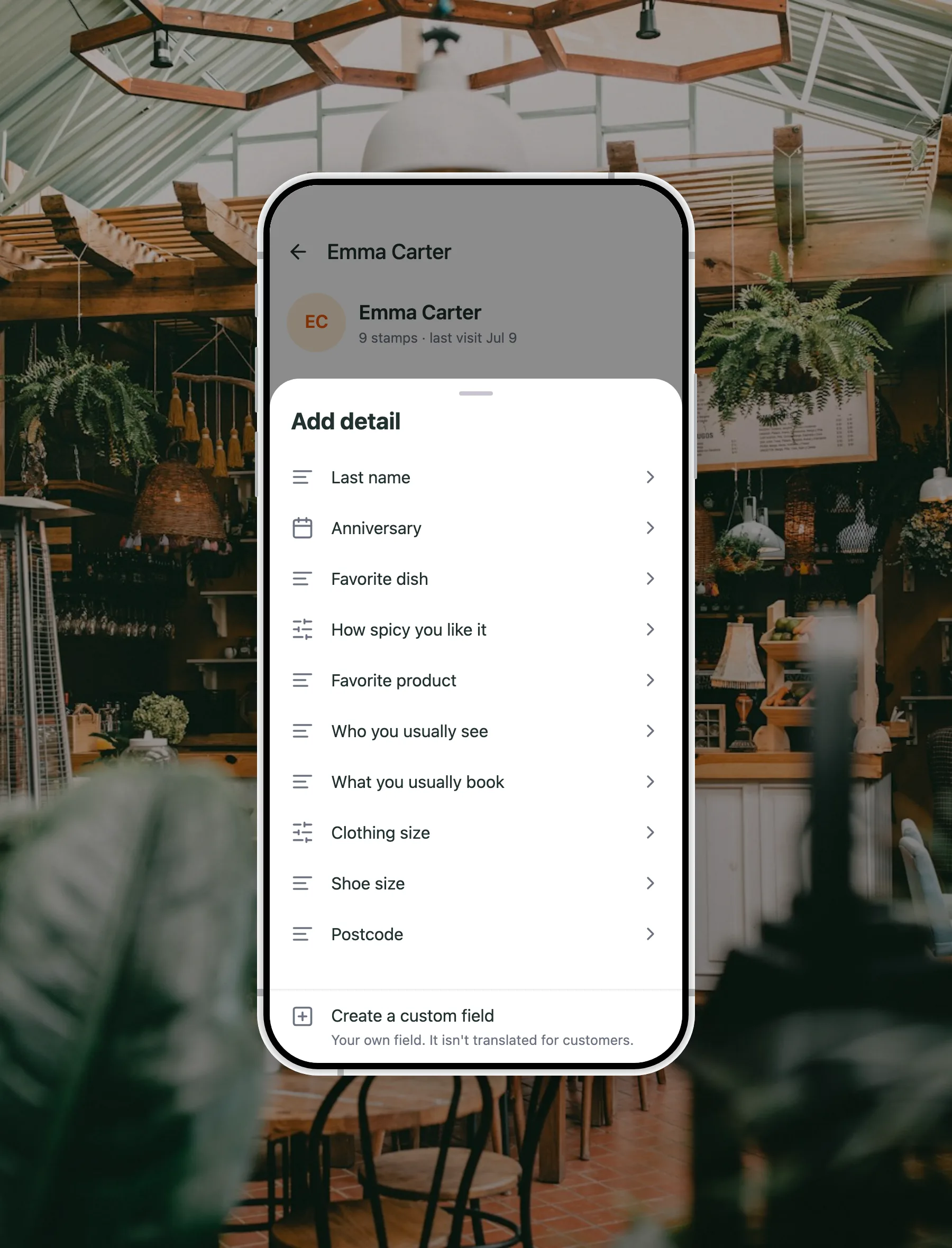
On the Business plan the signup answers sit further down that same screen, under a heading called Details. Being straight about the layout, it is below the Add stamp button, so it is a scroll rather than a headline. Worth knowing before you build a front-desk habit around it.
Contact details behave differently on purpose. A phone number or a last name shows on an admin login and is masked for everyone else, so whoever is on the desk sees the usual treatment but not the phone number. If you want to reach guests between visits, that is a separate job with separate tools.
What this does not do
It is a guest record, not a marketing system, and the difference is the whole point of the comparison.
It does: show every answer on the guest’s profile, labelled and marked with who supplied it. Let any member of your team correct or add an answer later, without the owner’s login. Export to CSV with a column for every question, including ones you have since removed. Let you filter your guest list on a question you wrote yourself.
It does not: filter or segment on the ready-made questions, search or sort your list by an answer, save segments, put an answer into a message as a merge tag, trigger anything automatically, produce any chart or report of the answers, or expose them through an API. Even “how did you hear about us?” is read one profile at a time, or counted in the export.
If your plan depends on segmenting a list and mailing it on a schedule, buy a CRM, and buy it knowing somebody has to run it. If it depends on a guest arriving and being known, none of that was ever the mechanism.
Next step: see how FaveCard works for spas: the stamp card, rewards for your guests and how to set it up.
Setting it up this week
- Open your booking system. Use the guest records and marketing tools you already pay for before adding anything.
- Get the loyalty card running. The card is what brings guests back between long gaps.
- Add one question: who you usually see. It is the highest-value answer in this trade.
- Add best time for you as a second. It is genuinely different, and it fills your quiet hours.
- Leave both optional, always.
- Show the desk once, then check in a month whether anyone looks at the answers. If nobody does, the question was not one you act on.
The extra signup questions and the answers on a guest’s record are part of the FaveCard Business plan and are switched on during the free trial. On Free and Pro the form collects a first name, an email address and a birthday. The pricing page sets out what each plan includes, and the customer memory feature page explains the mechanic in full.
The honest answer to “which CRM should my spa get” is usually that you do not need one yet, and that your diary already does the useful half. What you need is for a guest who comes every six weeks to arrive and be booked with the right therapist, for the right treatment, at a time that suits them, without anybody having had to remember across a month and a half.
Frequently Asked Questions
What is a CRM for a spa?
A spa CRM keeps a record of each guest and uses it to market to them. It holds a guest profile with contact details and visit history, groups guests into segments such as lapsed or high spend, sends email and SMS campaigns to those segments, and reports on the results. In most spas it arrives bundled inside the booking system rather than bought on its own.
Does a small day spa need a CRM?
Usually not, and it is worth checking your booking system before you buy anything, because it probably already includes guest records and a marketing module you have never switched on. A CRM starts to earn its place with more than one location, a guest list in the thousands that you actively mail, retail or membership sales to push, or somebody whose job includes marketing.
How do spas remember what a guest likes between visits?
A spa guest who comes every four to eight weeks leaves a gap that is too long for anyone to hold in their head. The usual advice is for therapists to write notes after each treatment, and that habit rarely survives a full diary. The alternative is to let the guest answer once, when they take your loyalty card: who they usually see, what they usually book, the time of day that suits them. The answers stay with the card and the desk sees them at the next visit.
Is it appropriate for a medical spa to ask what a guest usually books?
No. In a day spa or a beauty room the treatment is a preference and a guest will tell you happily. In a medical or aesthetic spa, an honest answer describes a condition or a clinical treatment, which is special-category data under Article 9 of the GDPR. FaveCard does not suggest that question to medical or aesthetic clinics at all. They are offered who the guest usually sees and the best time of day instead, and clinical detail stays in clinical records.
Can a loyalty card replace a spa CRM?
For recognition and repeat visits, often yes. For campaign marketing, no. Answers a guest gives at signup sit on their profile and in a CSV export. They do not drive segments, automated messages or reports. If your plan depends on slicing a list and mailing it, you want a CRM. If it depends on a guest arriving and being known, you want the card.
Which FaveCard plan includes the extra signup questions?
The extra signup questions, and the answers on a guest's record, are part of the FaveCard Business plan and are included in the free trial. On Free and Pro the form asks for a first name, an email address and a birthday. See the pricing page for what each plan covers.