



18 Customer Incentive Ideas for Cafés, Salons and Barbers
Customer incentive ideas for every step, from first visit to win-back: what each one costs, examples for cafés, salons and barbers, and what's not allowed.
Key Takeaway: A customer incentive works best when it asks for one specific action and costs you less than that action is worth. For a café, salon or barber that means a free add-on rather than a percentage off, the first stamp on the house, a small reward partway through the card, a two-sided referral reward, same-day offers on slow days and a we-miss-you offer with an end date. Recognition costs nothing and, in a Toast and Resy survey, made about half of diners feel most valued, against 22% for points. Never offer anything for a Google review.
FaveCard Team
Published September 29, 2026 · Updated September 29, 2026
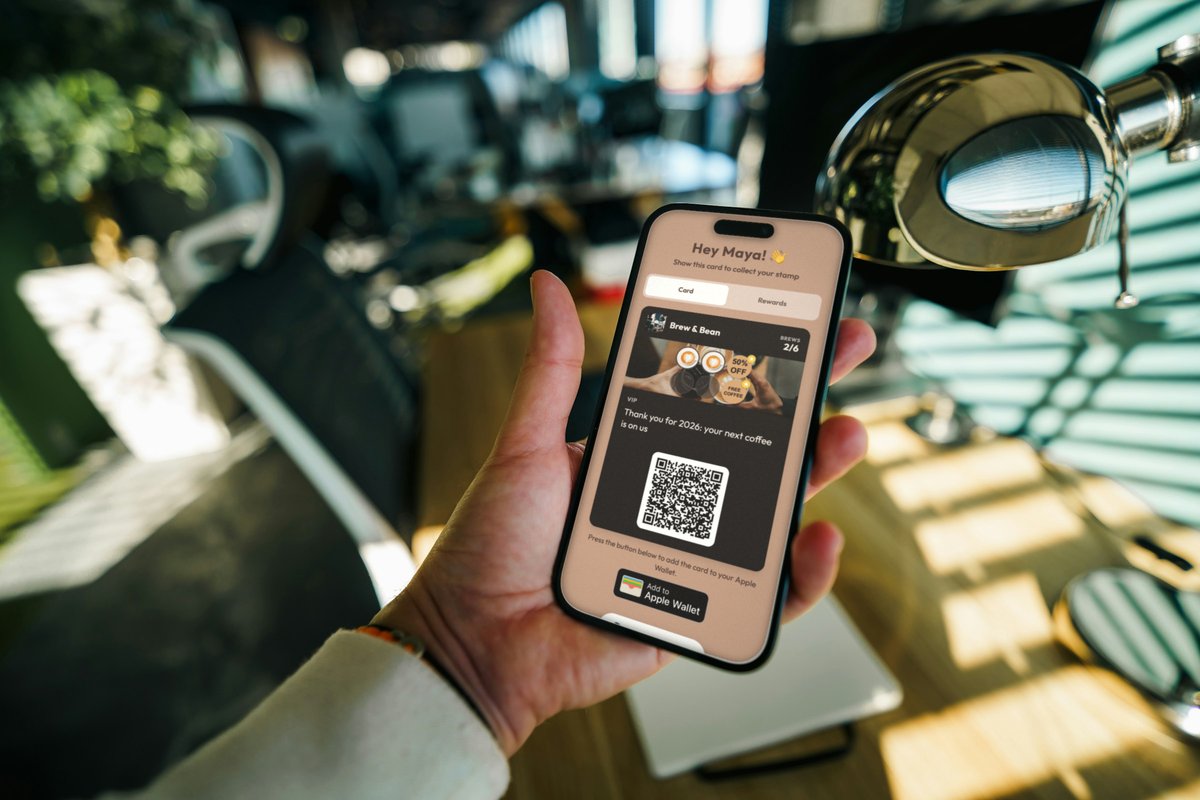
Last updated: September 2026
Search for customer incentive ideas and you’ll mostly find advice from gift card and rewards platforms, written for brands with a marketing department. A café owner or a barber needs something smaller: what do I give, to whom, for what, and what will it cost me?
This guide follows the customer from the first visit to the day they stop coming, and gives one or two incentives for each step. For each one you’ll find why it works, what it costs you, and an example from a real kind of shop. The headings are questions owners actually ask, on Google and in threads like “how do you successfully drive repeat visits without discounts?” in r/smallbusiness.
The short answer:
- Match each incentive to one action. A first visit, a sign-up, a return visit, a referral. An incentive that asks for nothing in particular is just a discount.
- Prefer a free add-on to a percentage off. It feels generous and costs you the price of the add-on, not a slice of every sale.
- Start the loyalty card at one stamp and put a small reward partway through, so the first reward is close.
- Use recognition before rewards. Names and usual orders cost nothing.
- Put an end date on every offer, and never offer anything for a review.
What are some examples of customer incentives?
A customer incentive is something you give to prompt one specific action. For a local business, the useful ones line up with the steps of a customer’s relationship with you:
| Step | What you want | A typical incentive | Idea |
|---|---|---|---|
| First visit | Someone new tries you | A free add-on with the first order | 1–2 |
| Sign-up | They take your loyalty card | The first stamp on the house | 3–5 |
| Repeat visit | They come back, again and again | Recognition, a free add-on, early access | 6–8 |
| Referral | They bring a friend | A reward for both of them | 9 |
| Review | They tell others | Nothing. Ask, don’t pay | 10 |
| Slow day | They come on a quiet afternoon | A same-day offer | 11–13 |
| Win-back | A regular who stopped returns | A personal offer with an end date | 14 |
| Milestone | They stay for years | A birthday treat, a thank-you | 15–17 |
If you already run a loyalty card and want ready-made offers for it, our loyalty card promotion ideas go deeper on the promotions themselves. This guide is about choosing the right incentive for each step.
How do you get someone to try you the first time?
Give newcomers something extra, not something off. A free add-on makes the first visit feel generous without teaching people that your normal price is negotiable.
1. A first-visit add-on
A free pastry with a first coffee. A free brow tidy with a first cut and color. A hot towel with a first haircut. Say it on your door sign, your Instagram bio and your Google Business Profile, so people see it before they decide where to go.
- Why it works: it lowers the risk of trying somewhere new, and the customer still pays full price for the main thing.
- What it costs you: the add-on itself, once per new customer. A pastry you bake anyway costs you its ingredients, not its menu price.
- Example (barber): “New here? Your first cut comes with a hot towel finish.”
2. A neighbor offer
Team up with a business next door that shares your customers but doesn’t compete with you: a gym and a juice bar, a nail studio and a café, a barbershop and a bike shop. Each leaves a small card at the other’s counter: “Show this for a free size upgrade.”
You pay for a few printed cards, and for the upgrade only when someone walks in with one. The recommendation comes from a place the customer already trusts, which does more than any flyer. A yoga studio handing out a free oat milk upgrade after class is a good match for the café on the corner.
How do you get customers to sign up for your loyalty card?
Ask every customer at the register, and make the card worth taking today. The sign-up is the step most worth paying for. In a joint Toast and Resy report, covered by Customer Experience Dive on June 2, 2026: “Restaurants that can get a guest to sign up for loyalty programs shift that customer’s return rate from a baseline 7% to nearly 30%.“
3. The first stamp on the house
Start every new card at one stamp instead of zero. An empty card asks for eight visits. A card with one stamp asks for seven, and the customer has already begun.
- What it costs you: one stamp’s share of the reward. On an 8-stamp card for a free coffee, that’s an eighth of a coffee per sign-up.
- Example (café): “Want our loyalty card? It’s one scan, and your first stamp is on us today.”
Our guide to promoting a loyalty program covers where to put the QR code and what the sign should say.
4. A small reward partway through the card
Put a small reward in the middle of the card and the big one at the end. The first reward then arrives in weeks, not months, which matters more than it sounds. In our study of 23,296 loyalty stamps from 1,013 small businesses, cards designed to be completed in 2 to 4 weeks were finished 11.4% of the time, against under 2% for cards that take 16 weeks or more.
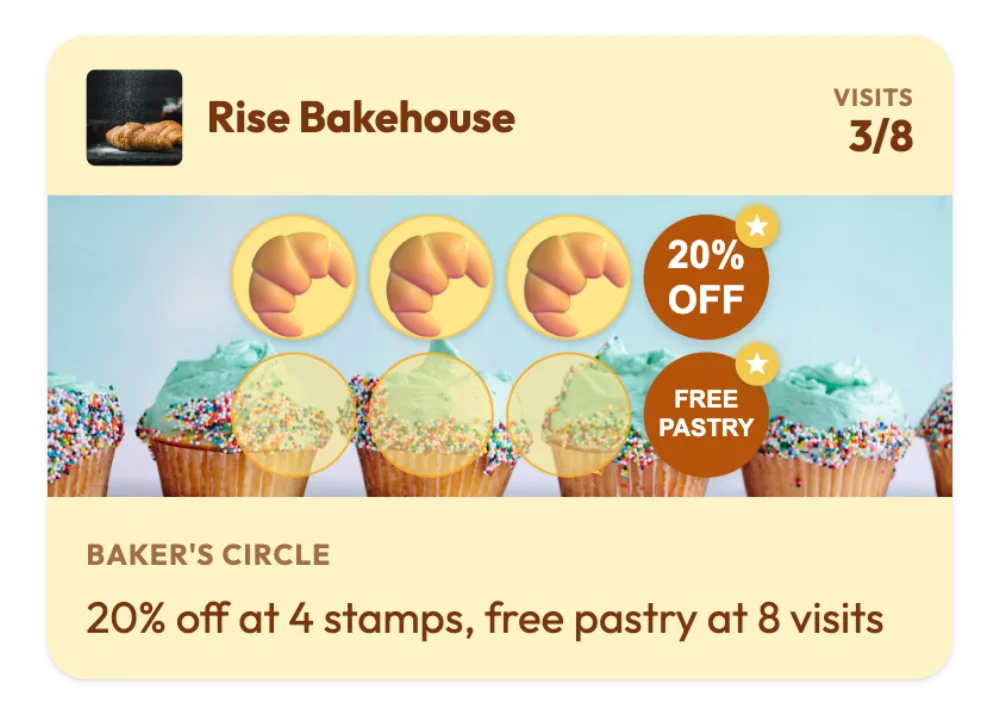
A FaveCard stamp card with two rewards on it. The owner sets how many stamps the card has, where the rewards sit and what they are.
- What it costs you: the small reward, once per card. You can make it a discount on the next visit, so it pulls the customer back in by itself.
- Example (salon): a 5-visit card with a free fringe trim at visit 3 and a free treatment at visit 5.
5. Ask a question at sign-up, then use the answer
This one isn’t a reward you hand over. It’s what makes every later incentive feel personal. Ask one or two short questions when the customer joins, like their favorite drink or who usually cuts their hair, and use the answer next time. Keep it to two or three questions at most. Our list of loyalty card signup questions has examples for every trade, and which ones not to ask.
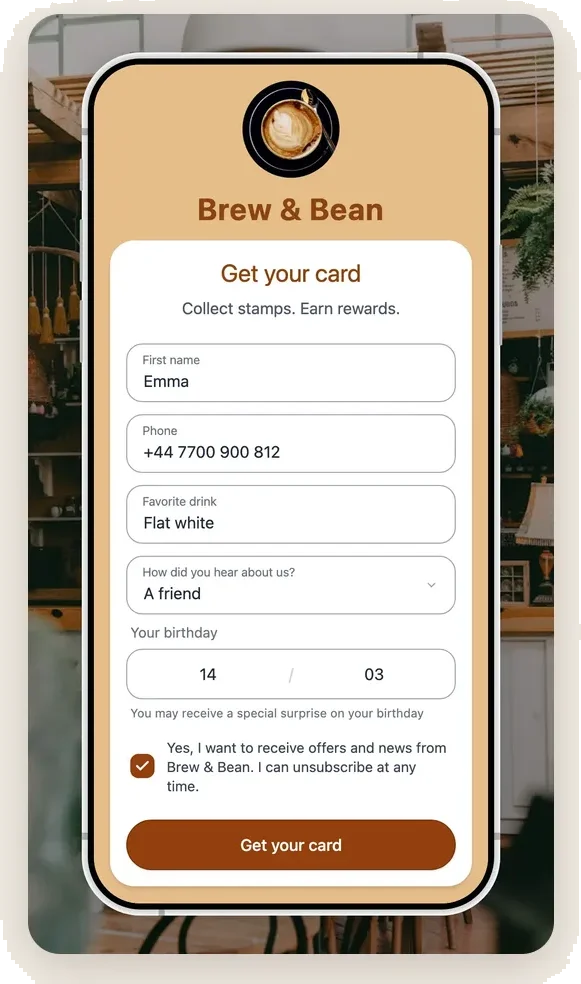
A FaveCard sign-up form with a favorite drink question and “How did you hear about us?”. The birthday field is there on every plan.
How do you drive repeat visits without discounts?
Recognize people, then give them small extras they didn’t have to earn. Discounts do bring people back, but they cost you on every sale and customers quickly start to wait for them.
6. Recognition: names and usual orders
The same Toast and Resy report asked diners what makes them feel valued. As Customer Experience Dive put it: “Diners said human recognition — staff remembering a name or a usual order — was the No. 1 factor that made them feel valued, selected by about half of respondents. Points-based loyalty reward came in at a distant second, selected only by 22% of respondents.”
Recognition costs nothing, but it needs a system, because nobody remembers 300 regulars. Write the name and the usual order down where your whole team can see them at the counter.
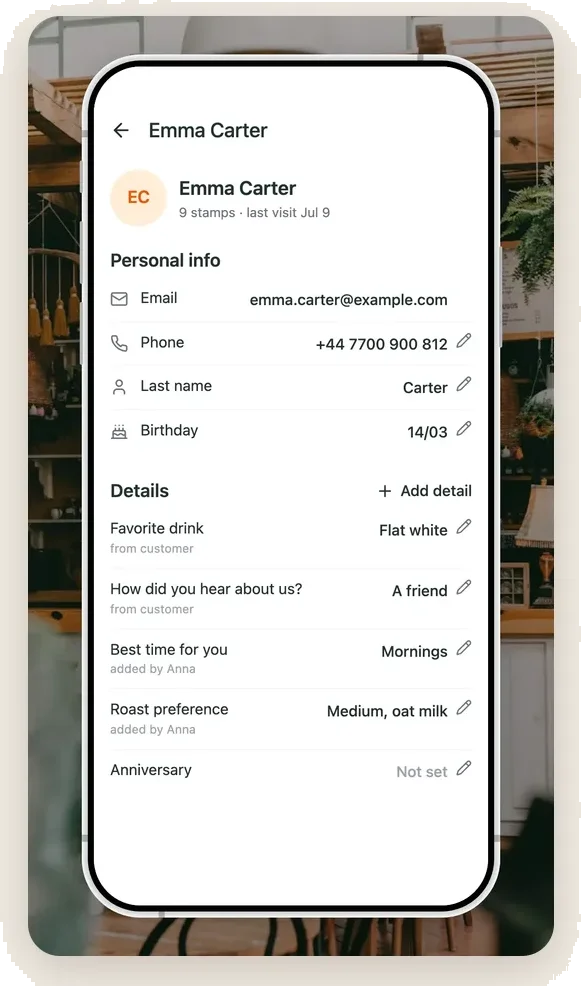
A customer’s details in the FaveCard app. Some answers come from the sign-up form, others were added by staff.
- Example (barber): “Same as last time, number two on the sides? And how did the half marathon go?“
7. A free add-on instead of a percentage off
Compare the two on a $5 latte. Ten percent off costs you 50 cents on every coffee, for every customer who uses it, including the ones who would have come anyway. A free extra shot or syrup costs you only what goes into the cup, and the customer still sees it as a treat. The same works in a salon (a conditioning treatment with a color) and in a barbershop (a beard line-up with a cut).
- What it costs you: the ingredient or the extra minutes, not a share of the price.
- Where it fits: as a card reward, as a thank-you, or as a slow-day offer (see idea 11).
8. First taste for cardholders
When you launch something new, let your loyalty customers try it first: a sample of the new fall drink, a first look at next season’s colors, a new beard oil to smell at the chair. Tell them a few days before everyone else.
All it costs is a few samples. In return, regulars get to feel like insiders, and you find out whether the new item is any good before you print the menu.
For more ideas that reward regulars, see how to reward loyal customers.
Do referral rewards work for a small business?
Yes, if both people get something and the reward comes after the friend’s first visit. A friend who comes on a regular’s recommendation already trusts you, and no flyer can give you that.
9. A two-sided referral reward
Give the new customer a first-visit add-on, and give the person who sent them the same add-on on their next visit. Pay out only when the friend actually comes in, not when someone says they’ll tell a friend.
- What it costs you: two add-ons per new customer.
- How to track it: ask “How did you hear about us?” when people sign up for your card, with “A friend” as one of the answers, and ask who. A paper referral card with the regular’s name on it also works.
- Example (salon): “Send a friend our way. When they come in, you both get a free deep conditioning treatment.”
Keep referrals and reviews apart. A referral reward is fine; a reward that depends on someone posting a review is not.
Can you offer customers an incentive for a review?
No, not on Google. Google’s policy doesn’t allow discounts, free goods or services, or other incentives in exchange for a review, and a loyalty stamp or a prize-draw entry counts. It doesn’t matter whether the review is positive or negative. Our guide to whether you can incentivize Google reviews quotes the policy and what US and EU law add.
10. Ask everyone, and make it one tap
What you can do: ask every customer the same way, whether the visit went perfectly or not, and put a review link or QR code where it’s one tap away. Thank reviewers with a reply, not a reward.
Thanks for coming in. If you’ve got a minute later, an honest Google review really helps a small place like ours. The QR code by the register takes you straight there.
What incentives work on slow days?
A same-day offer to people who already know you. On a quiet Tuesday your staff and rent cost the same whether the chairs are full or empty, so an extra customer that afternoon costs you only the offer.
11. The today-only offer
Send it on the morning of the slow day, to customers who already have your card, and make it end at closing time. “Free pastry with any drink, today only.” People plan their week around their routine; a same-day offer nudges someone who was going to come on Thursday to come today.
- What it costs you: one add-on per customer who comes.
- Example (nail studio): “Quiet afternoon here. Free nail art on any manicure booked for today.”
12. A short happy hour
Pick the two emptiest hours of the week and put an offer on them only: “Free cookie with any coffee, 2 to 4 pm.” A short window stops the offer from eating into your busy hours.
13. Double stamps on your slowest day
Two stamps for one visit, on one day of the week. It shifts regulars from your busiest day to your quietest. Nothing leaves the till today. The cost shows up later, because every double stamp brings a free coffee closer. Run it for a month before you make it weekly.
The trap on slow days is a storewide percentage off, advertised to everyone. It brings in bargain hunters who may never come back at full price. For more on quiet hours, see our loyalty card promotion ideas.
How do you bring back regulars who stopped coming?
Send a short, personal message with a small offer and an end date. A regular who drifts away hasn’t always found somewhere better. Often their routine changed (a new job, a new commute) and they need one reason to come back.
14. The we-miss-you offer
Pick the regulars who used to come every week and haven’t been in for a month, or the salon clients who are two appointments overdue. Send them something small they can claim within 7 to 14 days: “It’s been a while! Your next coffee is on us this week.”
- Why it works: it’s personal, it’s easy to say yes to, and the end date turns “some time” into “this week”.
- What it costs you: one item, only for the people who come back.
- Don’t: send it to everyone. If your regulars get it too, they learn that staying away earns a free coffee.
Our guide to bringing back inactive customers covers who to contact and when.
How should you reward milestones and your best regulars?
Mark the moments customers notice: their birthday, a big round visit, a year with you. They cost little because they’re rare, and they’re the incentives people tell friends about.
15. A birthday treat
Ask for the birthday (day and month, not the year) when people join your card, and give them something free during their birthday week: a drink of their choice, a free add-on to their next appointment. Let them claim it for a few days, not just on the day itself. Our birthday marketing ideas have 21 variations.
16. The 50th visit or the one-year mark
Pick a round number (the 50th coffee, the 20th cut, a year since the first appointment) and give something bigger than the usual reward, with a sentence from the owner. It works best as a surprise, not as a published rule.
- Example (barber): a free hot towel shave on a client’s first anniversary with the shop, and their name on the chalkboard that day.
17. A thank-you for your top regulars
Once or twice a year, pick your 20 most loyal customers by hand and thank them: a free coffee this week, a first look at the new menu, a free treatment. You know who they are better than any rule does.
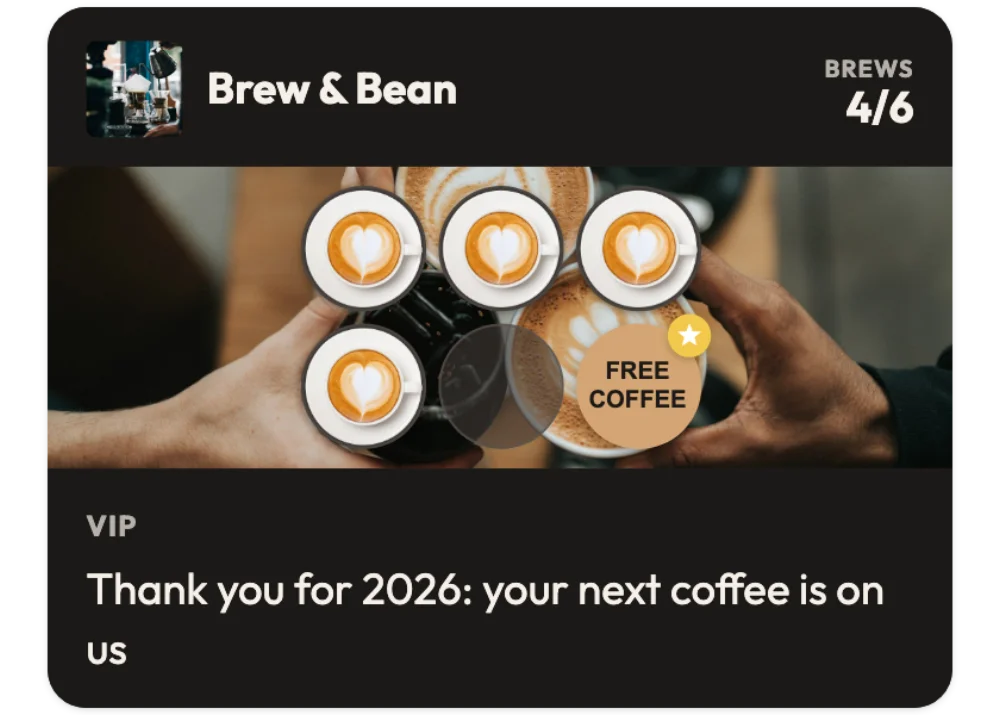
A thank-you offer shown on a customer’s FaveCard loyalty card during a VIP Thank You campaign.
18. Prize draws and giveaways, carefully
A monthly draw among your loyalty members (a free month of coffee, a free cut) can create some buzz. But the rules for prize draws, raffles and sweepstakes vary from country to country, and in the US from state to state. Check what applies where you operate before you run one, and never make a review a way to enter. For most small shops, the ideas above do the same job with less paperwork.
Which incentives cost the least for what they do?
Recognition and free add-ons give the most for the least. Percentage discounts and prize draws cost the most for what you get back.
| Incentive | What it costs you | What it’s good for | Watch out for |
|---|---|---|---|
| Recognition (names, usual order) | Nothing but a system to remember | Repeat visits, loyalty that lasts | Doesn’t work if it lives in one person’s head |
| Free add-on | The add-on’s cost, per use | First visits, rewards, slow days | Pick add-ons that are cheap to make |
| First stamp on the house | A fraction of one reward | Loyalty sign-ups | Only works if you actually ask |
| Small reward partway through | One small reward per card | Getting people to the second and third visit | Keep the card short |
| Early access, first taste | A few samples | Making regulars feel like insiders | Needs something new to show |
| Two-sided referral reward | Two add-ons per new customer | New customers who arrive trusting you | Pay only after the friend visits |
| Same-day slow-day offer | One item per visitor, on a quiet day | Filling empty hours | Send it to people who know you, not everyone |
| We-miss-you offer | One item per returning customer | Winning back lapsed regulars | Don’t send it to active regulars |
| Percentage discount | A share of every sale it touches | A quick bump in traffic | Customers learn to wait for it |
| Prize draw | The prize, plus your time on the rules | Buzz, social posts | Rules vary by country and state |
How do you keep incentives from turning into a discount machine?
Tie every incentive to one action, one group of customers and one end date. A thread in r/smallbusiness asks whether anyone has made a loyalty program profitable “without turning it into a discount machine”. Programs that end up there usually break one of these rules:
- Every offer asks for something. A first visit, a return this week, a friend. “10% off, all month” asks for nothing.
- Every offer goes to the right people. Win-back offers to lapsed customers only. Slow-day offers to people who already know you.
- Every offer ends. Today, this week, within 14 days. An offer that never ends becomes your new price.
- You can afford it on a busy day. If the offer would lose you money on a busy Saturday, run it on a quiet Tuesday.
For the bigger picture of how these pieces fit into one program, see our guide to building a customer rewards program and our 7 strategies for repeat customers.
How to run these incentives in FaveCard
Everything above works with paper cards and a notebook. Here’s how it looks in FaveCard, with the product’s real settings and wording.
The stamp card (every plan). You set the number of stamps, the rewards and where they sit on the card, so a first stamp on the house or a small reward at stamp 4 is a setting, not a workaround. Customers don’t download an app.
The sign-up form. On every plan it asks for a first name, an email address and a birthday. On the Business plan you can add ready-made questions, such as a favorite drink or “How did you hear about us?” (with “A friend” as an answer), or write your own. The answers show up on the customer’s profile for your team. See know your regulars.
Birthday automation (Business). You write the birthday message and the offer once, choose how many days it stays on the card, and can also send a birthday email. It then goes out automatically, once a year, in each customer’s time zone.
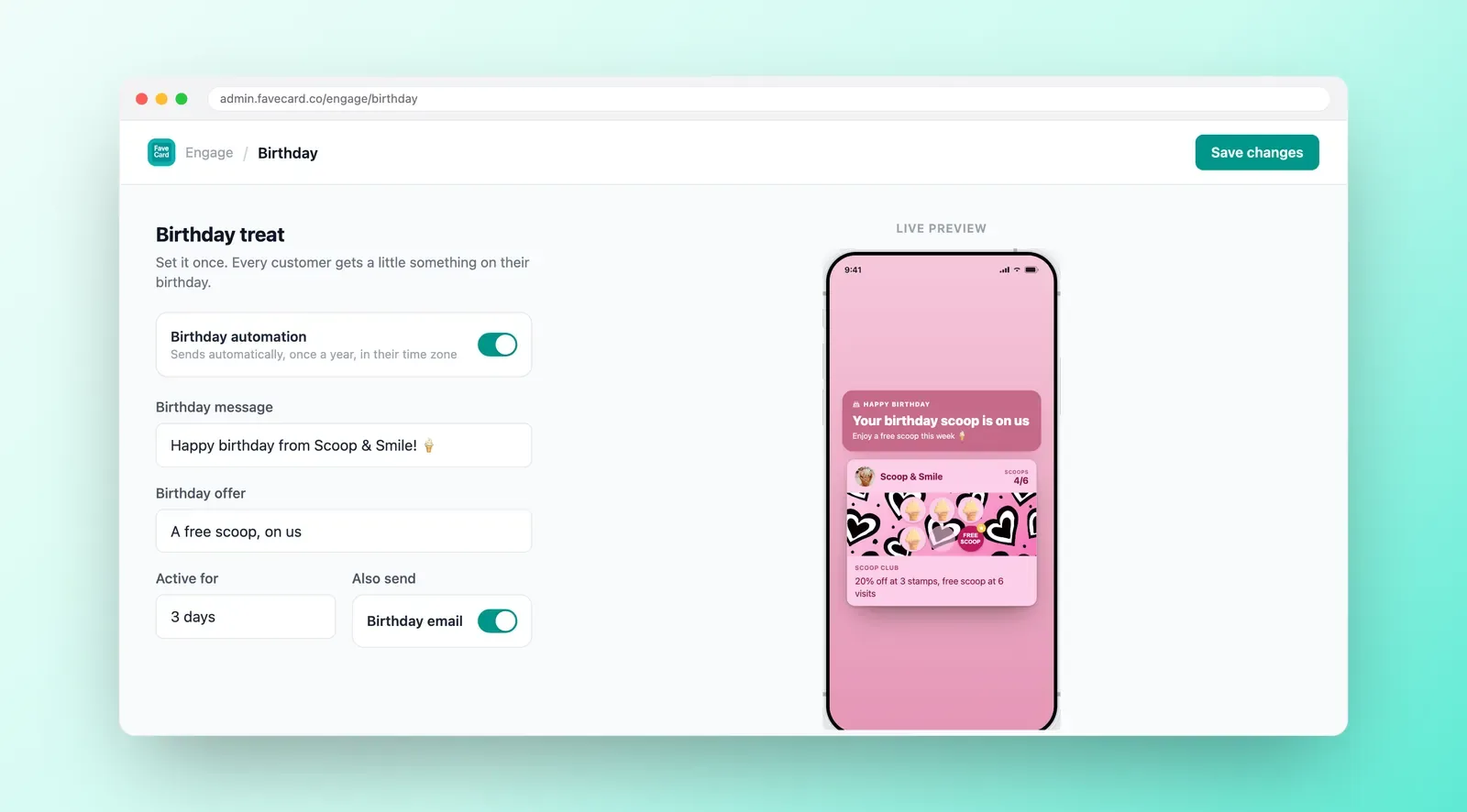
The birthday automation settings in the FaveCard dashboard, with a live preview of the card.
Campaigns (Business). A campaign puts an offer on your customers’ cards for a set time, with a notification to customers who keep the card in their wallet. The card goes back to normal after the customer’s next visit, or when the campaign ends. Campaigns run one at a time; the templates offer lengths from 2 hours to 14 days, and you can set any end time from 1 hour to 30 days. Seven ready-made templates map onto the ideas in this guide:
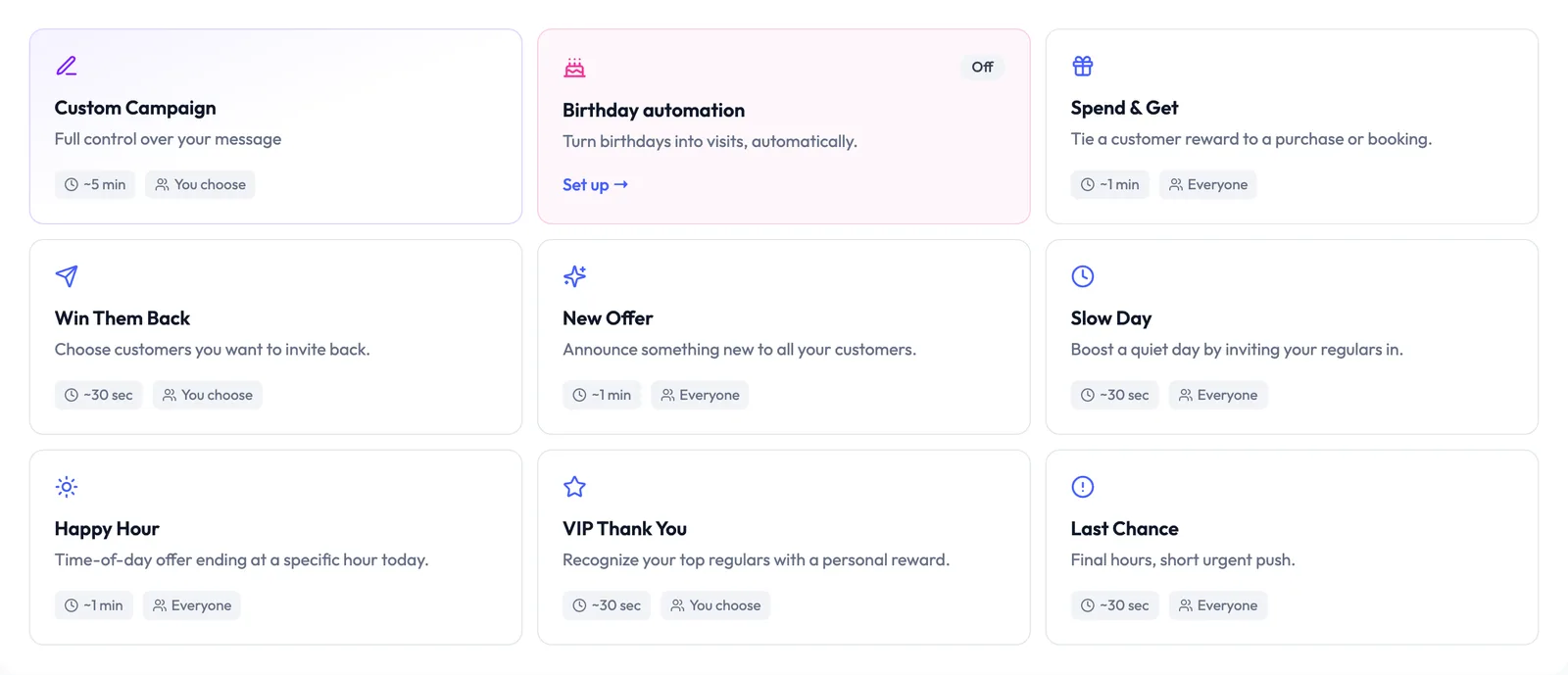
The campaign picker in the FaveCard dashboard. Birthday automation has its own settings page.
| Template | Default wording (you can edit it) | Who gets it, for how long |
|---|---|---|
| Spend & Get (idea 7) | “Free gift when you spend $40 or more. This week only.” | Everyone, lapsed customers or people you pick; tomorrow to 14 days |
| New Offer (idea 8) | “New on the menu! First taste on us this week” | Everyone by default; today to 7 days |
| Slow Day (idea 11) | “Free coffee waiting for you today only” | Your active customers; today to 3 days |
| Happy Hour (idea 12) | “Happy hour until [the hour you pick]: 2-for-1 drinks, stop in!” | Everyone by default; until a set hour, or the next 2 to 4 hours |
| Win Them Back (idea 14) | “We miss you, free coffee on your next visit this week” | Customers you pick; 3, 7 or 14 days |
| VIP Thank You (idea 17) | “Coffee on us this week, thanks for being a regular” | Customers you pick; 3, 7 or 14 days |
| Last Chance (quiet evenings) | “Last 2 hours: 50% off everything, grab it before close!” | Everyone by default; 2 to 6 hours |
The defaults are shown without their emoji. Each template also offers alternative wording, such as “Bonus stamp, valid 7 days” for a win-back or “Free pastry with any drink, today only” for a slow day.
Kiosk mode (Business). A spare tablet or phone at the counter shows a QR code customers scan to join and collect a stamp themselves, so nobody leaves without a card when the queue is long. After scanning, the customer sees their card, and the reward if they’ve reached one. See kiosk mode.
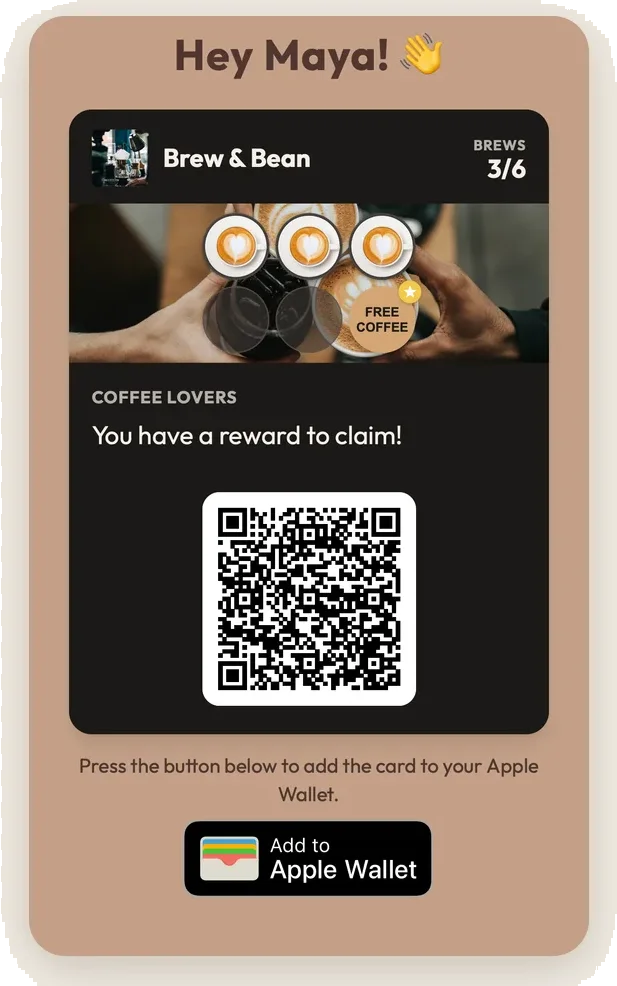
The customer’s screen after collecting a stamp at a FaveCard kiosk: a small reward reached at 3 of 6 stamps.
FaveCard has no built-in referral program. Referrals work as in idea 9: ask how people heard about you, and add the reward yourself.
Signup questions, birthday automation, campaigns and kiosk mode are part of the Business plan, and they’re included in the free trial for your first 30 customers. See pricing for what each plan includes, and the campaigns page for how a campaign looks on the card.
Where to start
Don’t run all 18 at once. Pick one incentive for the step where you lose the most customers. For most shops that’s the sign-up (idea 3) or the second visit (idea 4). Run it for a month, then add the next one.
Frequently Asked Questions
What are some examples of customer incentives?
For a local business: a free add-on with a first visit, the first stamp on a loyalty card, a small reward partway through the card, a free drink or service for a referred friend and the customer who sent them, a same-day offer on a slow afternoon, a we-miss-you offer with an end date, a birthday treat, and a thank-you for your most loyal regulars. The cheapest incentive of all is recognition: using a customer's name and remembering their usual order.
What is a customer incentive program?
It is a planned set of rewards that each ask for one specific action: a first visit, a sign-up, a return visit, a referral. For a café, salon or barber, the core is usually a stamp card, with a few short offers added at the moments that need a push, such as slow days or customers who have stopped coming.
How do you incentivize customers without discounts?
Give something with a high value to the customer and a low cost to you: a free add-on (an extra shot, a conditioning treatment, a beard line-up), early access to something new, or plain recognition. In a joint Toast and Resy report covered by Customer Experience Dive on June 2, 2026, about half of diners said staff remembering their name or usual order made them feel most valued; points came second at 22%.
Can I give customers an incentive for leaving a Google review?
No. Google's policy does not allow discounts, free goods or services, or other incentives in exchange for a review, and that includes a loyalty stamp or a prize-draw entry. Ask every customer the same way, make it one tap with a review link or QR code, and keep rewards for visits and purchases.
Are referral rewards allowed?
Yes. Rewarding a customer when a friend they sent comes in is a normal practice. Give the reward after the friend's first visit, give the friend something too, and keep it separate from reviews: a referral reward must never depend on anyone posting a review.
Can I run a prize draw or giveaway for customers?
Often yes, but the rules for prize draws, raffles and sweepstakes vary from country to country, and in the US from state to state. Check the rules where you operate before you run one, and never make a Google review a way to enter.