




Coupon Terms and Conditions for a Local Business
Plain coupon terms and conditions for cafés, salons, and local shops: fine print to copy, a policy for expired coupons, and EU, UK, and US rules.
In short
Write four to six plain lines right below your coupon offer—who qualifies, what purchase is required, one per customer or single use, no combining with other offers, and the last valid date—and keep a short counter policy by the till so staff know when to bend on a recently expired coupon.
Last updated: November 2026
Good coupon terms and conditions do one job for a local business: they let a busy barista, stylist, or cashier apply an offer in seconds without an argument at the counter. Below are ready-to-copy lines for a café, a hair salon, and a car wash, an expired-coupon policy, and the discount rules.
What are coupon terms and conditions?
Coupon terms and conditions are the four to six plain lines below an offer that explain who qualifies, what purchase is required, and when the deal ends. Clear rules let staff apply a discount in seconds without an argument at the till.
Most coupon disclaimer guides assume an online checkout checks a code against a cart, whereas at a local counter staff have only seconds to check a paper card or phone screen while a queue waits. While the headline invites the visit (see our coupon templates for the five front lines), plain rules below—like “With any hot drink” or “Last day included.”—prevent misunderstandings before anyone orders.
What should the fine print on a coupon say?
The fine print on a local business coupon should state five things: who gets the offer, what purchase qualifies, how many times one person can use the coupon, which days or hours apply, and the last valid date. Include only rules staff actually check.
In Voucherify’s 2025 analysis of May–June 2023 campaigns from 50 popular e-commerce brands, 76% included “not valid with any other promotional offer”, 64% listed product exclusions, 56% set time limits, 52% added “not transferable and not redeemable for cash”, 42% capped use at “1 per customer”, and 18% set a spending threshold. Online checkouts enforce long exclusion lists automatically; at a counter, keep only the four to six lines staff check:
| Line on the coupon | Why it matters at the counter | Plain wording |
|---|---|---|
| Who gets it | Keeps welcome deals for first visits | ”New customers” |
| Qualifying purchase | Ties the reward to a paid item or spend | ”With purchase: any hot drink” or “When you spend at least $10” |
| Usage limit | Caps uses per person, car, or table | ”One per customer” (paper) or “Single use” (digital) |
| Combining deals | Protects margin alongside combos | ”Can’t be combined with other offers” |
| Valid days and hours | Keeps deals to quiet hours | ”Only on Tuesday–Thursday, 14:00–17:00” |
| Last valid day | Confirms the printed end date counts | ”Valid until [date]. Last day included.” |
| Cash alternative | Shows the till pays no cash or change | ”No cash value.” |
Three ready-to-copy sets by trade:
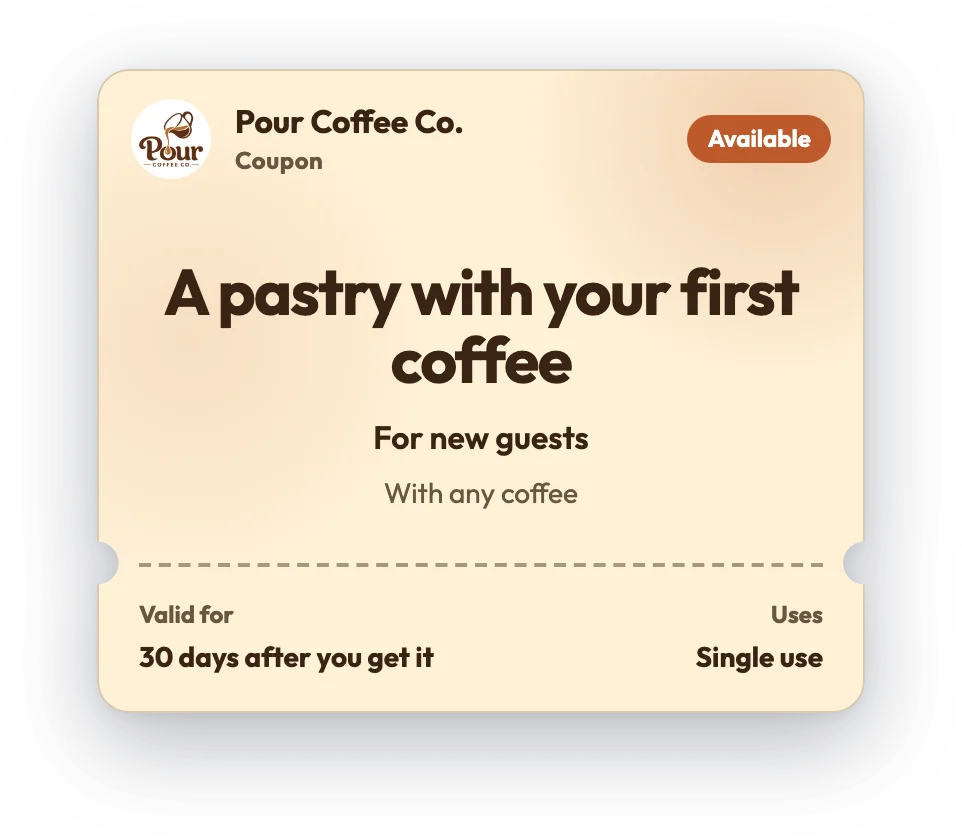
Example: Café — printed welcome card for a free pastry
- With purchase: any barista-made drink.
- New customers only. One per customer.
- Can’t be combined with other offers or breakfast combos.
- Valid until [date]. Last day included. No cash value.
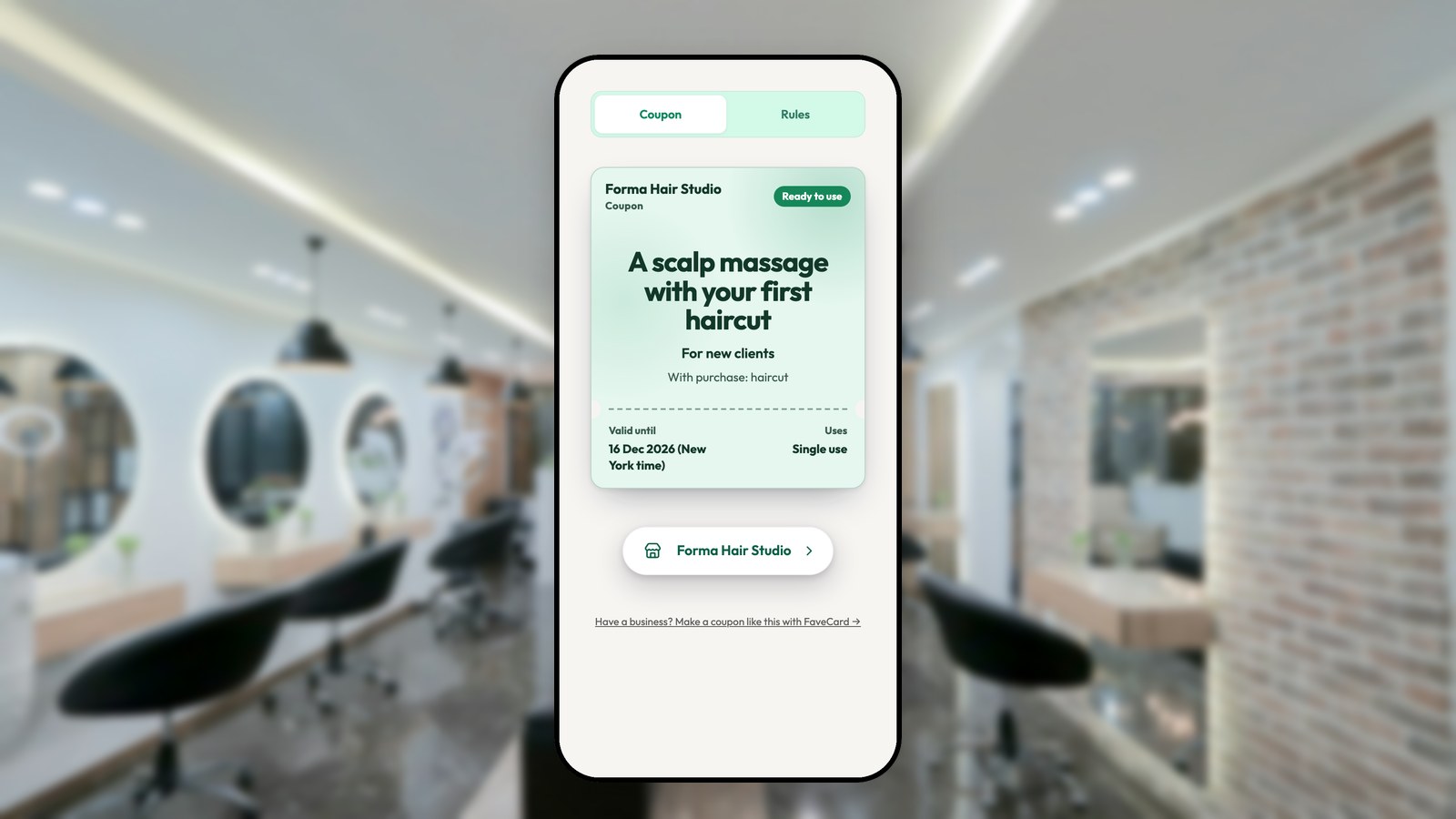
Example: Hair salon — digital quiet-hours coupon for a free treatment
- With purchase: cut and blow-dry.
- Valid Tuesday to Thursday, subject to availability.
- Single use. Mention when booking.
- Can’t be combined with other offers.
- Use it by [date] at the latest. Last day included.
Example: Car wash — printed upgrade card for free hot wax
- With purchase: any standard exterior wash.
- One per vehicle per visit (standard cars and SUVs).
- Can’t be combined with wash books or other offers.
- Valid until [date]. Last day included. No cash value.
Which lines can a local business leave out?
A local business running one shop can leave out chain-store fine print such as “void where prohibited”, “at participating locations”, “cash value 1/100 of a cent”, and “other restrictions may apply”. Cut any line that changes nothing at your counter.
Four template lines to leave out:
- “Void where prohibited”: written for offers across many states or countries with different laws; for one shop under one set of laws, it adds nothing and cannot make an offer legal.
- “At participating locations only”: needed when franchisees can opt out. If every branch you own takes the coupon, cut it; otherwise print the street address.
- “Cash value 1/100 of a cent”: a US habit from old state trading-stamp laws so one coupon works in every state (a few US states may still expect a stated value). For your own offer, “No cash value” says it plainly.
- “Other restrictions may apply”: a vague catch-all never replaces a real rule, and the UK and US rules below ask for the conditions that matter to be stated with the offer. Name the real limit (“Monday to Thursday only”) or drop it.
What does “one per customer” mean, and how do you enforce it?
“One per customer” on a coupon means one redemption per person—or per visit, table, or vehicle when you name that unit. Keep paper coupons in the till once redeemed, or scan a single-use digital coupon so the pass cannot be used twice.
Match the unit to how you charge:
- Per person (“One per customer”): cafés, bakeries, barbershops, and salons.
- Per visit (“One per customer per visit”): stops two coupons on one bill.
- Per table (“One coupon per table, even on split bills”): stops a group splitting checks to stack coupons.
- Per vehicle (“One per vehicle per visit”): car washes and oil-change bays.
With paper flyers—such as cards a neighbour shop hands out—keep each redeemed slip in the till so it cannot return. With digital coupons, scanning marks the pass used, and tying a welcome deal to a confirmed email stops people reusing a public code (see how to stop a coupon being used twice).
In FaveCard, the coupon maker prints “One per customer” on paper and “Single use” on a digital coupon (since nobody can check single use on paper), and a personal link states “This link is for one person. It works only with that email.” Staff scan the pass in the FaveCard app; a second scan shows “This coupon was just used at 2:41 PM. Do not give it again.”
How long should a coupon be valid, and what if it has no date?
A local business coupon should match its validity window to how often customers return in your trade, with a clear final date and time zone. Print “Last day included” so the end date is clear, and honour an undated paper coupon once before retiring the card.
Match the window to visit frequency (see how long a coupon should last) and close two gaps:
- Say whether the final date counts: write “Valid until 30 December. Last day included.” or “Use it by 30 December at the latest.”
- Name the time zone on digital coupons: stating that dates and times follow your shop’s time zone prevents midnight cutoff confusion.
For undated paper coupons, set one house rule: many owners honour an undated card once, keep the slip in the till, and put dated cards out instead. For a season-long offer, a dated paper card or till code fits better.
In FaveCard, a coupon’s last day can be at most 30 days ahead, counting today; the coupon maker explains: “Up to 30 days: long enough to come in, soon enough not to forget.”
What do you do with an expired coupon, a typo, or a second coupon?
Once a promotional coupon passes its expiry date, accepting the offer is a goodwill choice rather than an obligation, so write a short counter policy before starting. Forgive a coupon that expired a few days ago, honour a typo favouring the customer if you can, and decline a second use.
Keep a three-line “when to bend” note by the till:
- Expired by a few days: accept a recently expired coupon as a one-off gesture (“That one ended on Sunday, so I’ll put it through today”). If it expired months ago, decline warmly and offer your stamp card.
- A typo or missing condition: if a card says “Free muffin” without “with any hot drink”, honour it as printed if you can and fix the next batch; changing rules at the counter hurts trust.
- A second coupon or wrong day: hold the line calmly on single-use and quiet-hour limits, and offer to book a Tuesday–Thursday slot.
In FaveCard, scanning a past-date coupon in the FaveCard app shows “Expired” with a “What to tell the customer” note explaining that Apple Wallet or Google Wallet sets an expired coupon aside.
Do you need “no cash value” and “cannot be combined with other offers”?
A promotional coupon needs “Can’t be combined with other offers” whenever you run everyday deals like lunch combos, student cuts, or multi-buy bundles, so discounts never stack. Add “No cash value” to any free-item or money-off coupon so the till never owes cash or change.
Most shops run everyday counter deals—a café breakfast combo, a student haircut price, a bakery closing markdown, or a prepaid wash book. Adding “Can’t be combined with other offers” stops a coupon stacking on a low-margin bundle; state plainly if it still earns a loyalty stamp, and exclude buying gift vouchers. “No cash value” ensures the till never pays change when an order costs less than the discount.
Are there rules for discount coupons in the EU, the UK, and the US?
Discount coupon rules differ across the EU, the UK, and the US, but all three aim to stop misleading offers and surprise conditions at the till. State main restrictions and closing dates beside the offer, and across the EU show the 30-day lowest price on price tags for general goods discounts.
Here is what each rule states:
- European Union (price reductions on goods): Across the EU, Article 6a of Directive 98/6/EC—inserted by Article 2(1) of Directive (EU) 2019/2161—states that a price-reduction announcement on goods must show the prior price, defined as the lowest price applied during at least the 30 days before the reduction (member states may vary rules for perishables, goods on the market under 30 days, or progressive cuts). Under European Commission guidance (2021/C 526/02, sections 1.1, 2.2, 2.3, and 3), the prior price goes on the price tags at the point of sale, not necessarily on the coupon. The 30-day rule covers general goods discounts such as “Today 20% off with code XYZ” and members-only sales like “This weekend 20% off on everything for loyalty members only” when most customers are members. Outside Article 6a are real personal vouchers (next purchase, birthday, or joining your loyalty programme), standing loyalty discounts and points schemes, services, and conditional offers like “buy one, get two” or “30% off when buying three”. A haircut or car wash is a service—while salon-shelf shampoo or café coffee beans are goods—and services and conditional offers stay under the general rules against misleading prices.
- United Kingdom (promotional terms): For UK ads and promotions, CAP Code rule 8.17 states that marketing communications “must communicate all applicable significant conditions” where omitting them is likely to mislead, including restrictions and closing dates where they apply.
- United States (“free” offers): Under the US federal guide on the word “free” (16 CFR 251.1(c) and (h)), all terms, conditions, and obligations of a “free” offer should appear “clearly and conspicuously at the outset” and “in close conjunction with the offer”. In addition, a “free” offer on any single size of a product or single kind of service should not run in a trade area for more than 6 months in any 12-month period.
Because national, state, and local rules vary, check your local rules or ask a local adviser if you are unsure how a rule applies.
Is a coupon the same as a gift voucher?
A promotional coupon is not the same as a gift voucher: a coupon is a free marketing discount, whereas a gift voucher or gift card is prepaid credit bought with money. Never copy short coupon expiry dates onto paid gift vouchers, which follow separate rules.
In the UK, Ireland, Australia, and much of Europe, people call both a free deal (“a voucher for a free pastry”) and a paid gift card (“a £50 salon gift voucher”) a “voucher”. At the till, ask one question: did someone pay money for the voucher? (More on the two words in coupon vs voucher.)
For a free promotional coupon, you set the qualifying purchase and short end date. For a paid gift voucher or gift card, the law in many places sets a minimum life, and elsewhere general consumer-fairness rules apply—check yours (see whether gift cards expire).
How do you add the terms when you make a coupon?
When you make a coupon, put the key terms—what purchase qualifies, one per customer or single use, and the last valid date—right beneath the offer on your card, receipt, or digital pass. A good template or coupon maker fills in the expiry date and one-use line automatically.
Pick the format that fits your counter:
- A printed card or flyer: best when you or a neighbour shop hand out cards that staff keep in the till.
- A till receipt or booking message: best when your till or booking system prints a return offer on a receipt.
- A digital coupon or Wallet pass: best when customers claim an offer from a QR code, link, or email and staff scan phones.
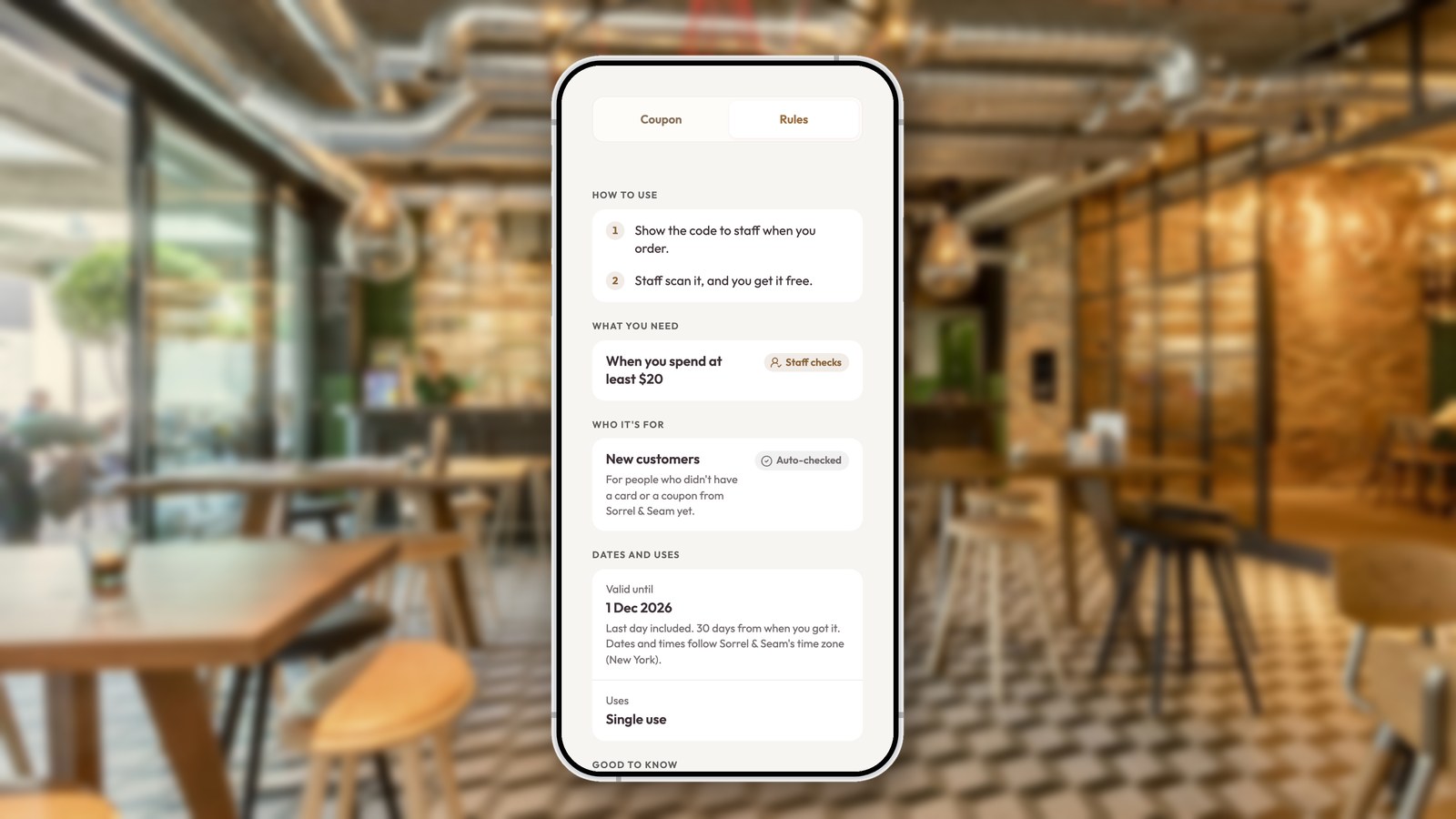
In FaveCard, the coupon maker fills in “Valid until” (up to 30 days ahead, counting today) plus “One per customer” on paper or “Single use” on a digital coupon. For a percentage offer in a European time zone, it also shows: “In the EU: if you raised prices or ran another promotion in the last 30 days, show the lowest price from those 30 days on your price tags or price list.” On a digital coupon, such as a clothing shop’s welcome coupon, the “Rules” tab next to “Coupon” splits what the pass checks by itself from what staff check: “Who it’s for: New customers” is marked “Auto-checked”, while “What you need: When you spend at least $20” is marked “Staff checks”. Customers also see “Last day included. 30 days from when you got it.” and “Dates and times follow Sorrel & Seam’s time zone (New York).”
Designing and printing a coupon with the coupon maker is free and needs no account. Giving FaveCard coupons to customers’ Apple Wallet or Google Wallet needs a FaveCard account: it is included in the 30-day trial, and then in the Business plan.
Frequently Asked Questions
Do coupons need a disclaimer or terms and conditions?
A few plain lines right below the offer save arguments at the till by showing customers how to qualify and staff how to apply the deal. Keep the fine print to the conditions you actually check: who gets the offer, what purchase qualifies, one per customer or single use, any day or hour limits, whether offers can be combined, and the last valid date.
What is the difference between 'One per customer' and 'Single use' on a coupon?
'One per customer' limits the promotion to one redemption per person, which is the plainest rule to print on paper because staff cannot tell how many paper copies someone has. 'Single use' fits a digital coupon that is marked as used once scanned at the counter, so the same pass cannot be redeemed a second time.
How long must I honour a coupon if I forgot to print an expiry date?
Set one clear counter policy for your staff: many owners choose to honour an undated paper coupon when a customer brings the card in, keep the paper slip at the till so it cannot come back, and replace the remaining flyers with dated ones. Because consumer rules on undated promotional offers vary, check your local rules before retiring an older batch.
Can customers combine two coupons on the same bill?
At the counter, customers often ask to use a coupon alongside a lunch combo, a weekday discount, or a loyalty reward unless your fine print says otherwise. Adding 'Can't be combined with other offers' protects your margin from stacked deals, and adding 'One coupon per table' in a café or restaurant stops a group from splitting a bill to use several coupons.
Does the EU 30-day lowest-price rule apply to a hairdresser, barber, or car wash coupon?
Across the EU, the 30-day lowest-price rule under Article 6a of Directive 98/6/EC applies to general price-reduction announcements on goods, where the prior price appears on the price tags at the point of sale. Under European Commission guidance 2021/C 526/02, services such as a haircut or a car wash, real personal vouchers (for a next purchase, a birthday, or joining your loyalty programme), standing loyalty discounts and points schemes, and conditional offers like 'buy one, get two' or '30% off when buying three' are outside Article 6a. Services and conditional offers still fall under the general rules against misleading prices, and retail products sold off a salon shelf count as goods.
Do I need an account to make a coupon with terms in FaveCard?
No account is needed to design and print a paper coupon with the coupon maker, which is free and fills in the expiry date and 'One per customer'. Giving digital coupons to customers' Apple Wallet or Google Wallet needs a FaveCard account: it is included in the 30-day trial, and then in the Business plan.