




Gym Loyalty Program: Reward Visits, Not Discounts
How to run a gym loyalty program that rewards check-ins: how many visits per reward, cheap rewards that work, self check-in limits and winning members back.
Key Takeaway: A gym loyalty program rewards members for each visit, not for what they pay: every check-in earns a stamp, and a set number of check-ins earns something free. Size the card so a typical member reaches the main reward within a few weeks, well inside eight: 8 check-ins for members who train two or three times a week, 6 for members who come about once a week. Give a small free reward about a third of the way in, such as a protein shake, and a guest pass or free class at the end. In FaveCard's study of 1,013 small businesses (January to May 2026), cards that paid out within 2 to 4 weeks were finished 11.4% of the time; cards that took 8 to 16 weeks, 4.0%.
FaveCard Team
Published October 1, 2026 · Updated October 1, 2026
Last updated: October 2026
A gym loyalty program rewards members for each visit, not for what they pay: every check-in earns a stamp, and a set number of check-ins earns something free, such as a protein shake or a guest pass. It rewards the habit that keeps members paying, rather than discounting the membership. Size the card so a typical member reaches the main reward within a few weeks, well inside eight: 8 check-ins for members who train two or three times a week, 6 for members who come about once a week.
Attendance is the number to protect. The Health & Fitness Association’s 2025 US consumer report found that members averaged about 1.5 visits a week in 2024, down from 2.1 in 2019. Its 2025 benchmarking report, built on data from 175 operators with more than 17,000 facilities, put the average member retention rate for 2024 at 66.4%, so roughly one member in three left during the year. A loyalty card won’t save a gym that members dislike. It gives a member who is starting to drift one more reason to come in this week.
The screens below come from a sample gym we set up in FaveCard, Forge Fitness. If you also want more new members and reviews, see our gym marketing ideas.
What should a gym loyalty program reward?
A gym loyalty program should reward visits, not spending. Give one stamp for each day a member trains and something free at set points on the card, because the monthly fee gets paid automatically while showing up is the part that slips.
A discount on dues lowers the price for members who would have paid anyway, and it does nothing on the Tuesday evening when someone is deciding whether to go. A stamp toward a free shake gives them a reason to go.
Three house rules keep it simple:
- One check-in per day, whatever the member does that day. A morning class and an evening swim still count once, so the card measures the habit, not the volume.
- Free things, not percentages. A shake or a guest pass has a clear value to the member and a known cost to you. FaveCard’s card editor gives owners the same advice when they add rewards: “‘Free’ rewards work better than discounts.”
- Rewards handed over at the desk, so someone on your team sees the member and says well done.
Stamps, points or tiers: which fits a small gym?
A stamp card fits most small gyms and studios best: one action (showing up), one count, and the next reward visible on the member’s phone. Points make sense when different actions should earn different amounts, for example a class, a referral and a supplement purchase, and that needs software that records every action. Tiers such as silver and gold suit large clubs where members stay for years and the perks are mostly access, like priority booking.
For most independent gyms the goal is more visits, and a stamp card rewards exactly that.
How many check-ins should a gym loyalty card have?
A gym loyalty card should have as many check-ins as a regular member collects in about four to eight weeks: 8 for members who train two or three times a week, 6 for members who come about once a week. The wait decides whether members finish: in FaveCard’s completion rate study (23,296 stamps from 1,013 small businesses, 20 January to 18 May 2026), cards that paid out within 2 to 4 weeks were finished 11.4% of the time, and cards that took 8 to 16 weeks 4.0%.
For drop-in and class-pack customers who come every two to three weeks, a 5-check-in card takes 10 to 15 weeks to finish. Add a small reward at the 2nd visit to put their first prize within about a month.
Count the weeks with the formula the study uses: days between visits × check-ins on the card ÷ 7.
| How often your members train | Check-ins on the card | Small reward at | Weeks to the main reward |
|---|---|---|---|
| 2 or 3 times a week | 8 | 3rd check-in | about 3 to 4 |
| 1.5 times a week (the 2024 US average) | 6 | 2nd check-in | about 4 |
| Once a week | 6 | 2nd check-in | about 6 |
| Every 2 to 3 weeks (drop-ins, class packs) | 5 | 2nd check-in | about 10 to 15 |
That’s why a common example on gym loyalty pages, “10 visits, get a free class”, is too long for many members. Someone who trains once a week needs 10 weeks to finish it, which puts the card in the 8-to-16-week group. At the US average of 1.5 visits a week it still takes almost 7 weeks. The same rule applies to every type of business; see how many stamps a loyalty card should have.
In FaveCard, the card editor asks “How often do your customers visit?” and suggests the number of stamps from your answer (as of October 2026). “A few times a week” gives 8, and “Every 1-2 weeks” gives 6. The editor lists gyms as an example of the second answer, which fits drop-ins and class packs. If most of your members train two or three times a week, choose “A few times a week”.
What rewards work for a gym loyalty program?
The best gym loyalty rewards are small, free and tied to the visit: a protein shake or smoothie about a third of the way through the card, and a guest pass, a free class or a personal training session at the end. Members can picture them, you know what they cost, and a guest pass brings a new person through the door.
| Reward (where it goes) | What it costs you | Why it works |
|---|---|---|
| Protein shake or smoothie (3rd of 8, 2nd of 6) | One drink | Arrives in the first week or two, so the card proves itself early |
| Guest pass (last check-in) | Close to nothing on a quiet day | Brings in someone who might join |
| Free class (last check-in on class-pack cards) | One spot in a class that’s running anyway | Extends a pack and keeps the routine going |
| 30-minute personal training session (last check-in) | Half an hour of a coach’s time | A first taste of PT for members who haven’t booked it |
| Towel, shaker bottle or T-shirt (last check-in on longer cards) | The item | Members carry your name out of the gym |
Two common rewards are worth skipping: a percentage off the monthly fee and a free month. The discount lowers your price in members’ heads and costs the same whether they come or not. A free month is too generous: on an 8-check-in card it trades a full month of dues for four weeks of attendance.
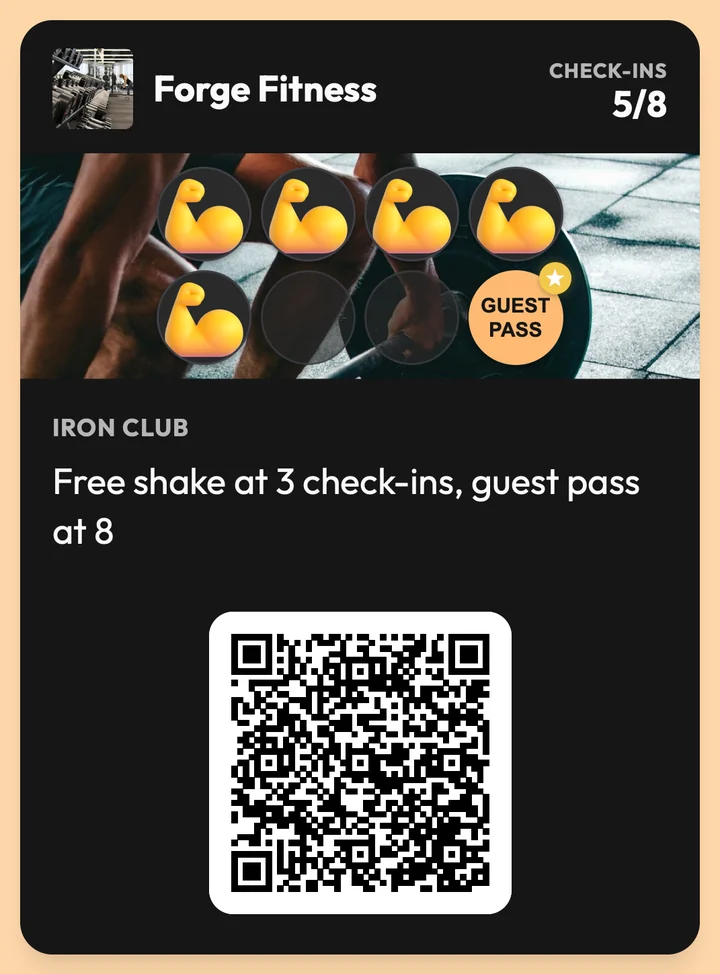
Here is the Forge Fitness card at 5 of 8 check-ins. The free shake at the 3rd check-in has been used, the guest pass sits on the 8th, and the card says “Free shake at 3 check-ins, guest pass at 8”. More reward ideas by type of business are in our punch card ideas.
Do members on a monthly membership need a loyalty card?
Yes: members on a monthly plan are the ones a gym loyalty card protects most, because they often leave by coming less, long before they cancel. The card rewards attendance, so it doesn’t compete with the membership fee. It gives a regular a short-term goal between their long-term fitness milestones.
For drop-in and class-pack customers, the same card turns a one-off visit into a reason to come back. If you have both groups, size the card for your monthly members and let drop-ins collect at their own pace.
A stamp for every visit also gives you a record of who is coming less, which is exactly what you need to win them back.
How do members check in, and how do you stop double check-ins?
A gym can record loyalty check-ins in two ways: staff scan the member’s card at the desk, or a tablet at reception shows a code that members scan with their own phone. To stop double check-ins, count one per day: a house rule at the desk, a daily limit of one on the self check-in screen. Staff scanning is the simplest. Self check-in saves the desk during the evening rush, but it also needs a code that changes and works once, and a minimum gap between check-ins.
In FaveCard, as of October 2026:
- Staff scanning is free on every plan. Staff scan the QR code on the member’s card with the FaveCard app and add the stamp. Staff stamps skip the self-service limits below, which is how you carry over stamps from an old paper card.
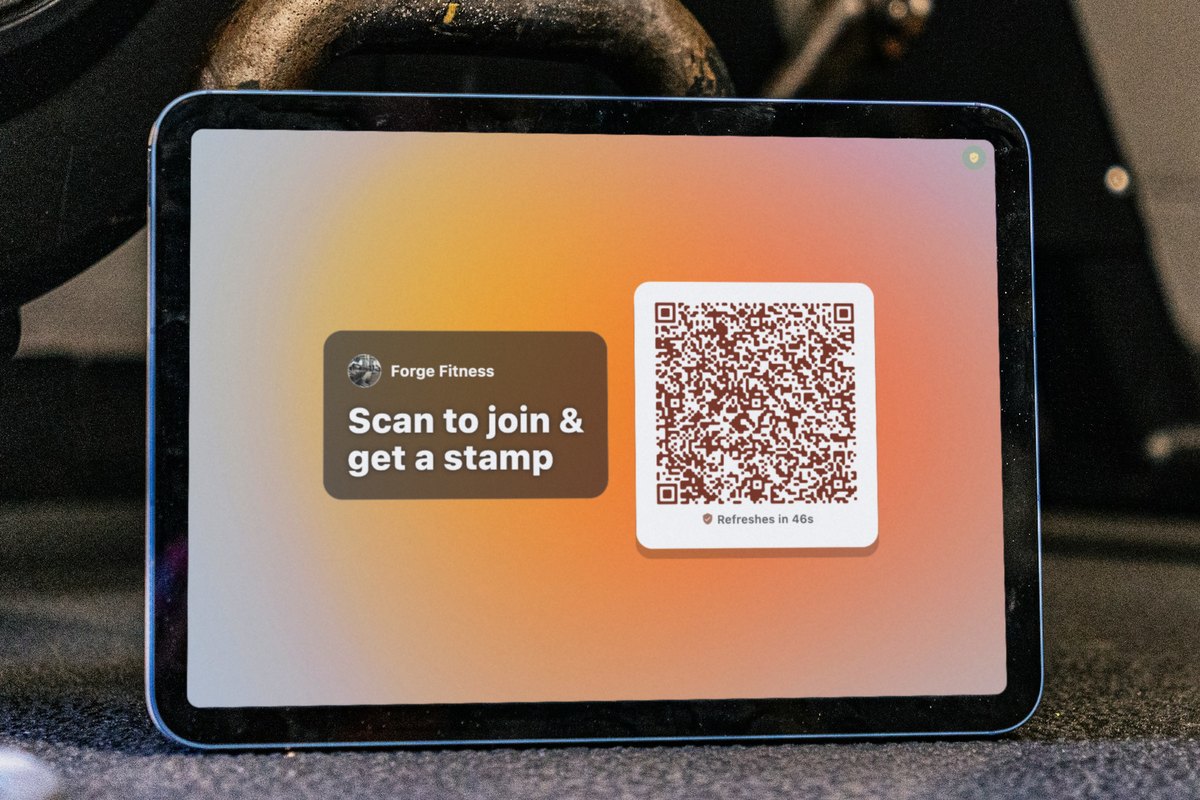
- Kiosk mode turns a phone or tablet at reception into a self check-in point. It is part of the Business plan and the free trial. The screen shows your gym’s name, the headline “Scan to join & get a stamp” and a QR code. Each code is signed by our server, works once and expires after 120 seconds.
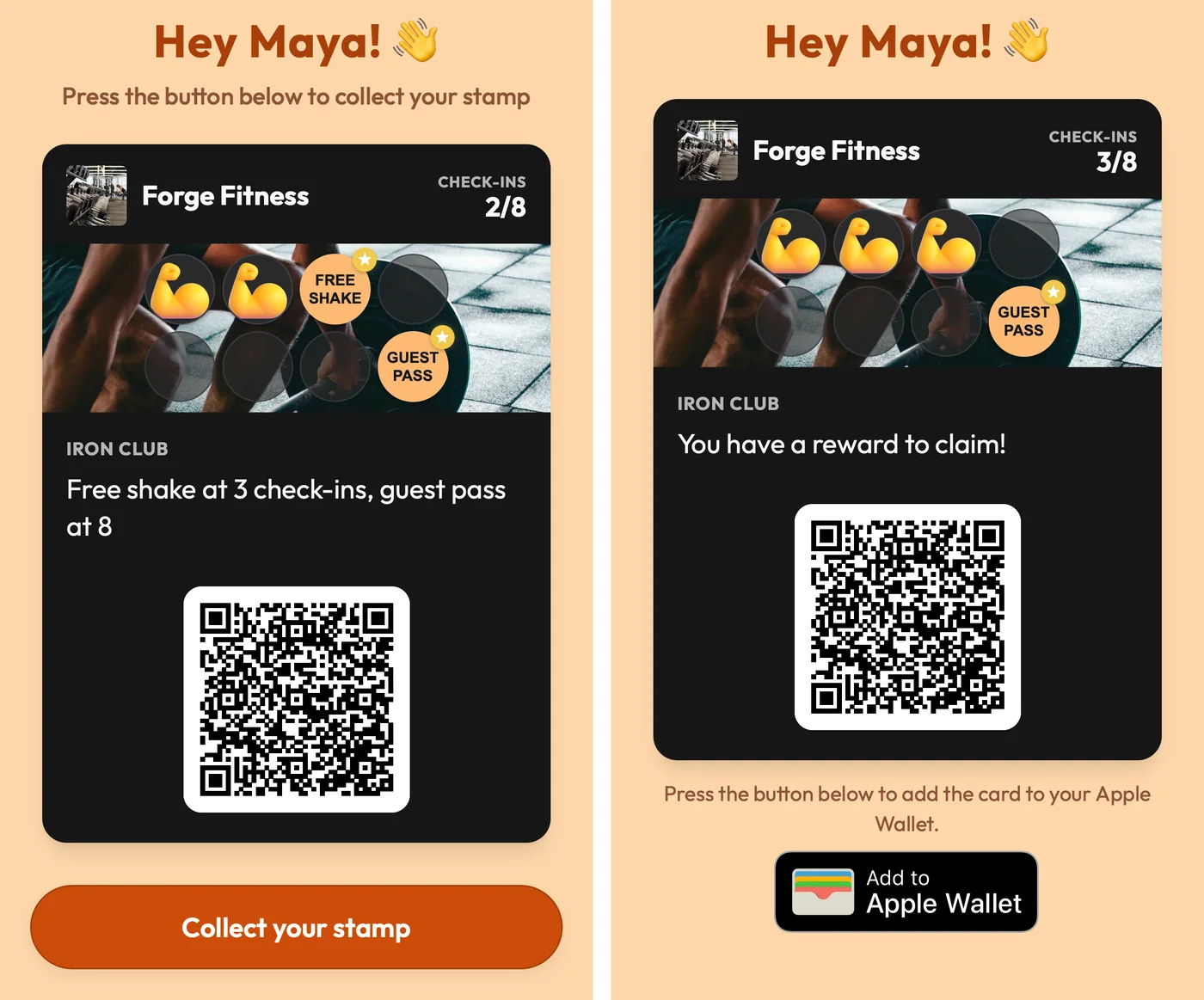
- Members scan the code with their phone camera. A returning member taps “Collect your stamp”. A new member enters an email, the 4-digit code sent to it and a first name, gets the card and collects the first stamp.
- Two self-service stamps per card per day by default. You can set anything from 1 to 5 in the app. For a gym, 1 matches the one-check-in-per-day rule.
- 15 minutes between kiosk stamps on the same card.
Below, a member at 2 of 8 has just scanned the kiosk and sees “Collect your stamp”. After the tap, the card moves to 3 of 8 and says “You have a reward to claim!”: the free shake.
For the full list of checks and how to spot faked cards, see how to stop stamp card cheating. For setting up the tablet itself, see the iPad kiosk mode guide.
Does a gym loyalty card need to connect to your gym software?
No: a gym loyalty card only needs to know that a member came in, so it can run alongside your booking, billing or door-access software. If your booking software already includes a rewards feature, try that first: check-ins are already counted and there’s one less tool at the desk. Paper cards still work for a small studio where the owner runs the desk, but you accept lost cards and no record of who is drifting away.
A separate digital card makes sense when your software has no rewards feature, or when you want the card on members’ phones without asking them to install your gym’s app.
FaveCard runs next to whatever you already use. A check-in counts when staff scan the member’s card or when the member scans the kiosk code. The card lives in Apple Wallet or Google Wallet on Pro, Business and the free trial, and in the phone’s browser on the Free plan. More on that in loyalty cards without an app.
What should a gym ask members when they join?
A gym should ask new loyalty members for as little as possible: an email and a first name to create the card, plus one or two questions coaches will actually use, such as what the member is training for and when they usually train, because every extra field costs sign-ups at a busy front desk.
FaveCard’s sign-up form always asks for an email and a first name. The birthday (day and month, no year) is optional, and the box for marketing emails starts unticked. On the Business plan and the free trial you can add up to 10 extra fields. When you choose “Gym” as your type of business in the sign-up form editor, it suggests three, all optional (as of October 2026):
- Phone
- What you’re training for, a free-text answer
- Best time for you: mornings, afternoons, evenings or weekends
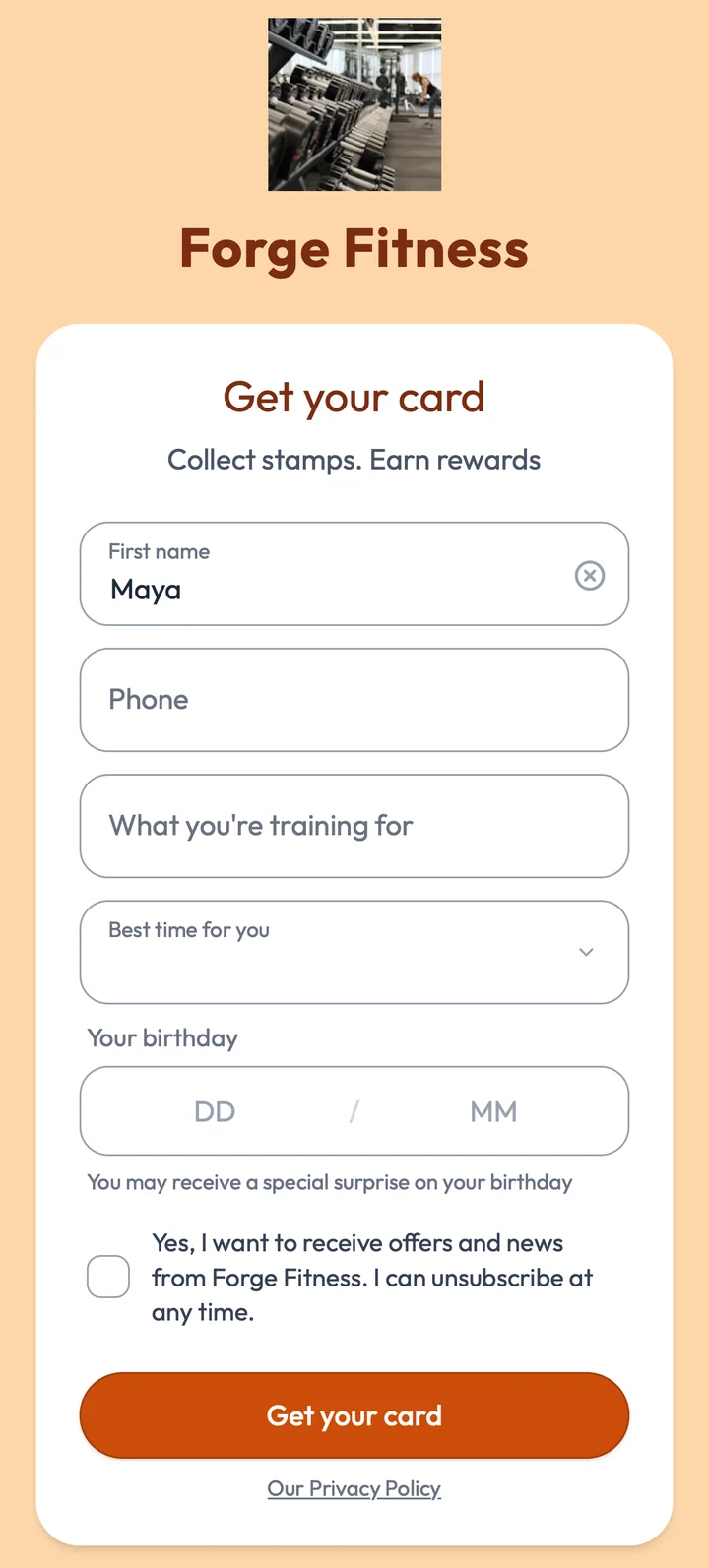
A coach who knows a member is training for a first half marathon has something better to say than “see you next week”. More example questions by trade are in our guide to loyalty card sign-up questions.
How do you bring back members who stopped coming?
To win back gym members who stopped coming, look for regulars whose check-ins have stopped and contact them within about two weeks with something tied to their next visit, such as a bonus check-in or a free shake, rather than a discount on dues. Two weeks is early enough that coming back doesn’t feel awkward; the longer the gap, the harder it is to restart the habit.
In FaveCard, the Win Them Back campaign does this on the Business plan and the free trial (as of October 2026):
- Open Win Them Back. It goes only to members you pick.
- In the picker, filter by Stamp count + last stamp, for example at least 5 stamps and a last stamp more than 14 days ago, and select those members.
- Write the message. One of the template’s own suggestions fits a gym as it is: “It’s been a while! Bonus stamp waiting for you, valid 7 days.”
- Choose how long it runs: 3, 7 or 14 days. Members who saved the card to Apple Wallet or Google Wallet and allow notifications get it on their lock screen. Members with the browser card see the text on their card.
- When they come in, staff add the bonus stamp at the desk.
A personal message from a coach works too, and for your longest-standing members it may work better. The playbook for both is in how to bring back inactive customers, and the limits on phone notifications are in how to reach customers between visits.
How to start a gym loyalty program this week
To start a gym loyalty program, first find out how often your typical member trains. That sets the card length and where the two free rewards go; then choose how check-ins are recorded and brief the desk.
- Find your members’ rhythm. Your booking or door system has check-in counts. If it doesn’t, ask the desk to tally one normal week.
- Pick the card length from the table above: 8 check-ins for members who train two or three times a week, 6 for once a week.
- Choose two rewards and write them as one line: “Free shake at 3 check-ins, guest pass at 8”.
- Decide how check-ins are recorded: staff scan, a kiosk, or both. If you use a kiosk, set the daily limit to 1.
- Put the sign-up QR code at reception and mention the card at every induction and every trial session.
- Brief the team: one check-in per day, rewards are handed over at the desk, and the person handing it over says the member’s name.
- Check after eight weeks: how many members reached the shake, how many the guest pass, and who has gone quiet.
On FaveCard, the Free plan includes the card and staff QR scanning. The Wallet card is part of Pro and Business. Self check-in, the extra sign-up questions and Win Them Back are part of Business, and the free trial includes all of them. Current prices for your country are on the pricing page, and the gyms page shows how the card looks for a fitness business.
Reward the habit of showing up, and reach out as soon as a regular breaks the routine.
Frequently Asked Questions
Do gym loyalty programs work?
They work when members can reach a reward within a few weeks. In FaveCard's study of 1,013 small businesses (January to May 2026), cards that paid out within 2 to 4 weeks were finished 11.4% of the time, against 4.0% for cards that took 8 to 16 weeks. A card that asks for 10 visits from someone who trains once a week sits in the slow group.
Should a gym give a free month as a loyalty reward?
Usually not. A free month costs a full month of dues, while a short attendance card is earned in about four weeks, so the reward costs more than the habit it builds. A protein shake partway through the card and a guest pass or free class at the end cost far less and still feel like a real prize.
How do I stop members checking in twice a day for extra stamps?
Count one check-in per day. With staff scanning at the desk, make that a house rule. With a self check-in screen, set a daily limit of one. By default, FaveCard's kiosk allows 2 self-service stamps per card per day with 15 minutes between them, and the owner can set the daily limit anywhere from 1 to 5 (as of October 2026).
Can a yoga or pilates studio with class packs use a loyalty card?
Yes. Give one stamp per class attended and size the card by how often students come: 8 stamps for two or three classes a week, 6 for one a week, 5 for students who come every two to three weeks. The card runs next to the class pack and rewards using it, for example with a free class after the last stamp.
Do gym members need to download an app for a digital loyalty card?
Not with a card that lives in Apple Wallet, Google Wallet or the phone's browser. On FaveCard, members scan a QR code at reception, enter an email and a first name, and get the card; staff then scan the QR code on the member's card at each visit.
How much does a gym loyalty program cost?
Paper cards cost the printing and the stamp. On FaveCard, the Free plan includes the digital card and QR scanning by staff. The Apple and Google Wallet card is part of Pro and Business. Self check-in, extra sign-up questions and campaigns are part of Business, and the free trial includes all of them. Current prices for your country are on the pricing page.