




Salon Marketing Software: What Your Booking App Covers
What Square, Vagaro, Fresha, GlossGenius and Booksy already do for salon marketing, what they charge per text and per new client, and what to add.
Key Takeaway: Your booking app is probably your salon's marketing software already. Check which marketing features your plan includes, compare the cost per text and per marketplace client, and add a separate tool only for the jobs your plan doesn't do.
FaveCard Team
Published October 6, 2026 · Updated October 6, 2026
Last updated: October 2026
Salon marketing software is the set of tools a salon uses to bring clients back and attract new ones: email and text campaigns, review requests, a loyalty program and a booking page. For most independent salons, the main one is already paid for, because Square Appointments, Vagaro, Fresha, GlossGenius, Booksy and StyleSeat all include marketing features in at least one plan.
The questions that matter are which features your plan includes, what the extras cost, and which jobs need a separate tool. The prices below were read on each company’s own US pricing page on October 6, 2026. Prices change often, so check the link before you decide.
The short answer:
- Start with your booking app. Every app here can send email, and most can send text campaigns, ask for reviews or run a loyalty program, though often only on a higher plan.
- Watch two costs: the price of each marketing text (from nothing inside an allowance to 8¢ each) and the fee per new client from a booking marketplace (from $0 to 30% of the first visit).
- Add a separate tool only for a missing job, such as a loyalty card when your plan has none, or one page that holds your booking link, services and review link.
This guide covers hair salons, nail salons, barbershops, day spas, massage studios and estheticians. Medical spas have different rules and tools and aren’t covered. For ideas on what to do with these tools, see our salon marketing ideas. We make FaveCard, a digital loyalty card and business page that works next to any booking app, and it appears below as a labelled example.
What marketing does a salon booking app already include?
A salon booking app usually includes appointment reminders and email marketing on every plan, while text campaigns, automatic review requests, rebooking reminders and loyalty often need a higher plan or a paid add-on. The table shows the cheapest plan of each app and what it adds for marketing.
| Booking app | Cheapest plan (October 2026) | Marketing included or extra |
|---|---|---|
| Square Appointments | Free; Plus $49 a month per location | Free: booking, reminders, Google review monitoring. Plus: unlimited email, 500 texts a month, automatic review requests, loyalty |
| Vagaro | $30 a month for one calendar ($23.99 for the first 6 months) | 1,000 emails a month and loyalty included; texts from $20 a month for 1,000 credits |
| Fresha | $19.95 a month for one calendar | 50 emails a month, then 2¢ each; texts 8¢ each; loyalty $59.95 and Google review prompts $14.95 a month per location |
| GlossGenius | $24 a month billed yearly, or $28 monthly | Unlimited email; review prompts with receipts; Google review integration and rebooking reminders on Gold ($48 or $56) |
| Booksy | $29.99 a month, plus $20 per extra user | Email and 2,000 marketing texts a month |
| StyleSeat | $19 a month | Email and text marketing, rebooking reminders, loyalty and review management |
| Timely | $26 per staff member a month | Email through Mailchimp; text campaigns (5¢ each), loyalty and review requests from $39; rebooking reminders at $47 |
| Boulevard | $143 a month billed yearly, up to 5 providers | 1,000 emails and 250 texts; automated campaigns $2 per completed appointment |
| Mangomint | $120 a month per location, plus $10 per user | Marketing add-on from $30 a month for 3,500 credits |
| DaySmart Salon | $29 a month | Email and loyalty from $69; text marketing from $149 |
| Mindbody | From $79 a month per location | Email and text campaigns on the Ultimate plan only |
| Phorest | Price on request | Review requests on Starter; loyalty and rebooking campaigns on Grow |
Two changes the older comparison lists miss: Schedulicity is now part of Vagaro, and Square moved email, texts and loyalty into Square Plus rather than selling them as separate add-ons.
Owners say the features go unused more often than they go missing. “Wish I had time in my days to utilize all of the features,” one beauty professional wrote in a Square Seller Community thread about running a beauty business on Square Appointments. Before you buy another tool, turn on what your plan already includes: reminders, a review request after each appointment and a monthly email.
What do booking marketplaces charge for a new client?
Booking marketplaces charge a one-time fee for each new client they say they brought you: Booksy Boost 30% of the first visit up to $100, StyleSeat 30% up to $50, Fresha 20% with a $6 minimum, and the Mindbody app 20% up to $30, as of October 2026. Square Go charges nothing, and a Vagaro Marketplace listing is free. Returning clients cost nothing on any of these marketplaces.
| Marketplace | Fee per new client | On a $40 cut |
|---|---|---|
| Booksy Boost (optional) | 30% of the first visit, up to $100 | $12 |
| StyleSeat New Client Connection | 30% of the first appointment, up to $50 | $12 |
| Fresha marketplace | 20%, minimum $6 | $8 |
| Mindbody app | 20% of the first purchase, up to $30 | $8 |
| Square Go | Free | $0 |
| Vagaro Fill My Books (optional promotions) | 20% for a brand-new client, 5% for an existing one | $8 |
For a day spa the numbers grow with the ticket. ISPA’s 2026 spa industry figures, from a study conducted by PwC, put average revenue per spa visit at $123.10, so a 30% fee comes to about $37 and a 20% fee to about $25.
A marketplace fee is the price of a new client. It is worth paying when your book has empty slots and the client would not have found you otherwise. It hurts when clients who found you on Instagram or through a friend get counted as marketplace clients, which is one of the complaints owners repeat most in App Store reviews of these apps. “9 out of 10 of my “new clients” actually come from Google, not Fresha,” one Fresha user wrote in June 2026. Another, on Booksy in September 2026: “I’m paying you a fee for clients on top of my monthly fee.”
Fresha’s help page on the fee says it also covers clients who “view your Fresha marketplace profile first and then choose to book through another online channel including your website or social media pages.” If most of your new clients come from referrals, keep optional promotions such as Booksy Boost or Vagaro’s Fill My Books switched off, and check each month which clients you were charged for.
Is text marketing worth it for a salon?
Text marketing is worth it for a salon when the message is short and timely, such as a last-minute opening, and goes only to clients who agreed to receive marketing texts. Appointment reminders are a different feature: most booking apps include them, and owners rate them as the most useful thing their app does. “The reminders have almost eliminated no shows,” one barbershop owner wrote in a Vagaro review in July 2026.
Here is what one marketing text to 500 clients costs, based on each company’s pricing page in October 2026:
| Booking app or tool | One text to 500 clients |
|---|---|
| Booksy | Included in 2,000 texts a month |
| Square Plus | Included in 500 texts a month, then 3¢ each |
| Timely (from $39 per staff) or Phorest Starter | $25, at 5¢ a text |
| Fresha | $40, at 8¢ a text |
| Vagaro | Needs a text plan: $20 a month for 1,000 credits |
| A standalone tool such as Textedly | $29 a month for 500 messages |
Square charges per phone number, not per campaign: a moderator in its Seller Community explained that a text “equals to how many phone numbers we send your campaign to.” Texts also reach fewer people than you’d think when clients mute an app. A barber who sends blasts through theCut wrote in an August 2026 review that “over half of my clients have notifications turned off” after too many promotions.
How do you get salon clients to rebook without paying for texts?
The cheapest way for a salon to get clients to rebook is to book the next appointment before they leave the chair, then follow up only with clients who missed their usual cycle. Rebooking at checkout costs nothing. Rebooking reminders come with StyleSeat, GlossGenius Gold, Timely’s top plan and Phorest’s Grow plan.
For clients who have drifted, a short message with a reason to come back works better than a discount. Count a client as lapsed only after they miss their usual cycle: for a hair salon whose clients come every four to six weeks, that means no visit in about three months, not four weeks.
Example: FaveCard. Win Them Back sends a message to clients you pick, for example everyone whose last stamp was more than 90 days ago. The card on their phone shows your header and text, and a notification appears on the lock screen if they saved the card to Wallet and allowed notifications. (Business plan and free trial.) Write the text in your salon’s own words, such as the bonus stamp below. More in how to bring back inactive customers.
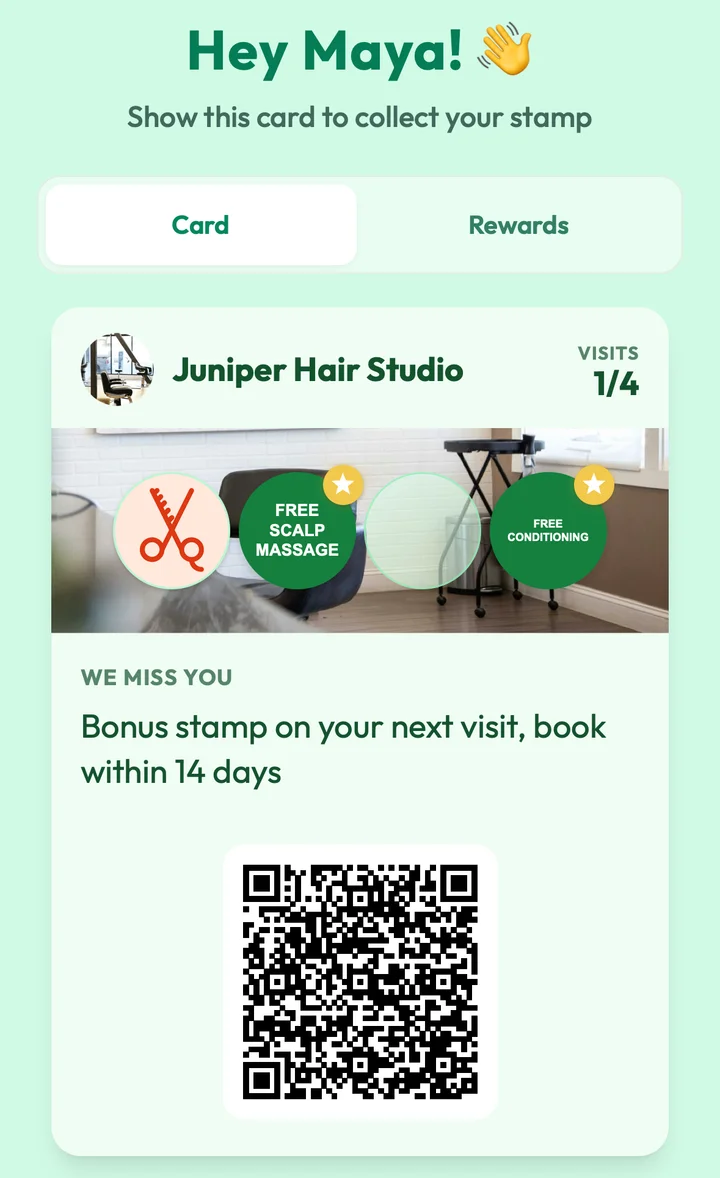
Juniper Hair Studio, a sample salon we set up in FaveCard: a 4-visit card with a free scalp massage at the 2nd visit and a free conditioning treatment at the 4th, during a “We miss you” message offering a bonus stamp within 14 days.
Which tools ask salon clients for Google reviews automatically?
Square Plus, GlossGenius, Fresha (as a $14.95-a-month add-on) and Timely (on its $39 plan) can ask salon clients for Google reviews automatically. The free alternative is sharing the salon’s Google review link after each appointment. GlossGenius sends its review prompts with receipts on every plan.
Reviews decide bookings. In BrightLocal’s Local Consumer Review Survey 2026 of 1,002 US adults, 47% won’t use a business with fewer than 20 reviews, 74% look for reviews from the last three months, and 83% of people who were asked to leave a review left one.
Check who receives the request. A reply in a 2026 Square Seller Community thread on post-appointment reviews notes that “Only customers who have subscribed to email or text marketing will get this email.” Google also doesn’t allow rewards for reviews or asking only happy clients; see whether you can incentivize Google reviews and how to ask for Google reviews.
Example: FaveCard. When a client redeems a reward, their card shows a request to “Leave a review on Google”, and an email follows two hours later. Every client who redeems gets it, whatever they thought of the visit (Business plan and free trial). The review link on the FaveCard business page is on every plan.
Does your booking app have a loyalty or referral program?
Many salon booking apps include a loyalty program on at least one plan, but referral tracking is rarer, and owners ask for it more than any other missing feature. Loyalty is included in Square Plus, Vagaro, Booksy, StyleSeat and DaySmart’s $69 plan, costs $59.95 a month per location on Fresha, and needs Timely’s $39 plan or Phorest’s Grow plan.
Owners say their best clients come from referrals. “Word of mouth is my biggest way of getting new customer and I feel like my loyalty to square is hurting my sales growth because I don’t have a referral system that integrates properly,” one owner wrote in a Square Seller Community feature request in 2025.
If your plan has no loyalty program, or you want one that works in Apple and Google Wallet without an app, a separate stamp card does the job. As of October 2026, BonusQR has a free plan, Loopy Loyalty starts at $25 a month and Stamp Me at $49.
Size the card to how often clients come back. FaveCard’s card editor lists hair salons, barbers, beauty and wellness under “Every 3-6 weeks” and suggests 4 stamps, with a small free bonus at the second visit. Clients who come every two to three weeks, as many nail clients do, suit 5. A free treatment, such as a scalp massage, usually feels more generous than a percentage off. The reasoning is in how many stamps a loyalty card should have, and reward ideas are in our salon loyalty program guide.
Which salon marketing tools are free?
A salon can run its basic marketing on free tools: a Google Business Profile and Apple Business listing to be found, Square Appointments Free and Square Go for booking with no marketplace fee, Meta Business Suite for Instagram and Facebook, and the free plans of Buffer and Mailchimp. Paid plans earn their cost when a feature saves you time every week.
| Free tool | What it covers | Free limit (October 2026) |
|---|---|---|
| Google Business Profile | Your listing in Google Search and Maps, reviews | Free |
| Apple Business | Your Apple Maps listing | Free (replaced Apple Business Connect in April 2026) |
| Square Appointments Free + Square Go | Booking site, reminders, marketplace listing | No monthly fee; card processing fees apply |
| Meta Business Suite | Posting and messages on Instagram and Facebook | Free |
| Buffer | Scheduling posts | 3 channels, 10 queued posts each |
| Mailchimp | Email to clients who opted in | 250 contacts, 500 sends a month |
| A free stamp card | Loyalty | BonusQR and FaveCard have free plans |
FaveCard’s free plan gives clients a stamp card in their phone’s browser. Apple and Google Wallet cards, review requests and Wallet messages are on paid plans; new accounts get them free until their first 30 customers join. Amounts are on the pricing page.
Does a salon need a website, a link page or both?
A salon needs one page it controls with its services, prices, a booking button and a review link; for many solo stylists and small salons, the booking app’s own page or a link page is enough. A full website adds most when it ranks in Google for your area and services.
Most booking apps give you a booking site: Square Appointments includes one on the free plan, and Fresha sells a “Smart Website” for $15.95 a month (October 2026). A link page such as Linktree, free or $6 a month billed yearly, collects your booking link, Instagram and review link in one place for your bio.
Keep one rule: print one QR code that opens a page you control, so changing booking apps never means reprinting cards. Owners describe the lock-in the other way around: “my booksy QR code is on all my marketing,” one wrote in a September 2026 review. See one QR code for your menu, reviews and loyalty card and our free link-in-bio tools.
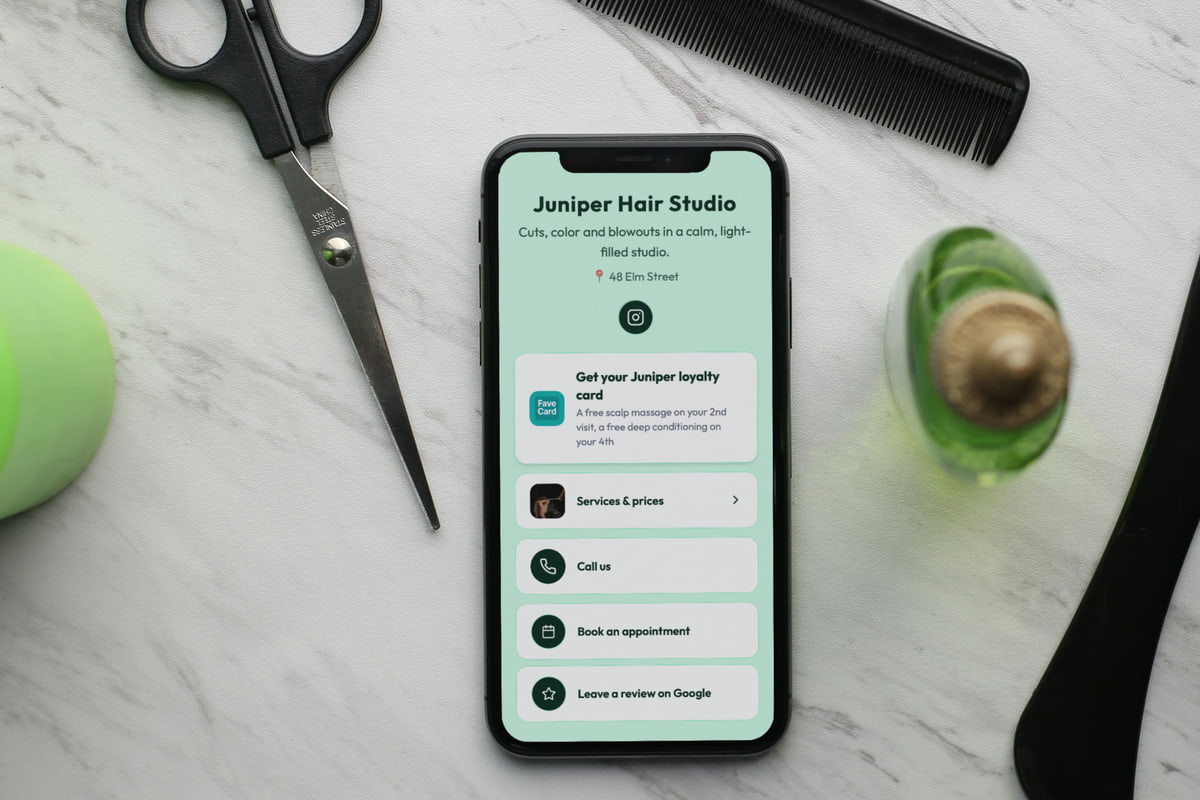
Example: FaveCard. The business page puts the loyalty card button first, then any links you add, such as “Book an appointment” pointing to your booking app, a call button, the Google review link and guest Wi-Fi, all on every plan. A Services & prices list needs the Business plan or the trial. Bookings stay in your booking app: the button opens it.
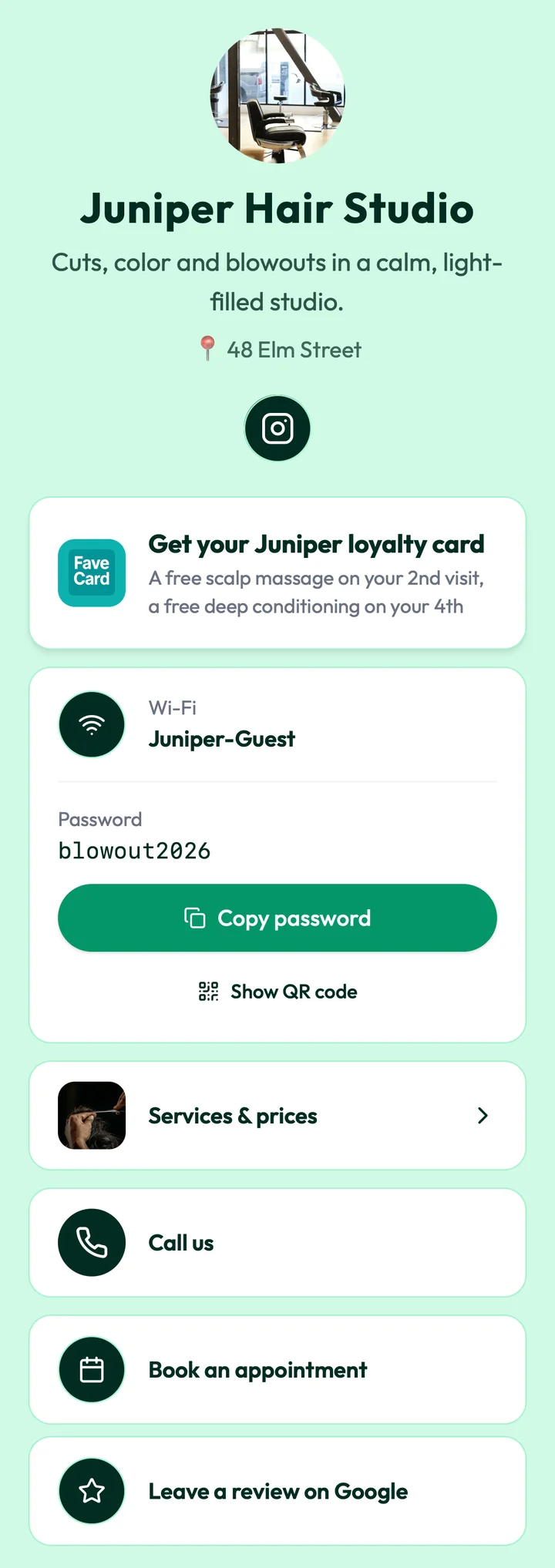
The same sample salon’s page: the loyalty card button first, then guest Wi-Fi, Services & prices, a call button, a “Book an appointment” link to the salon’s booking app and the Google review link.
Who owns your client list if you switch booking apps?
A salon keeps control of its client list when it can export clients with their email, phone and marketing consent, and when its printed QR codes and links don’t point to a single booking app. Check the export before you choose an app, not when you leave it.
Owners who switch worry about notes, photos and reviews more than contacts. “all of my clients chart notes are on their files in Vagaro along with progress photos,” a skin studio owner wrote in a Square Seller Community thread while weighing a move.
Keeping your own copy of the list with consent recorded lets you announce a move without starting from zero. In FaveCard, card holders export as a CSV with a marketing-consent column on the Business plan and the trial, ready for Mailchimp or another email tool. More in how to build an email list.
What changes for barbers, nail salons and day spas?
Barbers, nail salons and day spas use the same kinds of marketing tools as hair salons, with different priorities: barbers need booking that works with walk-ins, nail salons lean on Instagram and last-minute openings, and day spas rely on gift cards and packages.
| Trade | What matters most | Loyalty card length |
|---|---|---|
| Hair salon | Rebooking at the chair; review requests; a monthly email | 4 visits, small bonus at the 2nd |
| Barbershop | Walk-in friendly booking; blasts that clients actually see; a quick card at the counter | 5 for clients every 2 to 3 weeks, 4 for monthly |
| Nail salon | Same-day availability; Instagram for nail art; text for last-minute openings | 5 for clients every 2 to 3 weeks |
| Day spa or massage studio | Gift cards and packages; marketplace fees on a higher ticket; campaigns on top plans | 4 visits |
| Esthetician | Intake forms and treatment plans; education on social media | 4 visits |
Trade-by-trade tactics are in our guides for barbers, nail salons and estheticians. Day spas that want a client database can start with our guide to CRM for spas.
How do you know which salon marketing tool is working?
A salon knows a marketing tool is working when the number it should move goes up month to month: rebooking rate, returning clients, new reviews, or new clients from a named source. The simplest source of truth is asking every new client how they found you.
“I always ask my new clients how did you find me and majority of the time it’s from asking their friend where their hair is done,” one salon owner wrote in a Square Seller Community thread. Write the answer down in the client’s profile, and compare it with what your marketplace bills you for each month.
Sign-up questions help too. FaveCard, for example, suggests “Who you usually see” and “What you usually book” for hair salons, nail salons and barbers (Business plan and trial); our guide to salon CRM software covers what to ask.
In what order should a salon set up its marketing tools?
A salon should set up its marketing tools in four steps over a month: listings, then the booking app’s own reminders and review requests, then a loyalty card or rebooking routine, then a simple posting plan. Pay for an upgrade or a marketplace promotion only after a month with all four running.
| When | What to set up |
|---|---|
| Week 1 | Google Business Profile and Apple Business: hours, services, photos, booking link |
| Week 2 | In your booking app: reminders, a review request after each appointment, a rebooking prompt at checkout |
| Week 3 | A loyalty card sized to your clients’ cycle; one page and one QR code with booking, services and review links |
| Week 4 | Meta Business Suite and Buffer; two or three posts a week of your real work |
| Month 2 | A monthly email to clients who opted in; a “we miss you” message to clients who missed their cycle |
| Month 3 | Check each number; upgrade where a limit stops you, and decide whether marketplace fees are paying back |
If you’d like a loyalty card next to the booking app you already use, you can create a FaveCard loyalty card for free. Apple and Google Wallet cards come with the paid plans and the free trial; compare them on the pricing page. Salons can also see how FaveCard works for salons.
Frequently Asked Questions
What is the best marketing software for a salon?
For most independent salons, the best marketing software is the booking app they already use, set up properly: Square Appointments, Vagaro, Fresha, GlossGenius, Booksy and StyleSeat all include email, and most include text campaigns, review requests or loyalty on at least one plan. Add a separate tool only for a job your plan doesn't cover, such as a loyalty card or a link page.
Does Vagaro do marketing?
Yes. As of October 2026, every Vagaro plan includes 1,000 free marketing emails a month and customer loyalty programs, and text marketing is a paid add-on from $20 a month for 1,000 credits. The base plan is $30 a month for one bookable calendar, with a lower rate for the first six months.
How do I avoid Fresha's and Booksy's new-client fees?
Both fees apply only to clients the marketplace says it brought you. Fresha charges 20% (minimum $6) on a new marketplace client's first booking, and Booksy Boost charges 30% of the first visit up to $100, as of October 2026. Boost is optional, so you can turn it off. Fresha's fee also covers clients who looked at your marketplace profile before booking elsewhere, so check each month which clients you were charged for.
Is text marketing worth it for a hair salon?
Text campaigns are worth it for short, timely messages such as a last-minute opening, and only to clients who agreed to receive them. Costs vary widely: Booksy includes 2,000 marketing texts a month, Square Plus includes 500, and Fresha charges 8¢ per text (as of October 2026). Appointment reminders are a separate, included feature in most booking apps.
How many stamps should a salon loyalty card have?
Four stamps suit a hair salon whose clients come every four to six weeks, with a small free extra at the second visit and a free treatment at the fourth. Nail salons whose clients come every two to three weeks can use five. Free treatments, such as a scalp massage or a conditioning treatment, work better than discounts.
Do day spas need different marketing software from hair salons?
Day spas use the same kinds of tools, but booking apps built for wellness (such as Mindbody or Booker) put email and text campaigns on their top plans. Spa visits cost more, so a marketplace fee on a new client costs more too: 20% of ISPA's 2026 average spend per spa visit, $123.10, is about $25.